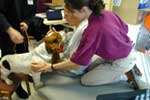
There are many ways
health and human service professionals can utilize animal assisted therapy and
animal assisted activities to enhance their treatments, and provide rewarding
stimulation for their patients and clients. Research has shown that utilizing
animals as part of a treatment program can provide very positive outcomes.
Physiological effects such as decrease in heart rate and blood pressure, as well
as, reduction in pain have often been observed in persons provided with animal
assisted therapy. The use of animals in therapy is only limited by the
professionals’ imagination and the abilities of the individual animal team
with which they work. Some suggestions are:
Occupational & Physical Therapy
Increase range of motion by throwing objects to be retrieved, utilizing
hand signals to give commands, petting or brushing the animal
Improve standing balance by providing stabilization or interaction from
standing position
Improve fine motor skills by petting or brushing
Improve mobility by walking with dog, with or without a device or
wheelchair
Utilize petting, stroking, brushing to improve coordination of a persons
with apraxia
Improve overall strength by interacting with animal
Speech Therapy
Increase vocal clarity and language production through use of verbal
commands
Increase vocal volume/breath support by calling/commanding dog from varying
distances
Encourage verbal expression with conversation about animal
Utilize animal response to reinforce patients successful vocalizations
Cognitive Skills
Stimulate cognitive processes by conversing about animal
Improve memory by recalling animals name, age, commands, etc.
Increase attention span of children with ADHD by attending to dog, task and
therapist
Provide sensory stimulation for persons with head injury
Improve awareness/multi-tasking by walking dog through obstacles
Counseling
Use animals presence to provide a source of outward focus for persons with
depression, eating disorders, etc.
Teach empathy by learning to read an animals body language
Use animal as ‘counselor’ by encouraging patients to communicate their
feelings and experiences to the animal
Use animal as a source of physical contact for persons who have been
physically or sexually abused
Social Skills
Alleviate social isolation by visiting with animal and handler, or group
members
Improve willingness to be involved in group activity by involving an animal
Improve interactions with others by sharing animal’s attention or taking
turns interacting
Use animal to provide acceptance without qualification for persons with
disabilities