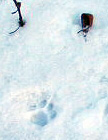
| A pawprint in the snow is likely an ancient artifact, belonging to a Viking cat, according to Edgar Allan, who spotted the mark in the backyard after a late spring snow. "This is really an important link to feline history," Edgar affirmed. Jens Jensen, who is heading up a team of Danish archeologists investigating the find, did not immediately pooh-pooh Edgar's claim. "We cannot draw any conclusions until the print is properly hydrocarbon dated," he said. In fact, Jensen more or less validated Edgar's claim: "I can confirm this is a feline footprint. And, ja, it is a real fact that cats lived in this area throughout all time periods, including the Viking era." Edgar found the pawprint while taking an afternoon walk in the Dankvart Dreyers Vej backyard last week. It had been snowing all day but had stopped just before his stroll. He was drawn to the far corner of the backyard, where the sun was reflecting an odd shadow. Edgar just had to investigate, and that's when he discovered the shadow was actually a pawprint stamped deep into the snow. Edgar believes the impression likely belongs to a pampered Viking puss because of fuzzy marks between the individual toe prints. "An outdoor cat wouldn't have any fuzzy marks between his toes, because he would have worn all of it down by running around a lot. A house cat, who only went out to play and occasionally hunt, would still have fur between the toes, because he has an easier life with all the polartec and blankies and stuff," said Edgar, raising his own furry-between-the-toes right front paw as an example. |
| Pawprint in snow linked to ancient Viking cat |
OTHER NEWS STORIES � Weeding Bee: cats lousy spellers � Pawprint in snow could belong to ancient Viking cat � Edgar pleads for a tattoo |
| Edgar offers compelling proof, but archeologists remain skeptical the snowprint is authentic |
| Jensen said Danish authorities take reports of archeological findings very seriously around Odense, where Viking tribes fished and farmed. Artifacts, such as boats, amulets and household goods, are frequently found in the area today, so every report of a discovery is investigated. "This is much important information," he said. "We consider all that is reported." The Danes might have learned a lesson from the episode in Southern France six years ago, when an amateur spelunker stumbled upon the so-called Chauvet Cave and found a barefoot print in the mud that appeared to belong to a boy. At the time, scientists were unimpressed. But, the discovery turned out to be legitimate, dating back at least 25,000 years. The footprint has now been declared the oldest in all of Europe. Edgar says he's sure the pawprint he found doesn't go back to prehistoric times - "I mean, it's no sabertooth tiger" - but he is convinced it might date to the 1300s. For now, Jensen said he will research whether any other Viking artifacts have turned up around Dankvart Dreyers Vej. Then he'll proceed from there. Edgar stressed the importance of time: "He must hurry, though, before the snow melts and the print goes away." |
 |
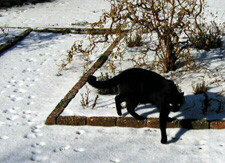 |
| The prized artifact could date to the 1000s (left). Edgar prowls the yard where the snowprint was found (right). |
 |
 |
 |
 |
 |
 |
 |
 |
| Pawprints Newslitter 2001 (TM). All rights reserved |