|
Balochistan
is a vast land full of contrast, and inhibited by cultured and
brave Baloch people whose number exceeds 15 millions.
Balochistan is one of the ancient inhibited land with a 12000
years history of civilization. Although of common ancestry,
history, language, tradition, culture and background, Baloch
people as well as Balochistan are divided
politically among Pakistan, Iran and Afghanistan. Baloch have
always fought for their 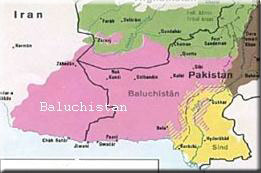 survival. Balochistan have been looted and oppressed by
outside invading forces. Alexander the Great was
defeated in Balochistan; Balochistan used to be far greater
than what is now. Constant invasion and wars, forced the
Baloch people to quit their land and move further away.
Deliberate administrative and boundary changes by central
governments in recent decades have eroded the actual
boundaries of Balochistan ever farther.
survival. Balochistan have been looted and oppressed by
outside invading forces. Alexander the Great was
defeated in Balochistan; Balochistan used to be far greater
than what is now. Constant invasion and wars, forced the
Baloch people to quit their land and move further away.
Deliberate administrative and boundary changes by central
governments in recent decades have eroded the actual
boundaries of Balochistan ever farther.
The
story of Baloch is very similar to the Kurds. Present day
divided Balochistan, like every other oppressed region in the
world despite being kept deprived and suppressed, is thriving
and modern. Some
of Baloch characteristics are: bravery, fearlessness, honesty,
loyalty, friendship, righteousness,
sincerity, integrity, unfussiness and simplicity. Like every
other nations who have been suppressed and kept back-ward,
Baloch are traditional in the sense they are rather resistant
to change. However, despite being traditional, and despite
deliberate deprivation by the ruling governments of Iran and
Pakistan, Both Iranian and Pakistani Balochistan are modern
places with all the facilities of modern life, though many
Baloch people are deprived. The Baloch people are very
hospitable, nice and friendly. They are generally intelligent,
learned, well-informed, initiated, cultivated, socially
accomplished and politically attentive. Culturally, they are
rich and self-dependent. The deliberate political, cultural
and economic deprivation and blatant discrimination and
rampant prejudice against the Baloch people are used as
political tools by the central governments of Iran and
Pakistan to ensure their respective Balochistan and
particularly the Baloch people are kept back-ward, poor and
deprived.
Balochistan is a land of contrast. It
has places with lofty and rugged mountains under Chiltan,
Takatu, Sulaiman, Sultan etc. and plains stretching to
hundreds of miles. It has fertile land like that of Nasirabad,
as well as, tracks' which are thirsty for centuries, and where
even a bush could hardly be sighted like that of Pat section
of Sibi District and Dasht-e-Makran in Makran Division.
It has hottest places in the country
like Sibi and Dhadar, where temperature shoots up to over 120
?F, as well as coldest towns like Quetta, Kalat, Ziarat, Kan
Mehtarzai where mercury falls down much below freezing point.
"The mountains are the Balochi's
forts; the peaks are better than any army; the lofty heights
are our comrades; the pathless gorges our friends. Our drink
is from the flowing springs; our bed the thorny bush; the
ground we make our pillow".
These lines are from a Balochi war
song. The land which nurtures such independent and brave
people is indeed daunting. Barren, rugged mountains that burn
in the summer and freeze in the winter
In between the cheerless mountains are
dry and wide deserts and,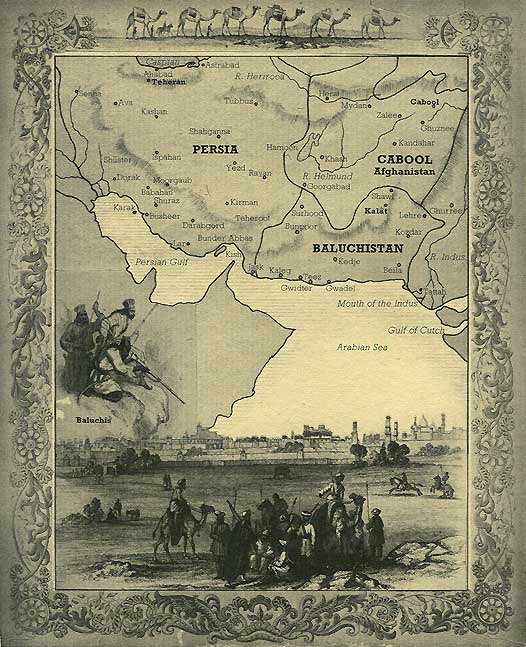 of course, beautifully fertile valleys - wherever water is
available. These give this rugged land great scenic beauty.
of course, beautifully fertile valleys - wherever water is
available. These give this rugged land great scenic beauty.
Balochistan Province covers a huge
area in the southwest of Pakistan. It is a sparsely populated
land bordering Afghanistan and Iran. Much of it is a high
barren plateau 1,000 to 1,250 meters (3.000 to 4.000 feet)
above sea level, enclosed by the Toba Kakar mountain range
along the Afghan border and by the Suleman range which borders
the Indus river. To the south lies one of the most
inhospitable deserts in the world, the Makran. which nearly
defeated Alexander the Great when he marched through it on his
way home.
Balochi is a generalized term, for the
people include the Dravidian-speaking Brahui possibly the last
descendants of the Indus Civilization, and the Jat or Zutt, an
Indo Aryan speaking people of Indian origin. In the northwest
of Balochistan, Pathans make up the majority of the
population, and there is a sizeable minority of them elsewhere
in the province. Most people speak Brabui, Baiochi and Pushto.
Almost half the population of Balochistan lives within 80 Kms
(50 miles) of the provincial capital, Quetta.
The north of the Province presents
picturesque fruit farms on the slopes of snow-clad hills and
blissful juniper forests. In the south there are extensive
date farms and rows upon rows of branchless coconut palms in
Makran District. There is scanty rainfall throughout. From 3
to 5 inches in the plains: maximum 12 inches in the hills.
Variations in temperature are also great. It may be 80 ?F in
Ziarat when it is upto 120 ?F sizzling in Lasbella and Turbat
in the south.
Naturally, water is scarce and is put
to the best use. Wherever available, you can see rows of
orchards and belts of cultivated fields. At places these fruit
farms and wheat fields merge beautifully in the backdrop of
rugged mountainous ranges.When this happens the atmosphere for
miles and miles is filled with aroma of fruits. These range
from apples, grapes, pomegranates, peaches and plums to
almonds, cherries and quinces. Most of the fruit produced is
exported out of the province - fresh or canned.
Development of underground and surface
water resources laying down of road over its vast stretches
and taking industry to Balochistan have been the first
priorities of the Government.
Talking of fruit, the date industry
occupies a special position - mainly in the Makran district
,which with an area of 23,460 sq. miles is the largest
district in the country.
More than a 100 commercial varieties
of dates are produced here. Other date-producing areas are
Thalwan, sub-division of Kalat and Mashkhel tehsil of Kharan
district. Incidentally the Balochi language has one ~ hundred
words for dates as also for camels.
The Balochistan coastline extends over
750 Km from near Karachi at Hub River to the Gwadar Bay on
Pak-lran border. The whole area is rich in fish.
Over a decade ago the fishing was done
by sail boats. Now most of these have been motorised with
out-board or inboard engines.The Government have brought about
this revolutionary change in fishing techniques with external
help from other countries and FAO-UNDP.
Fresh fish is now available for
Karachi and the interior of Balochistan. Before this only
dried fish could come from these sources. Simultaneously an
integrated development project for fisheries in Balochistan,
completed in 1983. has improved fishing techniques. fish
handling, distribution practices and the improvement in
vocational skills.
Under another project a fish harbour
has been built at Pasni at the cost of nearly 600 million
rupees. A Pasni Fish Harbour Authority also has been set up
and with purchase or sale engines from 15 to 55 horse-power
for the fishing fleet.
The fishermen from Balochistan now
compete with Karachi, trawlers in fishing from small boats.
Transport of fish by roads in insulated trucks has already
started. Turbat which lies at the cross-road from Makran coast
has emerged as a big centre of fresh fish and it is estimated
that there has been a 125 per cent increase in the income of
small fishermen,
Workshops have been set up at Ormara,
Pasni ,Gwadar and Jiwani for modernised repair of boats and
their engines. There are also Government operated ice plants
at Ormara and Pasni besides private plants at many places.
It is believed that thousands of years
before Christ, areas now called Pakistan had commerce with the
ancient civilization of Babylon and the trade route passed
through Balochistan into Iran and then into the valleys of
Tigris and Euphrates
Pakistan in the ancient times was
barred from the east by desert and jungle. It looked westwards
by land and sea it is presumed that the famous Indus
civilization derived most of its material elements from Iran
and beyond through the Baloch Borderland.
Trade, no doubt sustained this important
though distant relationship between the Indus and the rivers
of Tigris and Euphrates. Tangible evidence however is slight.
Indus Valley seals have been found in Mesopotamia, and
presumably traveled there on bales. Possibly of cotton which
has been found at Moen-jo-daro Beads and pottery and little
stone or pottery boxes for incense or cosmetics were
interchanged on small scale.
Tribal people of Pakistan are well known
for their hospitality. They would kill their last chicken for
a guest. And resent a refusal to eat their humble fare. Their
entertainment is uninhibited, sheer fun It you want to enjoy
this entertainment join the wedding ceremonies of some tribal
chief's children. The ceremonies are simple; but entertainment
and feasting last for days on end. In the words of foreign
visitor," the wedding is merely an excuse for the
Party". |


