|
How To Construct Pascal's Triangle
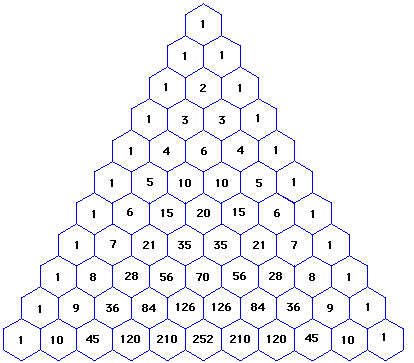
At the tip of Pascal's Triangle is the number 1, which makes up the Row 0. The Row 1 (1 & 1) contains two 1's, both formed by adding the two numbers above them(on the left and the right), in this case 1 + 0 (all numbers outside the Triangle are 0's).
|
1 1 Row 1 1 2 1 Row 2 1 3 3 1 Row 3 |
And the third: 0+1=1; 1+2=3; 2+1=3; 1+0=1.
A number in the triangle can also be found by nCr (n Choose r) where n is the number of the row and r is the element in that row. For example, in row 3, 1 is the zeroth element, 3 is element number 1, the next three is the 2nd element, and the last 1 is the 3rd element. The formula for nCr is:
n!
--------
r!(n-r)!
! means factorial, or the number multiplied by all the positive integers that are smaller than the number.
For example, 5! = 5 � 4 � 3 � 2 � 1 = 120 and...
3! = 3 � 2 � 1 = 6
To learn more about it's origin and patterns etc., navigate around with the menu bar below;).