| 0 | ||||||||||||||||||||
|

The Hockey Stick Pattern
The Magic 11's
The Fibonnacci's Sequence
Marvellous Triangular Numbers
Wonderful Square Numbers
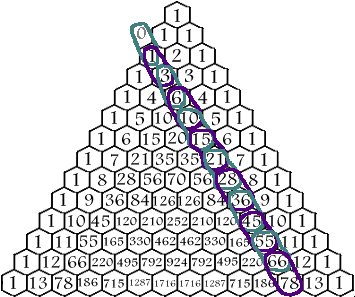
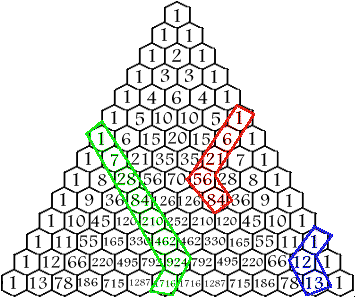
If a diagonal of numbers is selected starting at a 1's bordering starting at the sides and ending on any number inside the triangle on that diagonal, when the numbers inside the row are added up, the sum of these numbers will be connected to the last number but not on the same diagonal.
An eg.1+6+21+56=84
If you noticed, each row, when made into a single number by looking at all the digits in the row as one number(e.g.Row 3: 1 3 3 1 is 1331-one thousand three hundred and thirty one), will equal 11 to the nth power or 11n. For example, 11=11x1; 121=11x11; 1331=11x121; 14641=11x1331. See it for yourself!
If you look hard enough, you'll be able to find it in the Pacal's Triangle, just like we did. In consecutive rows, the sum of the numbers are the same as the first numbers of the Fibonnacci Sequence. By adding two consecutive numbers in the sequence, the next number will be produced, creating the sequence.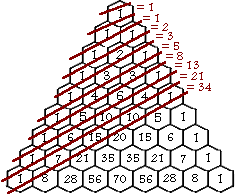
Triangular numbers are a type of polygonal numbers. They can be found in the diagonal starting at row 3 as shown in the diagram. The first is 1, second is 3 etc. You must be thinking - What are triangular numbers? So, here's what it is.
Polygonal numbers are 1,3,6,10,15,21......these are generated by the number 1.
1=1; 1+2=3; 1+2+3=6; 1+2+3+4=10
They are called triangular numbers because you can make them up in to neat rows like that:
*
Get the picture? We did so you will too!!!
* * *
* * * * * *
1 3 6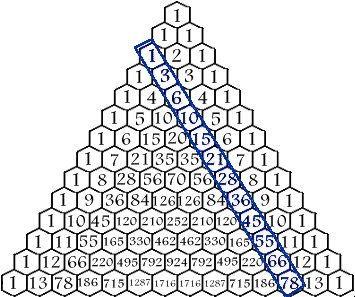
Similar to triangular numbers, square numbers are found also in the same diagonal. A square number is found in the sum of the two numbers in the circled area on the diagram. For example, 1+3=4; 3+6=9; 6+10=16; 10+15=25. As you can see, 4, 9, 16 and 25 are all square numbers! Interesting?! We know it is!