|
 |
 |
As you will no
doubt be aware, coach trips can be tiring or boring or frustrating and
at their worst a combination of all three. The first time that I
visited Rome on a day trip from Naples was none of these largely due to
the vivid commentary by the lady courier whose love of her subject was
apparent in every sentence that she spoke.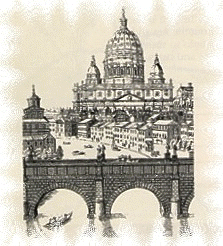 The approach to the
city was along the Appian Way, the main thoroughfare for over 2,000
years and literally the end of the road for Spartacus's slave army who
were crucified at intervals along its length in 79 B.C. The
attractions of the ancient road are almost as fascinating as Rome itself
and there were many times when the coach rolled past a monument or tomb
and thee was an almost irresistible urge to jump out and explore
further. The expert commentary compensated for a lot as did the
one stop we made at the Catacombs. The ancient Christian burial
grounds are cool and claustrophobic and many fellow passengers declined
to descend the narrow passages. After this, it was onto Rome where
the panorama of monuments and churches and statues through the windows
of the slow - moving coach only served to tantalise and frustrate and
after a while, the whole experience melded into a kaleidoscopic jumble
of wonders. it was obvious that to make any sense of this
wonderful but confusing place it would be necessary to return and study
its attractions on foot and to this end at one of the very few stops we
made I threw the compulsory coin into the Trevi Fountain. It was
twenty years into the future before it hit the jackpot and I returned to
The Eternal City. The approach to the
city was along the Appian Way, the main thoroughfare for over 2,000
years and literally the end of the road for Spartacus's slave army who
were crucified at intervals along its length in 79 B.C. The
attractions of the ancient road are almost as fascinating as Rome itself
and there were many times when the coach rolled past a monument or tomb
and thee was an almost irresistible urge to jump out and explore
further. The expert commentary compensated for a lot as did the
one stop we made at the Catacombs. The ancient Christian burial
grounds are cool and claustrophobic and many fellow passengers declined
to descend the narrow passages. After this, it was onto Rome where
the panorama of monuments and churches and statues through the windows
of the slow - moving coach only served to tantalise and frustrate and
after a while, the whole experience melded into a kaleidoscopic jumble
of wonders. it was obvious that to make any sense of this
wonderful but confusing place it would be necessary to return and study
its attractions on foot and to this end at one of the very few stops we
made I threw the compulsory coin into the Trevi Fountain. It was
twenty years into the future before it hit the jackpot and I returned to
The Eternal City.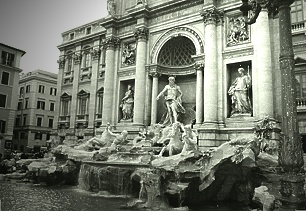 The following descriptions of statues and monuments are basically
something in the manner of the first trip ---they are not in any
particular order or scheme and to do this the only way is to orientate
the city in your own way by walking it. If you like statues and
you like churches then Rome is the place for you. There is a
church on every corner and statues of every shape and size; there are
religious statues, secular statues, Roman, Greek, bronze,
marble, ancient, modern, headless, armless, looted, large and small and
perfect and broken ---- a city of silent sentinels. It is of
course out of the question to produce them all here so what you see will
be a tiny proportion of perhaps the least common.
The following descriptions of statues and monuments are basically
something in the manner of the first trip ---they are not in any
particular order or scheme and to do this the only way is to orientate
the city in your own way by walking it. If you like statues and
you like churches then Rome is the place for you. There is a
church on every corner and statues of every shape and size; there are
religious statues, secular statues, Roman, Greek, bronze,
marble, ancient, modern, headless, armless, looted, large and small and
perfect and broken ---- a city of silent sentinels. It is of
course out of the question to produce them all here so what you see will
be a tiny proportion of perhaps the least common.
Just
a short walk through medieval, winding streets passing broken statues with
bikes leaning against them and the streets open out onto the imposing
structure of the Pantheon and the Piazza della Rotunda. While most people
mill about the Pantheon and the Piazza very few take the trouble to stroll
to the rear of the building. In fairness, the narrow, gloomy streets are
less than inviting but just a short distance away and the shadows give
way to a sunny square where a sculptured elephant stands holding an
obelisk on its back. |
|
The Capitol The
Capitol hill was the ancient citadel of Rome. The place where the Romans
fought the Sabines in the 8th century B.C. , the Temple of Jupiter once
stood and traitors were thrown from the Tarpeian Rock. From that sort of
perspective, the Piazza del Campidoglio is brand spanking new. The
pavings and buildings were designed by Michelangelo. An equestrian
statue of Marcus Aurelius ( 2nd century A.D. ) stands in the centre of
the Piazza while numerous statues are dotted about but the buildings of
the Capitoline Museum are a real treasure trove of statuary with an
eclectic mix of statues unequalled anywhere. The
best way to approach the Capitol is up the steps from the Theatre of
Marcellus and past the giant figures of Castor and Pollux and the best
way to depart is in the opposite direction down a shaded alley past a
sign of Romulus and Remus. Any visit to such a historical treasury as
the Capitol is a fulfilling event but there is an almost theatrical
quality to what comes next. At the bottom of the shaded alley there is a
small wall. Approaching the wall nothing can be seen, but looking over
is like someone drawing back the curtains on the most magnificent stage
set in the world, for there bathed in sunshine is the breathtaking site
of the ancient Roman Forum.
|
| The Forum Even after the passage of 2,000 years the Roman Forum still retains the power to impress. No pictures can prepare you for just how grand this place is and in some strange way, the crumbling edifices only serve to emphasise its past grandeur.
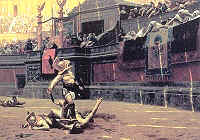
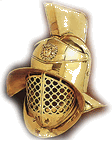
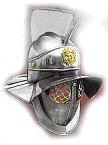
The gladiators were a different matter altogether as they did have weapons and some kind of a chance at either fighting another day or winning their freedom. Many gladiators won fame and fortune in the arena and more than a few gained the wooden sword signifying that they were now free men. Although most gladiators were pressed men there were many who volunteered for their day in the arena fighting because they liked to fight. The enclosed painting is in complete contrast to the above postcard portraying the elation of a gladiator winning fame and glory over a defeated opponent.
|
Castel Sant
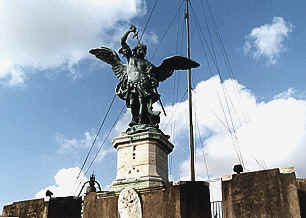
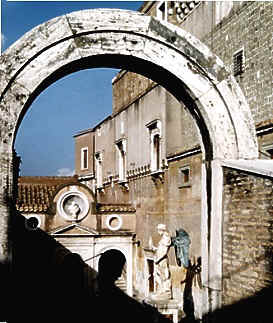
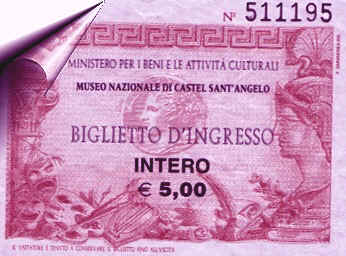
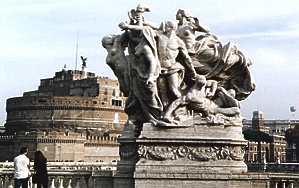
'Angelo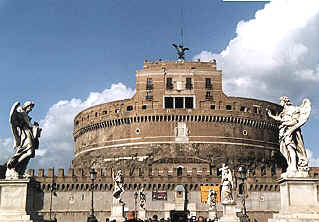 Originally built as the Mausoleum of the Emperor Hadrian in 139 AD the Castel remains an imposing and unusual circular monolith on the banks of the Tiber. The bridge leading up to the entrance is flanked by statues on either side reminiscent of the Charles Bridge in Prague. Over the millenia the building has had many incarnations including being a part of Aurelian's city wall, a prison and a medieval citadel. A stone's throw away from the Vatican it has also been a refuge for the Pope in times of danger and the Vatican Corridor built in 1277 travels underground from the Vatican to the Castel. It has been used several times most famously by Pope Clement in 1527 during the sack of Rome. But the bit that is relevant to us is the vision of Pope Gregory the Great who witnessed a visitation by the Archangel Michael { Circa 600 Ad } on the ramparts. The subsequent statue at the very top of the fortress is by Pieter Verschaffelt -- quite why it took 1,000 years to commemorate the great event is not known. There is another statue of the Angel in the courtyard of honour.  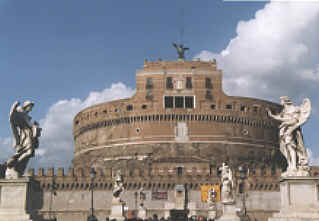
The
statues on either side of the bridge are by the ubiquitous Bernini and
represent angels. The stairs to the top of the Castel can be
daunting but the views across the city are breathtaking.
|
 es
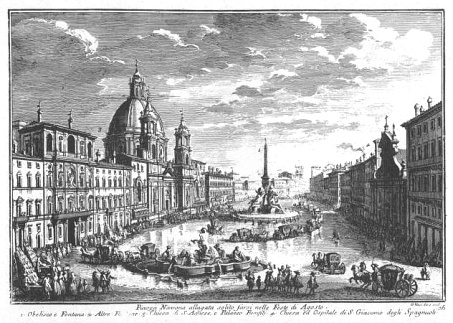
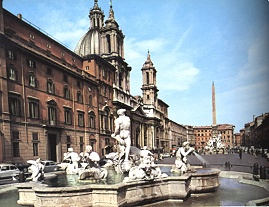
was martyred in A.D. 304. The original pillars of the stadium can still be
seen in the vaults.What was once the arena now contains three fountains
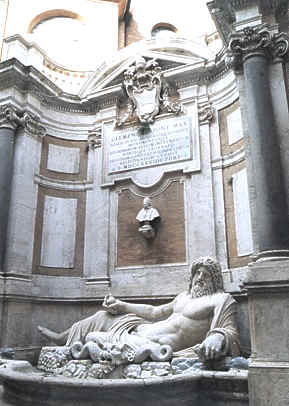
and basins. The Fontana di Nettuno is at one end and the Fontana del Moro
is at the other end. Both of these works were built by Giacomo della
Porta,circa 1575 with the Fontana del Moro embellished with the statue of
a Moor fighting a dolphin by Bernini added in the following century, Why
Bernini chose the Moor to fight the most peaceful animal in the sea is not
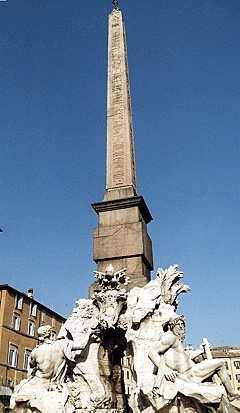
clear.The central Fontana dei Quattro Fiumi is all Bernini's work from
1651. A Roman obelisk which once graced the Circus Maxentius on the Appian
Way is the centrepiece surrounded by four immense stone "giants"
representing the Ganges, the Danube, the Nile and the River Plate which
again seem a strange selection.Overall, the Piazza Navona is stunning by
day and charming by night when the statues are illuminated and take on a
whole new aspect.
es
was martyred in A.D. 304. The original pillars of the stadium can still be
seen in the vaults.What was once the arena now contains three fountains
and basins. The Fontana di Nettuno is at one end and the Fontana del Moro
is at the other end. Both of these works were built by Giacomo della
Porta,circa 1575 with the Fontana del Moro embellished with the statue of
a Moor fighting a dolphin by Bernini added in the following century, Why
Bernini chose the Moor to fight the most peaceful animal in the sea is not
clear.The central Fontana dei Quattro Fiumi is all Bernini's work from
1651. A Roman obelisk which once graced the Circus Maxentius on the Appian
Way is the centrepiece surrounded by four immense stone "giants"
representing the Ganges, the Danube, the Nile and the River Plate which
again seem a strange selection.Overall, the Piazza Navona is stunning by
day and charming by night when the statues are illuminated and take on a
whole new aspect.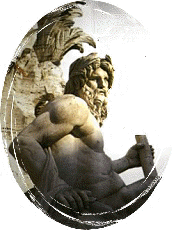
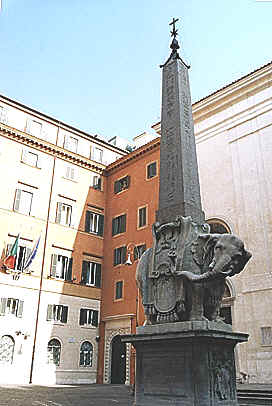 overgrown garden and they requested that it be erected
in the Piazza of the church. When Bernini was invited to take part in the
proceedings in an uncharacteristically capricious mood placed the obelisk
on the back of an elephant where it stands today in the centre of the
church Piazza.
overgrown garden and they requested that it be erected
in the Piazza of the church. When Bernini was invited to take part in the
proceedings in an uncharacteristically capricious mood placed the obelisk
on the back of an elephant where it stands today in the centre of the
church Piazza.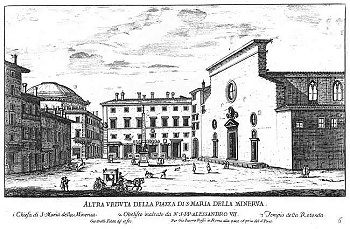
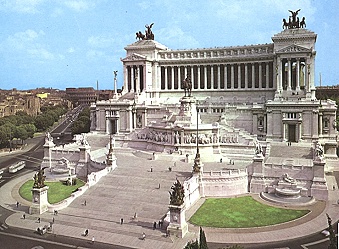 Completed
in 1911 to commemorate Italy's first King, theVictor Emmanuel monument
has been a source of controversy ever since. Its many detractors call it
"the Wedding Cake" but like it or not there is no doubt that
it is big and bold and brash and impossible to ignore. My feelings are
that if it had been built in another part of the city it would have been
far less controversial but situated as it is in the very epicentre of
ancient Rome there is no doubt that it does look incongruous. Standing
on the steps of the Monument the most recent buildings to be seen date
from the Renaissance and the oldest from Republican era. Just across the
road is the Palazzo Venezia with the famous balcony where Mussolini
regularly dispensed wisdom to the Nation, on the right is Trajan's
Column and on the left The Theatre of Marcellus. But it is the rear of
the building, hidden from view which we are most interested in here.
Completed
in 1911 to commemorate Italy's first King, theVictor Emmanuel monument
has been a source of controversy ever since. Its many detractors call it
"the Wedding Cake" but like it or not there is no doubt that
it is big and bold and brash and impossible to ignore. My feelings are
that if it had been built in another part of the city it would have been
far less controversial but situated as it is in the very epicentre of
ancient Rome there is no doubt that it does look incongruous. Standing
on the steps of the Monument the most recent buildings to be seen date
from the Renaissance and the oldest from Republican era. Just across the
road is the Palazzo Venezia with the famous balcony where Mussolini
regularly dispensed wisdom to the Nation, on the right is Trajan's
Column and on the left The Theatre of Marcellus. But it is the rear of
the building, hidden from view which we are most interested in here.
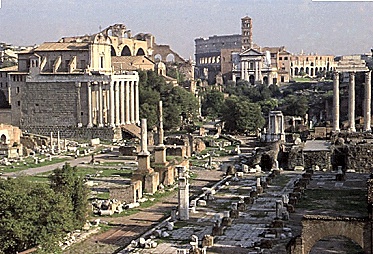 The
magnificence of the triumphal arches at each entrance still create a
sense of humility and proclaim that this place was once the hub of the
greatest Empire the world has ever seen. Overlooking all, is the sombre
circle of the Colosseum and adjacent to the ancient arena is yet another
arch even more magnificent than the other two. This is the arch of
Septimius Severus.
The
magnificence of the triumphal arches at each entrance still create a
sense of humility and proclaim that this place was once the hub of the
greatest Empire the world has ever seen. Overlooking all, is the sombre
circle of the Colosseum and adjacent to the ancient arena is yet another
arch even more magnificent than the other two. This is the arch of
Septimius Severus.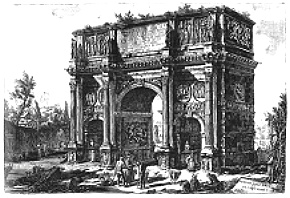
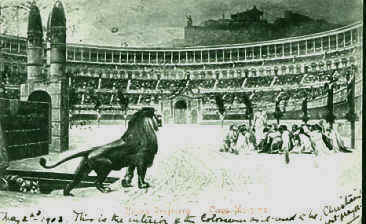
 The
gladiatorial contests in the arena were undoubtedly bloody and merciless
but there was nothing to compare with the sufferings of the early
Christians.
This 1903 postcard depicting a group of Christians huddling together in
terror as an imperious looking lion emerges into the sunshine could so easily have
trivialised the event simply because the subject matter is a dubious
subject for a postcard. The simplicity of the
The
gladiatorial contests in the arena were undoubtedly bloody and merciless
but there was nothing to compare with the sufferings of the early
Christians.
This 1903 postcard depicting a group of Christians huddling together in
terror as an imperious looking lion emerges into the sunshine could so easily have
trivialised the event simply because the subject matter is a dubious
subject for a postcard. The simplicity of the