|
 |
 |
| Travel on to Rome |

 |
|
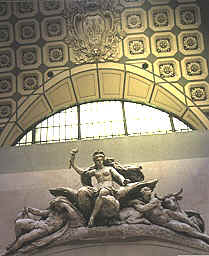
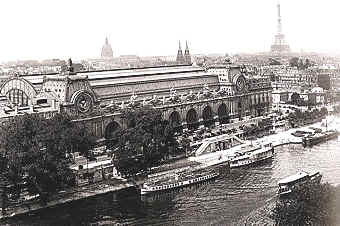
| I was in two minds about leaving out the Musėe D'Orsay from this site, or even Paris itself, because they are both so popular. However, I had a change of mind, partly because I like Paris so much and partly because the city is so rich in statuary that very few people will know them all. Again, although the Musee D'Orsay is a tourist magnet and is really a subject on its own, many people are put off by the wait to get in { 3 hours is not rare } and if you love statues then this place is a treasure trove. So, I have included both Paris and the Musėe D'Orsay with the proviso that I go for subjects which are a little off the beaten track and the knowledge that both are just " tasters". I have omitted the history and the parvis of the Musėe for lack of space here but they are both fascinating in their own right. | |
 After the hours of queuing,
entering the Musee D'Orsay for the first time must be akin to Howard Carter's
emotions when he opened the tomb of Tutankhamen. The whole place is
gleaming with paintings you know only from prints and statues in all
shapes and hues and materials are to be seen everywhere.
After the hours of queuing,
entering the Musee D'Orsay for the first time must be akin to Howard Carter's
emotions when he opened the tomb of Tutankhamen. The whole place is
gleaming with paintings you know only from prints and statues in all
shapes and hues and materials are to be seen everywhere. 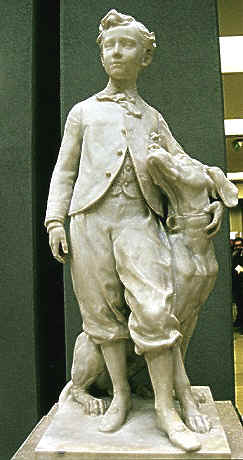 Most
people just glance at the statue of the small boy and his dog as they
race towards the Rodins. It is not dramatic and not very well known at
all but it is in actuality a portrait of The Last Napoleon, The Prince
Imperial, with his dog Nero. When the military ambitions of Napoleon the
Third crashed down about his head at Sedan in 1870, there was a
devastating change in the fortu Most
people just glance at the statue of the small boy and his dog as they
race towards the Rodins. It is not dramatic and not very well known at
all but it is in actuality a portrait of The Last Napoleon, The Prince
Imperial, with his dog Nero. When the military ambitions of Napoleon the
Third crashed down about his head at Sedan in 1870, there was a
devastating change in the fortu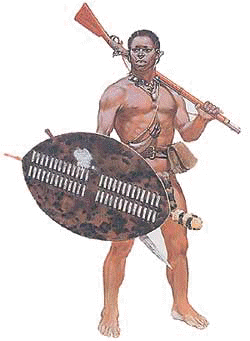 nes
of all his family. Under the patronage of Queen Victoria, the Imperial
family spent their exile at Chislehurst. Napoleon plotted a return
and Eugenie bemoaned her fall from grace, while the scion of the family,
The Prince Imperial, found himself a new role. If he could not be a part
of the French army then he would become a part of the British, which is
what he did quite successfully. nes
of all his family. Under the patronage of Queen Victoria, the Imperial
family spent their exile at Chislehurst. Napoleon plotted a return
and Eugenie bemoaned her fall from grace, while the scion of the family,
The Prince Imperial, found himself a new role. If he could not be a part
of the French army then he would become a part of the British, which is
what he did quite successfully.When the British army suffered the humiliating massacre at Isandlwana, Lord Chelmsford was ordered to assemble a punitive expedition meant to re-establish British superiority in Zululand. The Prince Imperial used all the diplomatic influence at his disposal and travelled with the Army to South Africa. Always impetuous, he travelled with a group of eight soldiers on a scouting expedition deep into Zululand, where in deference to his rank, he was allowed to give an order to dismount for a rest. The ground he chose was surrounded by tall grass which allowed a Zulu patrol to approach closely without being seen. When the Zulus burst from cover, panic ensued and the soldiers dashed for their horses, mounting on the run. An expert horseman, the Prince, nine times out of ten would have outran his pursuers and returned to brag of his exploits, but on this occasion, he slipped from the saddle and found himself alone facing a fierce enemy who killed with no quarter given. The Prince Imperial tried to defend himself to the last and fired his revolver several times but in the end he was overcome by nine Zulu warriors. I always think there is something surreal in the death of the last Napoleon by Zulu assegais. He was born in 1856 and died in 1879 ---- the statue was sculpted in 1865 when his future appeared golden. There is a copy of this statue in a small belvedere in a field next to Malmaison --- it is rarely visited. 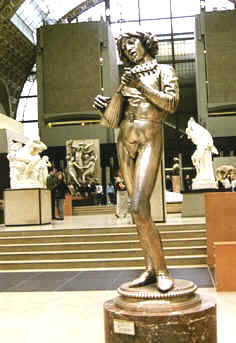 While the statue
of the Prince Imperial is meaningful and poignant because I know the
background, the statue in silver means nothing to me at all in that
respect. I like it as a work of art but I am sure if I knew as
much about it as I did the Prince then I would probably find it even more
interesting. I said previously that for some reason information on
some statues can be difficult { especially when you forget to look at the
plaque on the base } but that's not to say they can't be enjoyed
just the same. In the absence of any information just make your own up ---
I call this one The Tin Man, inspiration -- The Wizard of Oz. The set-piece
depicted here is an allegorical scene again by Carpeaux with the
pretentious title of ----- wait for it - Imperial France Protecting
Agriculture and Science. Although I like the clean lines of the
sculpture I have to say that I if you are waiting for me to go into who is
Science and who is Agriculture and why France feels it necessary to
protect them then you are due for a disappointment. Personally, I
think all this allegorical stuff is just an excuse to sculpt nudes and
since mid-19th century France was just as hypocritical as Victorian
England then I don't think I am far wrong.
I know it's hard to leave and I did say that it was just a quick visit but believe me when I tell you that it is just as hard to leave the Musée D'Orsay after 4 hours as it is after a glance at this page. |
The
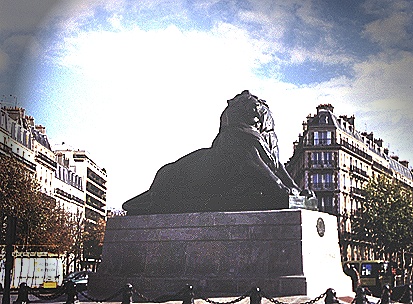
lion at Denfert-Rocherau always makes me smile. No matter how ferocious
he tries to be, he always ends up looking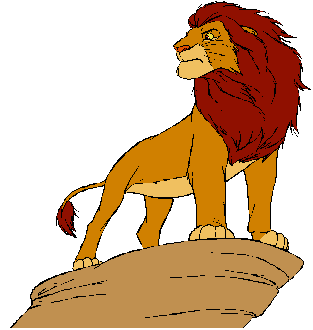 like a like a
 bronze
version of the Lion King { "I laugh in the face of danger
" }. In fact most of the lions in Paris have the
same look about them, haughty but nice, which makes me think they were
all sculpted by the same person. bronze
version of the Lion King { "I laugh in the face of danger
" }. In fact most of the lions in Paris have the
same look about them, haughty but nice, which makes me think they were
all sculpted by the same person.
If you're in
the mood for something a bit on the scary side, then across the road
from the lion is the entrance to the catacombs. The section open to the
public is just a fraction of the true area they cover underground but
nevertheless it is still quite a walk and you travel underneath the lion
and come out some distance away. The catacombs are the receptacles for
millions of bones from the old Paris cemeteries which had become so full
that they were literally overflowing. There have been stories of
Parisians living next to these places who had to seal their cellars off
because the bodies were falling into them. Anyway, night after night
during the year of 1785, the bones were moved from their resting places
and stacked neatly in the winding corridors of the catacombs where they
can still be seen today in artistic arrangements of skull and hip and
thigh. Napoleon the Third once paid a State visit and the Resistance had
their headquarters here during the war and at one time it was a Punk
hangout. The winding corridors were here a long time before all of this
however, as this was where the stone for most buildings in Paris was
hewn from, so it was a pretty neat idea to use them as an ossuary.
Although it was never proved, the discovery of thousands of cat
skeletons in one corridor directly beneath a restaurant by the Odéon,
specialising in rabbit and hare dishes, was a bit suspicious to say the
least. A short walk
away is Montparnasse Cemetery which, while not having the same cachet
as Pere LaChaise does have some famous Parisians buried there --
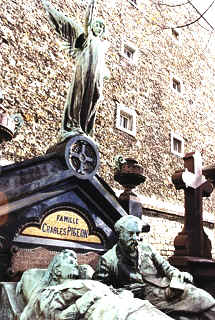
Dreyfus, Baudelaire, Sartre and de Maupassant among them. One of
the most distinctive of the tombs is that of the inventor Charles Pigeon
who is sitting up in his four-poster, obviously worrying about the
electric bill while his wife has a lie-in.
|
One
of the richest sources of statues is the delightfully decrepit Jardin
des Plantes. First established in 1626, the gardens comprise The
National History Museum, a menagerie, massive greenhouses and the
gardens themselves. The menagerie is a bit on the expensive side
considering they are still re-stocking it, after all the animals were
eaten during the siege of 1870 { the porcupines were the last to end up
in the pot } and truth to tell, most of the animals
look a bit flea-bitten anyway. Buffon was the curator in the mid
1700's and it was via his work that the gardens rose to the pre-eminent
position in the world of Natural History.
Cuvier was a precursor of Darwin and an avid fossil collector in the
early 1800's, making some very astute observations as to their
origins. He was revered both in France and in England earning
the soubriquet;
Apart from the natural sciences, the area was also a hot-bed of learning in what some might term the unnatural sciences. Becquerel discovered radioactivity in 1896 and the Curies, for better or for worse, discovered radium.
|
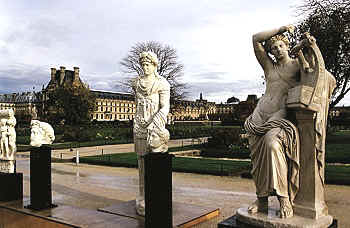
The
selection of statues here are a pot-pourri of things which have caught
my eye and are captured on film. Some statues are well known for
being in-situ for hundreds of years while some are ephemeral and may
never be seen again.
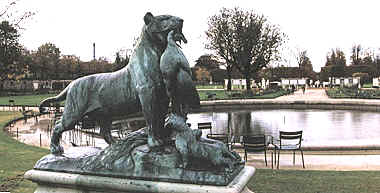
The lion here, on the other hand, is a permanent resident and even
though he's eating a bird, still retains that cartoon-like
aloofness of all the Paris lions.
Very
few tourists take the trouble to make their way to Parc Monceau but if
it is Belle Epoque Paris you are seeking then look no further than this
beautiful little park. Laid out in 1778 for the Duc d'Orleans in
the English style and surrounded by opulent mansions, the park is chock
full of "follies" -- several pyramids, arcades and the
"ruins" of a mock Roman lake with an old toll-house at the
entrance go t
|
No visit to Pari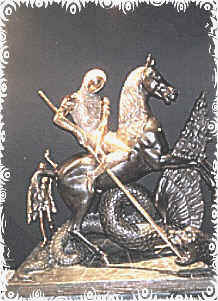 s would ever be complete without a trip to
Montmartre.
Strangely, there are few statues outdoors to speak of but the
Salvador Dali museum tucked away around the corner from the Place du
Tertre, concentrates
on Dali statues more than his paintings. s would ever be complete without a trip to
Montmartre.
Strangely, there are few statues outdoors to speak of but the
Salvador Dali museum tucked away around the corner from the Place du
Tertre, concentrates
on Dali statues more than his paintings. The statues are no less enigmatic than the paintings and there are superb miniatures on sale --- sadly far above my pocket. 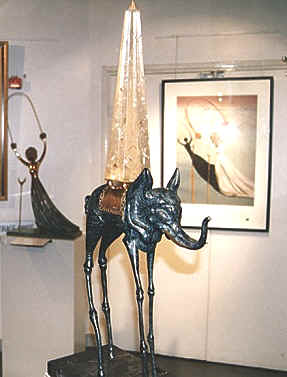 Some of the statues here can be found in one or two paintings and the elephant here is straight out of "The Temptation of St Anthony" and reminiscent of Bernini's elephant in Rome. Maurice Utrillo's studio
which was also the home of his mother Suzanne Valadon has recently been
refurbished and opened as a museum. Despite rumours to the
contrary
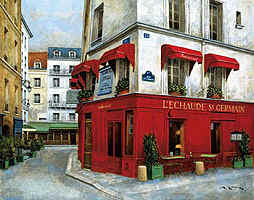
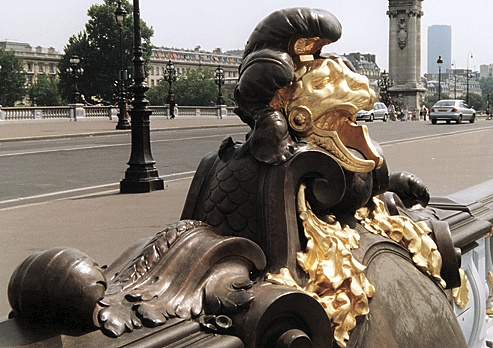
The picture
on the left is typical of Montmartre while the picture below is a detail
from the Pont Alexander 111. I have put it in to show just how
amazing sculpture such as this golden lion can be missed while
concentrating on the more conventional subjects.
As I said at the start I could go on and on painting pictures of Paris but
this little
work is not a definitive study of anything or anywhere ---
think of it as a " sampler" and move on.
|
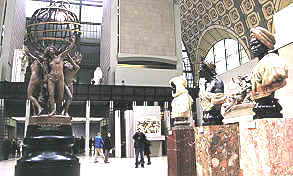 rican
busts, apart from being realistic and colourful, are forerunners of the
use of several stones as seen in the Oscar Wilde statue. The
sculptor here has used bronze, onyx and porphry to produce lifelike
studies of what were at that time very exotic subjects.
rican
busts, apart from being realistic and colourful, are forerunners of the
use of several stones as seen in the Oscar Wilde statue. The
sculptor here has used bronze, onyx and porphry to produce lifelike
studies of what were at that time very exotic subjects.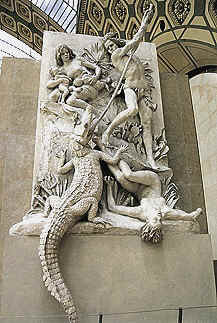
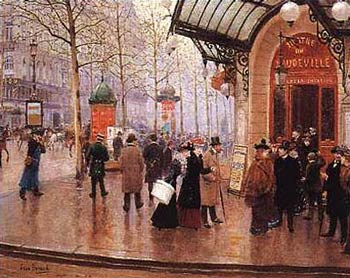
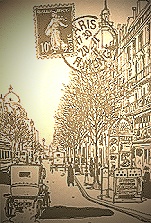 If the truth be known, most people think of La Belle Epoque as
the Paris they would have liked to have known, given a choice. But
the era is not that long ago and Paris is not all that different ----the
only things missing are the men and women who made Paris "gay"
at that time. The Place Montholon, just a short walk from the
Folies Bergere and the Gare du Nord, is not so very different now as it was a century
ago and the only people you will see there are Parisians. The
sculptor here, obviously loved La Belle Epoque also and has taken the
trouble to people this beautiful little square with ladies of the
era.
If the truth be known, most people think of La Belle Epoque as
the Paris they would have liked to have known, given a choice. But
the era is not that long ago and Paris is not all that different ----the
only things missing are the men and women who made Paris "gay"
at that time. The Place Montholon, just a short walk from the
Folies Bergere and the Gare du Nord, is not so very different now as it was a century
ago and the only people you will see there are Parisians. The
sculptor here, obviously loved La Belle Epoque also and has taken the
trouble to people this beautiful little square with ladies of the
era. 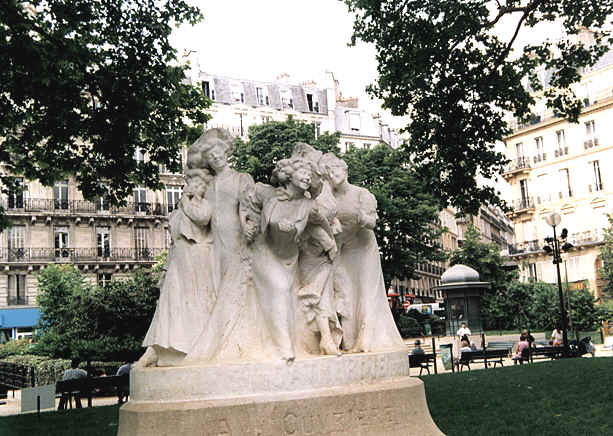
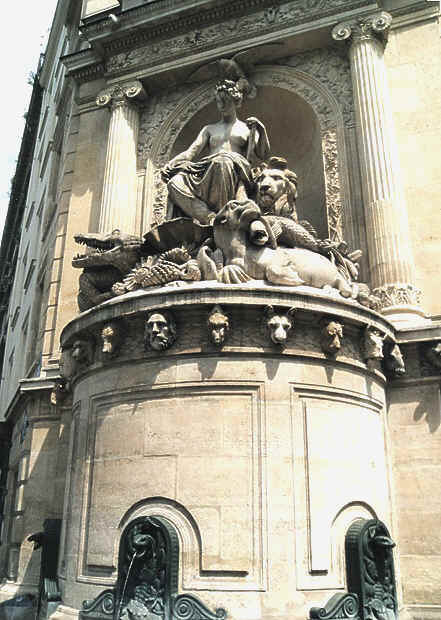 Actually, I should be a little ashamed to be so flippant about a
sculptor I know nothing about because the fact is that I really love
this fountain with it's eclectic collection of animals that in real life
wouldn't have been seen dead together { or perhaps would have ---if you
see what I mean }.
Actually, I should be a little ashamed to be so flippant about a
sculptor I know nothing about because the fact is that I really love
this fountain with it's eclectic collection of animals that in real life
wouldn't have been seen dead together { or perhaps would have ---if you
see what I mean }.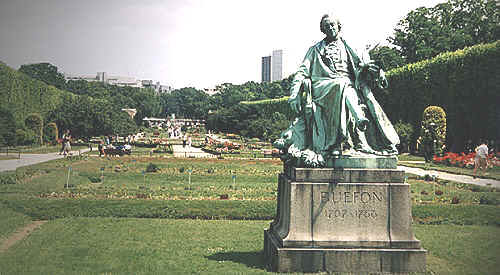
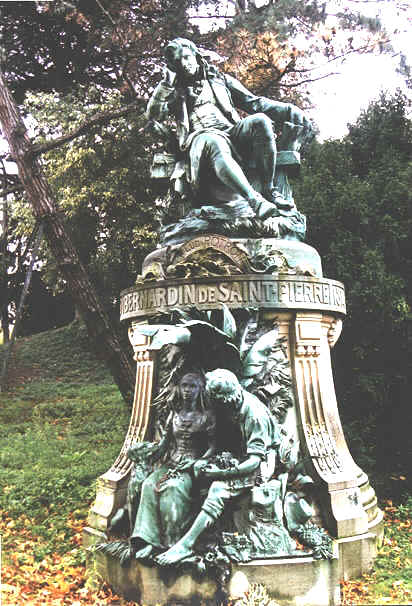 I don't know
too much about the statue on the left, apart from the fact that it
stands at the entrance to the Jardin and I like the way it is set with
the wooded background. What I do know is that the Jardin was a
thriving centre of learning in all the Natural Sciences from the day of
its inception, a perfect counterpoint to the Museums of London, where
Darwinism was hotly debated.
I don't know
too much about the statue on the left, apart from the fact that it
stands at the entrance to the Jardin and I like the way it is set with
the wooded background. What I do know is that the Jardin was a
thriving centre of learning in all the Natural Sciences from the day of
its inception, a perfect counterpoint to the Museums of London, where
Darwinism was hotly debated.
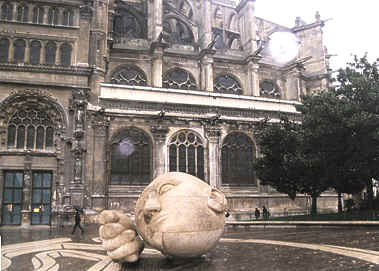 The church of St Eustache was begun in 1523 and took over 100 years to
complete. Madame de Pompadour was baptized here as was Cardinal
Richelieu while Moliere was buried here. During the Revolution the
parvis was a popular meeting place for sans-culottes who sang the Ça
Ira and danced the Carmagnole but apart from its Gothic splendour the
church's main claim to fame is as the parish church of Les Halles.
Hugo called the massive market Le Ventre de Paris { The Belly of Paris }
and so it remained until the 1960's when the old cast iron buildings
fronting the church were pulled down. Most Parisians are still
upset at what they regard as the loss of a great part of the life of the
city but one of the good points was that it exposed the outstanding
façade of St. Eustache. Where the market-place used to be there
is now a pedestrianised area of gardens and trellis-work which is very
pleasant, leading from the Bourse to the Beaubourg and on the parvis is
a huge head which I can't make my mind up whether I like or not.
The Parisians have a penchant for placing modern art next to traditional
architecture, the most striking example being of course the glass
pyramids in the Louvre forecourt. I have seen a Miro totem-pole in
the courtyard of the French Foreign office and the Pont Neuf draped in
hessian and while I applaud the audacious use of modern art on one hand,
there is just something which doesn't seem right. I think that
many people feel the same way ---but here's the church and here's the
head, so judge for yourself.
The church of St Eustache was begun in 1523 and took over 100 years to
complete. Madame de Pompadour was baptized here as was Cardinal
Richelieu while Moliere was buried here. During the Revolution the
parvis was a popular meeting place for sans-culottes who sang the Ça
Ira and danced the Carmagnole but apart from its Gothic splendour the
church's main claim to fame is as the parish church of Les Halles.
Hugo called the massive market Le Ventre de Paris { The Belly of Paris }
and so it remained until the 1960's when the old cast iron buildings
fronting the church were pulled down. Most Parisians are still
upset at what they regard as the loss of a great part of the life of the
city but one of the good points was that it exposed the outstanding
façade of St. Eustache. Where the market-place used to be there
is now a pedestrianised area of gardens and trellis-work which is very
pleasant, leading from the Bourse to the Beaubourg and on the parvis is
a huge head which I can't make my mind up whether I like or not.
The Parisians have a penchant for placing modern art next to traditional
architecture, the most striking example being of course the glass
pyramids in the Louvre forecourt. I have seen a Miro totem-pole in
the courtyard of the French Foreign office and the Pont Neuf draped in
hessian and while I applaud the audacious use of modern art on one hand,
there is just something which doesn't seem right. I think that
many people feel the same way ---but here's the church and here's the
head, so judge for yourself.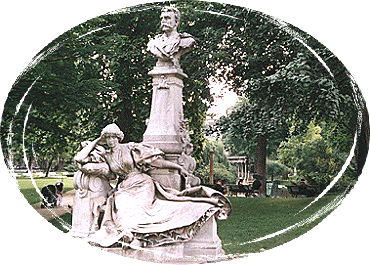 o
make up a Royal trifle which retains its pre-revolutionary charm.
The follies are supplemented by various statues dotted throughout the
grounds and there are none better or more in keeping than this one of de
Maupassant et sa femme reclining at his feet.
o
make up a Royal trifle which retains its pre-revolutionary charm.
The follies are supplemented by various statues dotted throughout the
grounds and there are none better or more in keeping than this one of de
Maupassant et sa femme reclining at his feet.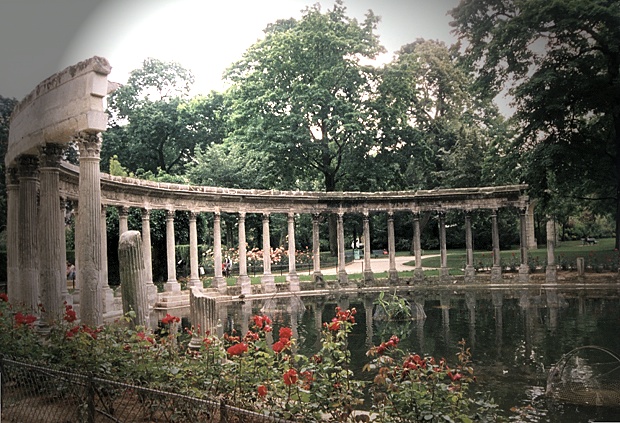
 first sight of the Eiffel Tower is the classic vista from
Trocadero, The Palais Chaillot, looking down upon the fountains and the
always awesome Tower itself. But just a glance backwards reveals a
vast square { more of a roundabout } with an equestrian statue of
Marshall Foch in the centre. Just to the side is a statue of
Benjamin Franklin and across the road are a surround of forbidding
concrete walls. The walls themselves are off-putting but they
enclose the bijou Passy Cemetery. Now cemeteries in Paris are
completely unlike cemeteries elsewhere in that they are repositories of
French celebrities past, little history lessons and places of fine
sculpture all at the same time. While showing the proper
respect to the dead they also have an indefinable humour about the
tombstones.
first sight of the Eiffel Tower is the classic vista from
Trocadero, The Palais Chaillot, looking down upon the fountains and the
always awesome Tower itself. But just a glance backwards reveals a
vast square { more of a roundabout } with an equestrian statue of
Marshall Foch in the centre. Just to the side is a statue of
Benjamin Franklin and across the road are a surround of forbidding
concrete walls. The walls themselves are off-putting but they
enclose the bijou Passy Cemetery. Now cemeteries in Paris are
completely unlike cemeteries elsewhere in that they are repositories of
French celebrities past, little history lessons and places of fine
sculpture all at the same time. While showing the proper
respect to the dead they also have an indefinable humour about the
tombstones. 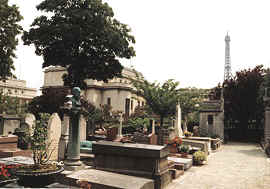 ackdrop
to any cemetery anywhere. Henry Farman's { 1874 - 1958 } tomb has
him seated at one of his earliest biplane designs. Farman made the
first flight over New York city and designed one of the most hated
aircraft of the First World War, the FE2B {Farman Experimental }.
The fliers were allowed no parachutes and the observer travelled in a
sort of bin contraption which would normally have been the
nosecone. Edourd Manet is entombed alongside his sister-in-law
Berthe Morisot while Debussy, Fauré and Fernandel are scattered
throughout but the strangest grave for me is that of the silent movie
star Pearl White. A single white rose placed upon a black basalt
tombstone denotes her last resting place and it is bizarre and surreal
that the star of so many Hollywood epics should be buried
here. The last time I saw Pearl White was many years ago
tied to a railroad track as usual by a moustachioed villain and here she
is now all those years later in the shadow of Eiffel's
Tower.
ackdrop
to any cemetery anywhere. Henry Farman's { 1874 - 1958 } tomb has
him seated at one of his earliest biplane designs. Farman made the
first flight over New York city and designed one of the most hated
aircraft of the First World War, the FE2B {Farman Experimental }.
The fliers were allowed no parachutes and the observer travelled in a
sort of bin contraption which would normally have been the
nosecone. Edourd Manet is entombed alongside his sister-in-law
Berthe Morisot while Debussy, Fauré and Fernandel are scattered
throughout but the strangest grave for me is that of the silent movie
star Pearl White. A single white rose placed upon a black basalt
tombstone denotes her last resting place and it is bizarre and surreal
that the star of so many Hollywood epics should be buried
here. The last time I saw Pearl White was many years ago
tied to a railroad track as usual by a moustachioed villain and here she
is now all those years later in the shadow of Eiffel's
Tower.  And
although the cemetery is as fitting a place
And
although the cemetery is as fitting a place