|
 |
 |
| It's a strange
thing how seemingly unrelated places and events can go for years without
being apparent and then suddenly coalesce to become a whole. Several years ago, on a trip to Canada, in the wake of my wife's interminable quest to seek out bargains wherever they may be found { the economies of several small countries are still recovering } I absent-mindedly noticed a shop called Bowrings. There was a logo of a sailing ship alongside the wording. Having nothing better to do, and in a short intermezzo from signing cheques, 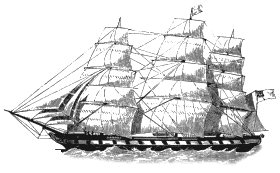 I asked the shop
assistant { who was exceedingly pretty, by the way } the reason for the
sailing-ship logo and unlike some shop persons I have come across who
are hard-pressed to tell me the price of a loaf, she was happy and proud
to divulge her knowledge. It seems that a certain Mr Bowring had
sailed from Liverpool and set up as a merchant adventurer in
Newfoundland in the 1800's and having become very successful formed a
chain of shops. As the conversation unfolded, I became m I asked the shop
assistant { who was exceedingly pretty, by the way } the reason for the
sailing-ship logo and unlike some shop persons I have come across who
are hard-pressed to tell me the price of a loaf, she was happy and proud
to divulge her knowledge. It seems that a certain Mr Bowring had
sailed from Liverpool and set up as a merchant adventurer in
Newfoundland in the 1800's and having become very successful formed a
chain of shops. As the conversation unfolded, I became m ore
intrigued and one or two cogs began to turn ----- first of all Liverpool
is my home town, secondly I once worked in a park named Bowring and
lastly the name Bowring resonates throughout Liverpool in street names
and so on. Anyway, the shop assistant { who I had fallen deeply in love with by this time } said that
Bowring had sold his chain of shops and the firm she worked for had
bought the chain and retained the name. I asked her if she would
run away with me but she turned me down so I reluctantly went back to
destroying the basal economic structure of Toronto { you have to start
small in a big place like Canada }. ore
intrigued and one or two cogs began to turn ----- first of all Liverpool
is my home town, secondly I once worked in a park named Bowring and
lastly the name Bowring resonates throughout Liverpool in street names
and so on. Anyway, the shop assistant { who I had fallen deeply in love with by this time } said that
Bowring had sold his chain of shops and the firm she worked for had
bought the chain and retained the name. I asked her if she would
run away with me but she turned me down so I reluctantly went back to
destroying the basal economic structure of Toronto { you have to start
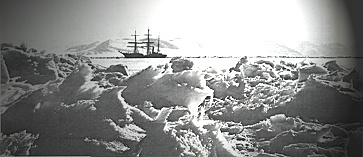
small in a big place like Canada }.When I returned home I did some research and found the story of the Bowring dynasty far more epic and complex than can be recounted here but some of the facts are; the indefatigable Benjamin Bowring had indeed sailed for Newfoundland in 1811and set up a shipping, sealing and trading company which became extremely successful. The company went in for ship owning as the years went by and one of their ships became world famous. The Terra Nova was sold to the British Admiralty for the specific job of accompanying Scott to Antarctica in 1912 and she performed so admirably that Scott went on record to say that he grew very fond of the ship.
By
this time, the Bowrings had made Newfoundland their home and in keeping
with many Victorian Colonials they sculpted their surroundings into
something resembling their English homeland. They purchased a farm
and shaped and moulded the landscape into the nearest thing they could
get to an English estate and today there is I believe { Although I
haven't seen it } a Bowring Park in St. Johns bequeathed to Newfoundland
in 1911. Over the years, the Bowrings added to the park with gifts
of bridges and lakes and not least, statues. There is a statue of
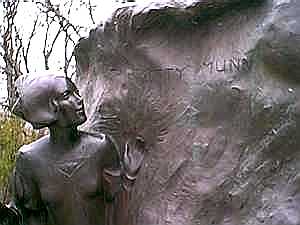
Peter Pan by Frampton which is a duplicate of one in Sefton Park, Liverpool which is in turn a copy of the famous original in Kensington
Gardens, London. Frampton liked the Newfoundland Peter Pan best of
all - he thought the woodland setting was most in keeping. When the First
World War broke out, Newfoundlanders would have had every reason to
believe that it was an event as remote as something on Mars, but
Canadians and Newfoundlanders volunteered in droves and perhaps an
allegiance to Benjamin Bowring and those like him had an influence in
those decisions. Whatever it was, patriotism, loyalty, call it
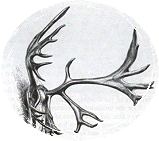
what you will --- it is the reason why there is also a Woodland
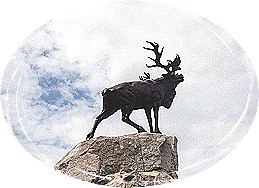
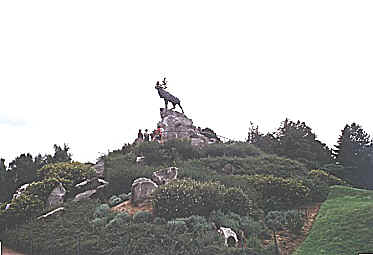
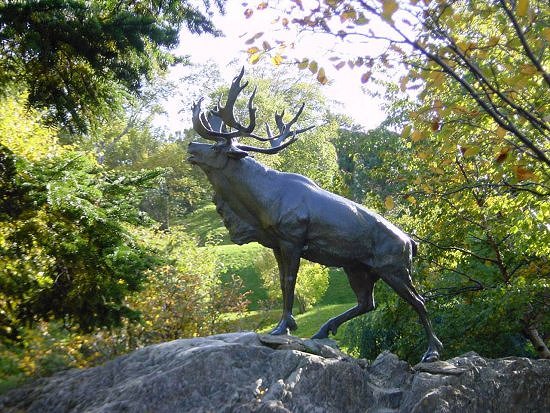
Caribou in a field in France, 3500 miles away from its homeland.
|
||||||||
|
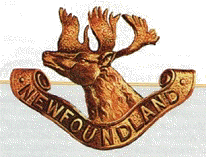
On July 1st, 1916, the Newfoundland Regiment, volunteers all, found themselves at the northern tip of the Somme front; only Serre divided them from the channel. The attackers at Serre had an even more impossible job than that of the 1st Newfoundland Regiment , attacking entrenched machine guns up a steep hill. Walking up it in the middle of summer with the birds singing is hard enough so it is difficult to imagine how anyone could have stormed through a hail of machine gun bullets toting a 30 lb pack. Most of the Serre attackers are still at the base of the hill in the enclosed cemetery next to their shallow trenches.
|
||||||||
 |
|
|||||||
| In
1921, The Newfoundland politician, Sir William Ford Coaker visited the
battlefield and found several bodies of Newfoundland soldiers still
unburied and soon afterwards the Newfoundland Government purchased the
land. The bronze Woodland Caribou was exhibited in London before
being sited upon the great mound where it can be seen today as evocative
as ever. Beaumont-Hamel was a battlefield before and after the Newfoundland massacre and the field is dotted with cemeteries ---the headstones of Newfoundland soldiers can be easily picked out by the caribou |
||||||||
|
"
See that little stream". We could walk it in two minutes. Dick
Diver's observations on visiting a trench at Beaumont-Hamel
|
"
If you could hear at every jolt, the blood
Come gurgling from the froth-corrupted lungs
My friend you would not tell with such high zest
To children ardent for some desperate glory
The old lie ; Dulce et Decorum est Pro Patria Mori.
."
Wilfred Owen after a gas attack on the Western Front
.
|
|
| | ||||
 Newfoundland.


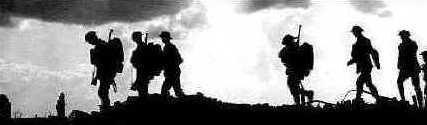
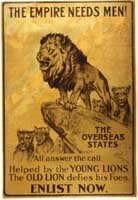 Many
years ago I worked with a Welshman who was "on the
Somme". He knew about minnenwerfers{ moaning minnies he
called them }and he detested barbed wire { it was underwater at
Gallipoli } and he had thrown up the first time he had to bayonet a man,
but according to him the worst things were the lice and the mud. Even
after all these years the phrase " just like the Somme" is in
common usage in the UK and everyone knows that it means a quagmire or a
tortuous slog through mud.
Many
years ago I worked with a Welshman who was "on the
Somme". He knew about minnenwerfers{ moaning minnies he
called them }and he detested barbed wire { it was underwater at
Gallipoli } and he had thrown up the first time he had to bayonet a man,
but according to him the worst things were the lice and the mud. Even
after all these years the phrase " just like the Somme" is in
common usage in the UK and everyone knows that it means a quagmire or a
tortuous slog through mud.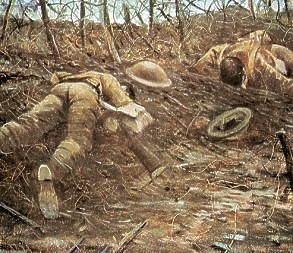
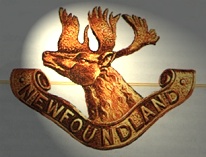 The
Newfoundlanders were facing their first battle on French soil. They were
well trained and fit and anxious to prove their worth. Their experience
at Beaumont-Hamel was to be a devastating microcosm of what occurred
along much of the Somme front that day. The massive Hawthorn mine had
exploded on their left, the barrage had finally ceased and the whistle
blew to advance into No-Man's Land at 9.16 am. The distance to the
German trenches was about 300 m and within a half hour 710
Newfoundlanders were lying dead all over that field. The German machine
gunners had emerged unscathed from their trenches and carried out their
work with an ease and efficiency which made a mockery of all the British
preparations.
The
Newfoundlanders were facing their first battle on French soil. They were
well trained and fit and anxious to prove their worth. Their experience
at Beaumont-Hamel was to be a devastating microcosm of what occurred
along much of the Somme front that day. The massive Hawthorn mine had
exploded on their left, the barrage had finally ceased and the whistle
blew to advance into No-Man's Land at 9.16 am. The distance to the
German trenches was about 300 m and within a half hour 710
Newfoundlanders were lying dead all over that field. The German machine
gunners had emerged unscathed from their trenches and carried out their
work with an ease and efficiency which made a mockery of all the British
preparations.