|
The city of
Madrid stands on a plateau in the centre of Spain and is the highest
Capital city in Europe. The days are hot and the nights are sultry
which accounts for the late hours that the Madrileño's keep.
Whole families take to the streets and restaurants and shops and
boulevards are buzzing into the early hours. During the Winter
months, sharp frosts are common and the watery sun shining all day
cannot quite melt iced-over ponds.
Like many old European cities, the origins of Madrid are are shrouded in
mystery. One complicated legend holds that a Prince Bianor taking
flight after the Trojan War wandered from place to place [ shades of
Ulysses here and the founding of ancient Rome by Aeneas } until the god
Apollo appeared to him in a dream and ordered him to build a city in a
place ordained by him. On completion of the building of the city
then Bianor would forfeit his life ---which must have been a real
incentive to start work. When Bianor awoke from his dream he found
himself in a place of rich groves of oak and madroño trees where
shepherds were tending their flocks ---the shepherds were called "carpetanos"
or "those who have no city". Bianor told the Carpetanos
of his dream and the shepherds began to build the city, not daring to
oppose the god. When the city was nearing completion Apollo again
appeared and directed that the city should be called Metragirta and
demanded the death of Bianor wh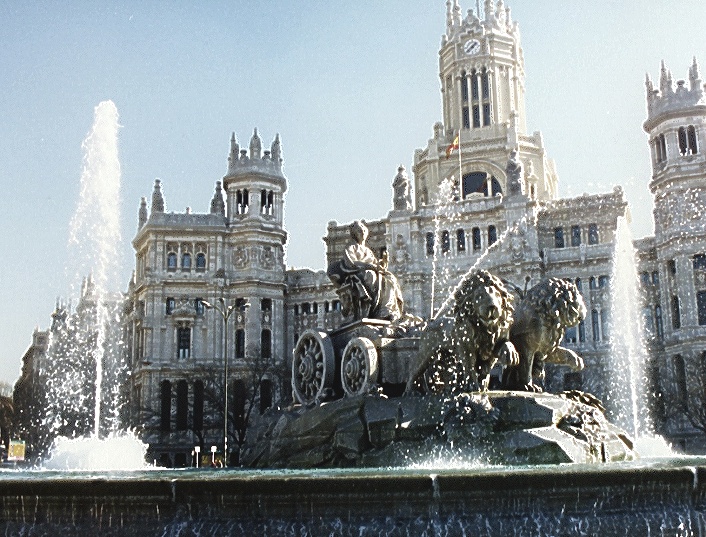 o
very obligingly fell off his perch and was buried in an ornate tomb
which must have been some consolation. The same night the goddess
of the earth and a daughter of Saturn appeared and pulled him from his
tomb and presumably made him take a hot shower. Metragirta then
became Magerit and then
Madrid. The above story is far more complex than I have recounted,
involving Bianor's sister founding Mantua and stories persist all over
Europe of cities founded by refugees
from the Trojan War and whether or not they have any basis in fact they
are fascinating if
only for their longevity. o
very obligingly fell off his perch and was buried in an ornate tomb
which must have been some consolation. The same night the goddess
of the earth and a daughter of Saturn appeared and pulled him from his
tomb and presumably made him take a hot shower. Metragirta then
became Magerit and then
Madrid. The above story is far more complex than I have recounted,
involving Bianor's sister founding Mantua and stories persist all over
Europe of cities founded by refugees
from the Trojan War and whether or not they have any basis in fact they
are fascinating if
only for their longevity.
And here
is Cybele herself outside the ornate main post office in Madrid with two
lions pulling her chariot.
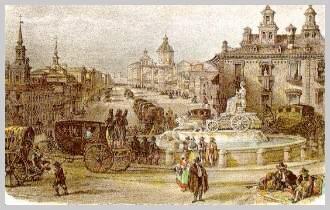
The
postcard shows a romanticized
version of the Cybele ---date is anyone's guess
|
 There are two
other main origin tales ---both are far simpler. There are two
other main origin tales ---both are far simpler.
The first
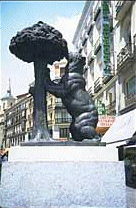
involves the prevalence of bears and madroño
trees in the area causing the city to be called Ursa. The local
name of madroño
tree has the botanical name of Arbutus Unedo which in England and
Ireland is the Strawberry tree, so called because the fruits resemble
strawberries in appearance. They are edible and a delicacy to
bears ---borne out by the symbol of the city in the Puerto del Sol in
the centre of Madrid.
Nowadays, the bears have gone but the Strawberry trees are still
plentiful.
The most scholarly
interpretation is far more prosaic and as in so many other matters
involved the coming of the Moors in 711 A.D. It seems that in the
area of the present Royal Palace there was a watercourse called Matrise,
The Mother of Waters, which the Arabs converted to Matrit and from there
it was just a small step to Madrid.
So you pays your money ----- personally I like all of them.
|
|
The
Prado
Just
a short walk along from the Cybele is the Paseo del Prado which is a
beautiful boulevard made for strolling. There is us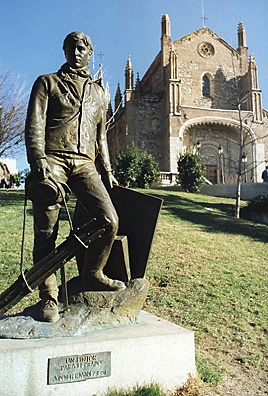 ually
a market or exhibition in the central reservation but most people come
here to sample the delights of the Velasquez's, Murillo's and
Goyas in the Prado art gallery. The statue of the painter on the
left is tucked away to the rear of the Prado and the only reason I can
think of is that there is such a beautiful backdrop in the form of the
Church of San Jéronimo. ually
a market or exhibition in the central reservation but most people come
here to sample the delights of the Velasquez's, Murillo's and
Goyas in the Prado art gallery. The statue of the painter on the
left is tucked away to the rear of the Prado and the only reason I can
think of is that there is such a beautiful backdrop in the form of the
Church of San Jéronimo.
Once
again, I would like to show many of the paintings housed within the
Prado but space permits only a sample and it is my favourite which is
Goya's "Los Fusiliamentos". A terrified peasantry are
being executed by firing squad during the Napoleonic Wars. The
French invaded and occupied Spain and Portugal for several years from
1808 prompting guerrilla warfare in the countryside and a general
uprising in Madrid on the 2nd May 1808. Goya's painting
commemorates the aftermath of the uprising when the executions hardly
endeared them to the Madrileños. The site of the 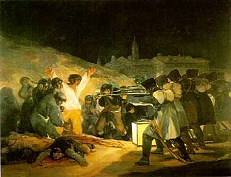 firing
squad can still be seen today at the side of the Montaña del Principe
Pio and not far from the Royal Palace near to what was once Murat's
headquarters, although it is much changed. firing
squad can still be seen today at the side of the Montaña del Principe
Pio and not far from the Royal Palace near to what was once Murat's
headquarters, although it is much changed.
The French never understood that the Mamelukes based in the city were
associated with Moors by the Spaniards and but for that fact the
uprisings might never have taken place.
Parque del Retiro |
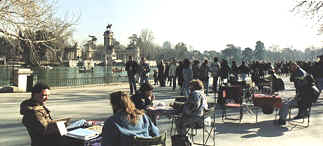 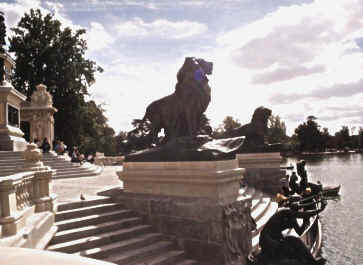 
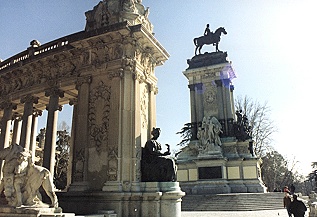 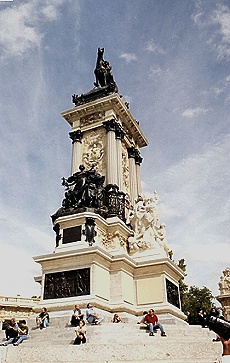
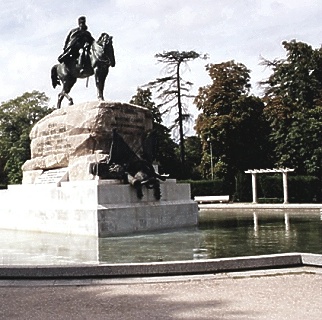 
The above
montage of photographs is a small section of Parque del Retiro
which is a short walk from the Prado. Once the Royal residence of
Philip 11
the area incorporated San Jeronimo and in the 16th century was the scene
of bullfights, firework displays, theatrical performances and so
on. The Park became open to the citizens of Madrid in 1869 and has
been a favourite Sunday stroll ever since. The pictures above are
of the magnificent monument to Alfonso X11. In the foreground is
the boating lake teeming with huge mirror carp which will eat from your
hand
Plaza de
España |
During
the 50's and 60's there seemed to be an explosion of tower blocks of
exquisite mediocrity throughout the cities of Eur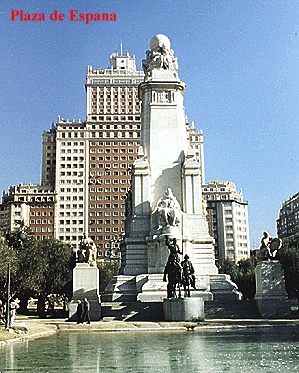 ope.
Although central Madrid escaped relatively unscathed, one of the places
they did encroach upon is the Plaza de España so that the gardens are
under siege by high rise buildings. The square itself has retained
its qualities as a haven of peace and tranquillity and office worker ope.
Although central Madrid escaped relatively unscathed, one of the places
they did encroach upon is the Plaza de España so that the gardens are
under siege by high rise buildings. The square itself has retained
its qualities as a haven of peace and tranquillity and office worker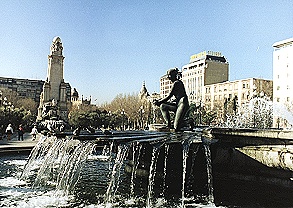 s
and tourists value it accordingly. s
and tourists value it accordingly.
The centrepiece of the gardens is devoted to Madrid's favourite son{ if you exclude most of the Réal Madrid team } in the form of
concrete monolith with a seated Cervantes fronted by bronzes of his best
known characters Don Quixote and Sancho Panza. Don Miguel de
Cervantes actually mentions this site in his famous novel and it
is reasonable to suppose this was one reason why this site was chosen
for the homage to the great man.
Cervantes's life was as colourful and picaresque as any of his novels ;
born in 1547 he fought at the naval battle of Lepanto in 1571 and thus
saw action in one of the most decisive naval battles in history.
Unfortunately, he lost a hand in the fighting but continued his naval
career undaunted participating in many other battles off the North
African coast. In 1575, he was imprisoned in an Algeria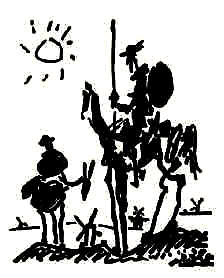 n jail
where he attempted to escape several times, finally succeeding with the
help of Trinitarian fathers. On his return to Madrid he wrote
several unsuccessful novels and then became a government official whose
work entailed gathering cash to fund the ill-fated Spanish Armada.
Twice he was imprisoned for alleged mishandling government funds but
both accusations were unproved and Cervantes once again returned to
writing. His long odyssey finally culminated in Don Quixote de la
Mancha which was first published in 1605 and has never been out of print
since. Several poems and novels followed until Cervantes's death
in 1616 and Don Quixote has since been the second most published book in
history next to the Bible and is regularly voted top in Best Book lists
throughout the world. n jail
where he attempted to escape several times, finally succeeding with the
help of Trinitarian fathers. On his return to Madrid he wrote
several unsuccessful novels and then became a government official whose
work entailed gathering cash to fund the ill-fated Spanish Armada.
Twice he was imprisoned for alleged mishandling government funds but
both accusations were unproved and Cervantes once again returned to
writing. His long odyssey finally culminated in Don Quixote de la
Mancha which was first published in 1605 and has never been out of print
since. Several poems and novels followed until Cervantes's death
in 1616 and Don Quixote has since been the second most published book in
history next to the Bible and is regularly voted top in Best Book lists
throughout the world. |
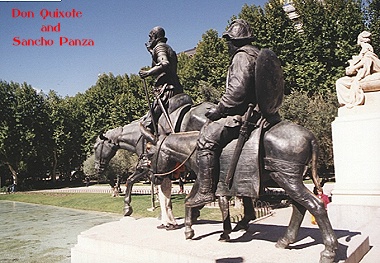 |
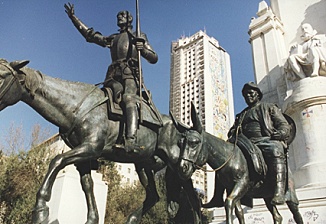
Look closely at the water on
the left and it can be seen that the winter sunshine has not melted the
morning ice. |
The
Plaza Major
I
have to say that the traditional King-on-horseback
statues are so widespread as to be boring in the extreme. Not only
that, they are usually completely unrepresentative of the King or
whoever as to be virtually useless as a representation i.e. there are
Kings laden with medals from wars they never fought, angelic looking
Kings who were as bloodthirsty as Attila and worst of all the Monarchs
wearing togas and laurel wreaths 2,000 years past their sell by
date. So, for these reasons I have made a point of excluding this
type of statue from this document unless there is a very good reason for
doing so and in the inclusion of the statue here it is the setting that
surrounds it which is the factor.
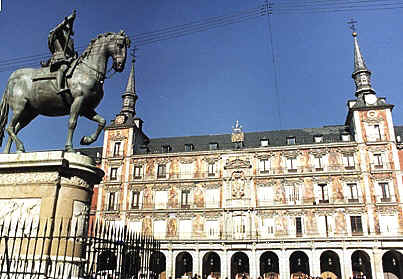 The
Plaza Major is a beautiful medieval square which is so well preserved
that it could have been built yesterday. The arcades attract
shoppers, there is a stamp market and the pavement cafes are ideal for
reflecting on one's luck in not having to squabble over a cheap bottle
of wine, as the winos also share an appreciation of the Plaza. It
takes a great leap of imagination to envisage the square in it's
medieval heyday when it was a Spanish version of the Colosseum. The
Plaza Major is a beautiful medieval square which is so well preserved
that it could have been built yesterday. The arcades attract
shoppers, there is a stamp market and the pavement cafes are ideal for
reflecting on one's luck in not having to squabble over a cheap bottle
of wine, as the winos also share an appreciation of the Plaza. It
takes a great leap of imagination to envisage the square in it's
medieval heyday when it was a Spanish version of the Colosseum.
Having instigated the debacle of the Armada, the Plaza Major was
one of Philip the Second's better ideas in 1580. But the square was not
completed until 1617 and Philip the Third received most of the credit
due to his predecessor. There again perhaps Philip the Second
would have distanced himself from the Plaza if he had known the uses to
which it would be put. Nothing less than a huge arena for
theatrical displays, the Plaza was utilised as a bullring, Kings were
proclaimed here one day while criminals were burned the next.
Never short of spectators who paid extremely high prices to watch the
proceedings the hypocrisy of canonising a Saint and then burning
heretics seemed lost on both the priests and the crowds who no doubt
went home filled with virtuous memories of a good day.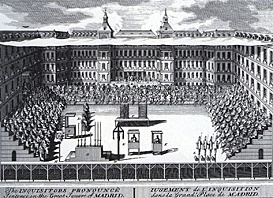
The auto da fe { trial of faith } was without doubt the most
highly attended of the displays, although most present would deny they
were taking any pleasure in being there but had paid to attend through a
pious sense of duty. The Plaza was one of the public arenas
scattered throughout Spain where the Spanish Inquisition regularly put
on theatrically thrilling displays always culminating in the burning of
numbers of so-called heretics. Despite the day-long ceremonies,
the spectators who sometimes counted Royalty among their number, being
pious in the extreme never left their seats before the grand finale even
though the result as always a predictable Inquisition 20 ---Heretics 0.
|
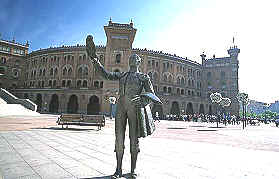 Bullfights
went on in the Plaza Major until the middle of the 1700's, when
the spectacle had become so popular that it was realised that a larger
venue was needed. The first bullring was built in 1745 in the
Calle Alcala and subsequently moved to its present site of Las Ventas
seatin Bullfights
went on in the Plaza Major until the middle of the 1700's, when
the spectacle had become so popular that it was realised that a larger
venue was needed. The first bullring was built in 1745 in the
Calle Alcala and subsequently moved to its present site of Las Ventas
seatin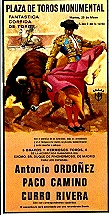 g 23,000 aficionados. Never been to a corrida and
don't really wish to but the matador makes a great subject for a statue. g 23,000 aficionados. Never been to a corrida and
don't really wish to but the matador makes a great subject for a statue.
Madrid's
a great city by any standards and as I have emphasised several times in
all of the places
represented here there is always plenty more to see. What you see
here is never more than a personal
view of the things that take my eye and also an attempt to show things
which are a little out of the way of
the normal tourist sights. One of the places not shown here is
Atocha Station which is an excursion in itself with its tropical
gardens and just half an hour away is Toledo and we never even went to
the Royal Palace ..................

|
|
|
|
|