 |
 |
 |
| Index | Liverpool |
 |
|
||
| Charles
Dickens regularly gave readings of his works in Liverpool's St George
Hall and invariably painted pictures of a Victorian England where
a very large majority were crushed beneath the Iron Heel { Jack London's
phrase } of the unacceptable face of Capitalism. Debts and
Workhouses and grinding poverty were prevalent in all of Dicken's novels
and the reader would be hard put to come across a member of the upper
classes with any sensibilities at all for the lower working class.
Even up to the 1930's George Orwell was telling the same tale; -- in
"The Road to Wigan Pier" he describes how the face workers in
the Lancashire mines did not start to earn a wage until they had
actually begun to hew at the coal-face itself. The journey to the coal-face which was often more than a mile, crawled 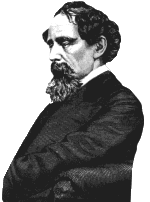 underground in stygian blackness, was deemed to be in their own time and penalised the harder worker. If all these things were true and there's no reason to believe that they were not, then the employees of William Hesketh Lever, industrialist and philanthropist, must have believed that they had died and gone to some Victorian heaven. Lord Leverhulme as he was later known was a manufacturer of soap, food and related products selling world wide and the epitome of a Victorian entrepreneur. Where he differed from Dickens archetype was in his Christian outlook to the people who created his products. Born in Bolton in 1851, his firm of Lever Bros. had a factory in Warrington and in 1888 relocated to Port Sunlight in Cheshire. There was nothing new in building homes for a workforce dedicated to a job for their lifetimes ---the cottages of the labourers who chiselled at Woolton quarry for the stone for Liverpool Cathedral are still standing just down the road from me ---but Lord Leverhulme did not just build houses he built a community of beautiful houses, village greens with bridges and ponds which was a show-piece then and is a show-piece today, so much so that the area is a prized place to live. |
|||
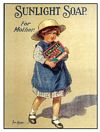
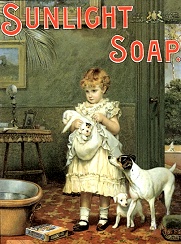
 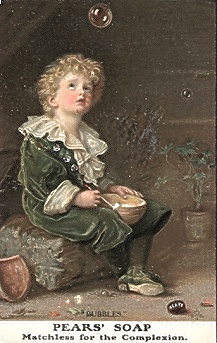  As far as advertising goes, Lever's greatest moment came when he caused a sensation by advertising Sunlight Soap against a background of Millais' famous "Bubbles" . Inadvertently, he popularised the Pre-Raphaelite paintings of which Liverpool and it's galleries has a collection second to none. Adverts such
as those on the right were typical of Victorian domesticity and are
so well painted that they are a record of Victoriana in themselves.
|
Lord
Leverhulme was never anything less than innovative and his advertising posters
were works of art which are prized by collectors
|
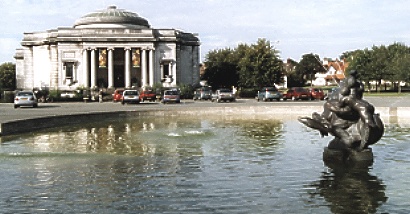
| Wealthy Victorians were famous for collecting in those days -- butterflies, orchids, rare flowers, the Elgin Marbles -- you name it and it is a cast-iron guarantee that some Victorian hunter/gatherer had one in a glass case. Lever was no exception and his passion for things Napoleonic was exceeded only by his zeal for sculpture and painting. As his collection grew he required a building appropriate and large enough to house his growing mass of treasures and the result was the building that you see today. Quite what his workers thought of a Neo- Grecian Temple dedicated to the fine arts plonked down right in the middle of their show-piece estate is anybody's guess. Most of them would have probably settled for a nice pub and a Fish'n Chip shop but when you worked for Lever eccentricity was the norm. Anyway, be that as it may, the Lady Lever art gallery as it is now called is a little gem of eclectic paintings and sculpture and just one more example of the rich heritage the Victorians bequeathed to us. | |
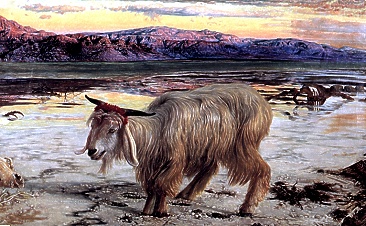
"The Scapegoat" by William Holman Hunt {1827-1910 } is just one of the many examples of Pre-Raphaelite paintings scattered throughout the Liverpool galleries. This picture was painted during a trip to the Holy Land { Holman Hunt-not me} and is a departure from Hunt's usual Biblical scenes, focusing upon a bleak landscape and the tethered goat rather than his usual pictures chock full of people. |
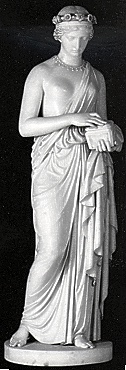
The marble statue of Pandora is by the same John Gibson {1790 -1866 ] who sculpted The Tinted Venus in the Walker art gallery. Pandora was sculpted after The Duke of Wellington suggested it when he visited Gibson in his Rome studio in 1856. |
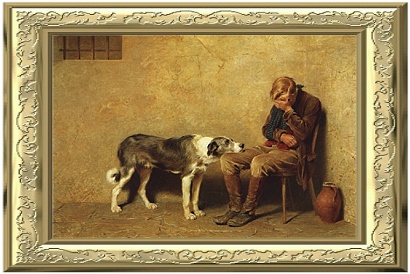
The surrounding paintings and statues may give some idea of the eclectic nature of the Lever collection. The painting above is "Fidelity" by Briton Riviere{ 1840-1920 } and portrays the anguish of a poacher as he languishes in prison. The true pathos is portrayed in the eyes of the dog sympathising with his master. The size of this reproduction can't reproduce the pathos in his dogs eyes. |
 |
 |
|
|
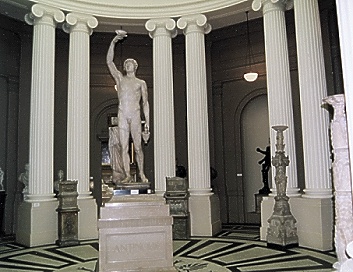
The neo-classical nude in the above picture gives some idea of the vestibule while at the far end of the building there is a duplicate of the above with a statue of Flaubert's Salambo in the centre.
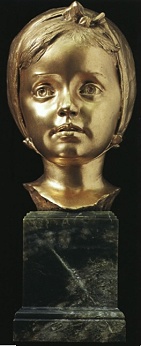
The gilt
bronze head of a child is a portrait of the artist's daughter Muriel aged
4. Sir William Goscombe John
|
 |
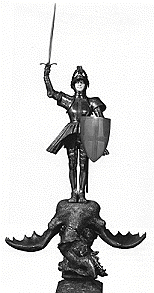
The
statue above is the strangest depiction yet of St George and the
Dragon but when it is explained that St George is modelled on the
sculptor's son and that the figure is meant to be an elaborate salt
container then the picture becomes clearer. Onslow
Ford {1852-1901 }sculpted this piece circa
1890 and it is just one of his many works in the Lady Lever.
|
|
|
|
|
Lord
Lever was a personal friend of William Goscombe John and in addition to
commissioning busts of himself and Lady Lever he also entrusted the
sculptor to create the ornate medieval-looking sarcophagi which are now a
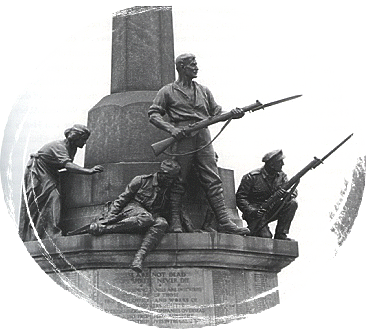
feature of Christ Church, Port Sunlight. Ever the patriot, Lever was
anxious to produce a memorial to the First World War
|
||
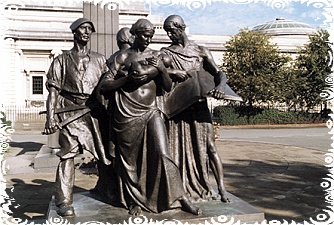


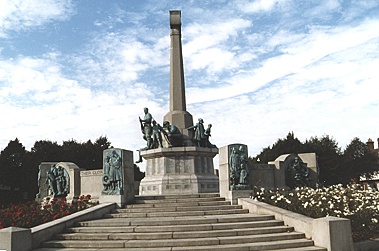
 fallen
from the Port Sunlight area and it was to Goscombe John that he turned
once again to translate his dreams into reality. And the artist who
had lovingly crafted the delicate features of the gilt"
Muriel"now set about the task of designing Lever's monolithic
creation. The result was a huge stone mound with a central cross
representing English village life, surrounded by a series of bronze
statues and reliefs with the theme being "in defence
fallen
from the Port Sunlight area and it was to Goscombe John that he turned
once again to translate his dreams into reality. And the artist who
had lovingly crafted the delicate features of the gilt"
Muriel"now set about the task of designing Lever's monolithic
creation. The result was a huge stone mound with a central cross
representing English village life, surrounded by a series of bronze
statues and reliefs with the theme being "in defence  of
home and country".
of
home and country".