|
 |
 |
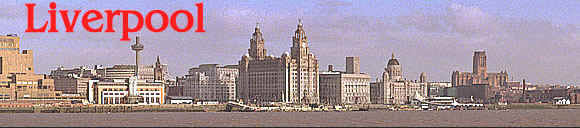
Liverpool and Dublin
are two cities with a great deal in common ; the numbers of Irish people to have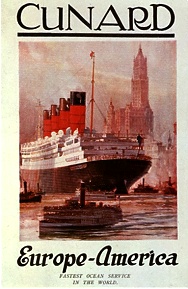 passed into and through Liverpool particularly since the Famine years are legion
and at one time Liverpool was commonly called the capital of Ireland. For
those who stayed and made Liverpool their home their influence has been
pervasive in every way and although it is taken very much for granted, the
integration of the two cultures can be held up as an exemplar for others to
follow. Having said that, there are one or two differences ; despite the
fact that the Duke of Wellington was born in Dublin we haven't yet blown up the
Wellington Column in Lime St ----although his remark that " because
someone is born in a stable doesn't make them a horse"is a bit
defamatory to say the least. There was a Custom House on the banks of the
Mersey which was a twin of the one in Dublin until a stray German bomb levelled
it to the ground during the second World War but regarding statuary Liverpool
still has its fair share spread throughout the city.
passed into and through Liverpool particularly since the Famine years are legion
and at one time Liverpool was commonly called the capital of Ireland. For
those who stayed and made Liverpool their home their influence has been
pervasive in every way and although it is taken very much for granted, the
integration of the two cultures can be held up as an exemplar for others to
follow. Having said that, there are one or two differences ; despite the
fact that the Duke of Wellington was born in Dublin we haven't yet blown up the
Wellington Column in Lime St ----although his remark that " because
someone is born in a stable doesn't make them a horse"is a bit
defamatory to say the least. There was a Custom House on the banks of the
Mersey which was a twin of the one in Dublin until a stray German bomb levelled
it to the ground during the second World War but regarding statuary Liverpool
still has its fair share spread throughout the city.

|
The
most famous statues in Liverpool are of course the Liver Birds and sadly
are the least accessible. The stories of why Liverpool adopted the
Liver Birds as their crest are lost in the mists of time but they
closely resemble cormorants which used to be common in the Mersey and
can still be seen from time to time dipping for fish -- the smartest of
them hang around Harry Ramsdens these days where they now enjoy chips with their fish.
|
The picture
above is |
|
|
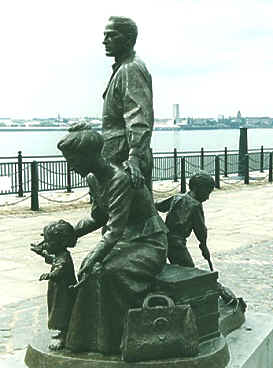
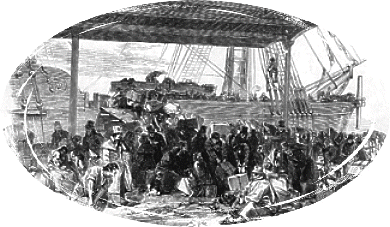
The picture of the immigrants on the right is in contrast to the statues on the quay at Dublin. In this portrayal of a group of immigrants { which is un-related to the Dublin group} the figures are conventional as opposed to modern art. The costumes are Victorian and the family are quite well-heeled judging by their clothes. Nevertheless, they are seeking a new life in America and it was close to here that the Transatlantic Liners sailed for the New World and a new life.
|
 |
||
 |
The Walker Art
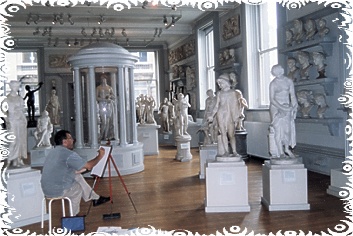
Gallery is a rich source of statuary from various sources. The picture on the left shows a roomful of Victorian statues in white marble.  The statue in the
centre inside the miniature Greek temple is The Tinted Venus which is in
delicately muted colours and harks back to the time when statues were
painted and not the all-white renditions we see today. The
"paint" itself is a coloured wax covering and the statue dates
from 1852 when the discovery had just been made that classical statues had been coloured.
The statue in the
centre inside the miniature Greek temple is The Tinted Venus which is in
delicately muted colours and harks back to the time when statues were
painted and not the all-white renditions we see today. The
"paint" itself is a coloured wax covering and the statue dates
from 1852 when the discovery had just been made that classical statues had been coloured.The sculptor is John Gibson { 1790 - 1866 } and there are several more of his works in the Walker. |
|
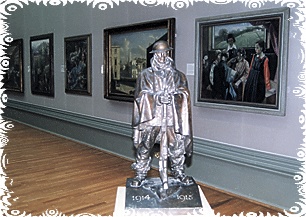
I don't know the
sculptor of the soldier on the right --I included it here because I just
like it and have known it for years. |
 |
|
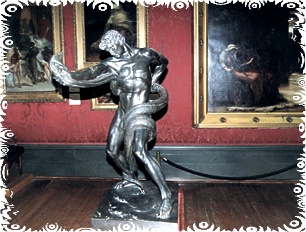
The statue on the left is by Frederic Lord Leighton and is called Athlete Wrestling With a Python executed in 1876. Frederic Lord Leighton
although a gifted sculptor was far better known as a painter and several
of his works are presented in the Walker. |
The
Nelson Monument in Exchange Flags to the rear of Liverpool Town Hall had
its origins in a Council meeting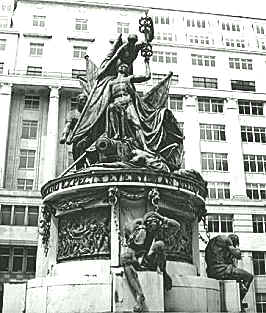 held in that very building in the year
of 1805. The Lord Mayor, William Roscoe and other worthies met to send
an address to the King lamenting the death of Nelson and at the same
time congratulating the
victory of Trafalgar. Out of this meeting the decision was made to
appropriate funds from public subscription for a statue to commemorate
both events. The resulting group of figures was unveiled seven years
later. Richard Westmacott was the sculptor and he has created a work
which is rich in allegory beginning with the figure of Lord Nelson in
the Apotheosis group at the top. The great man is standing over
the body of a fallen enemy raising his sword upon which Victory
personified is placing a fourth crown to indicate Trafalgar. A captured
flag covers Nelson's missing arm and half- hidden in its folds is a
skeleton, Death reaching out to held in that very building in the year
of 1805. The Lord Mayor, William Roscoe and other worthies met to send
an address to the King lamenting the death of Nelson and at the same
time congratulating the
victory of Trafalgar. Out of this meeting the decision was made to
appropriate funds from public subscription for a statue to commemorate
both events. The resulting group of figures was unveiled seven years
later. Richard Westmacott was the sculptor and he has created a work
which is rich in allegory beginning with the figure of Lord Nelson in
the Apotheosis group at the top. The great man is standing over
the body of a fallen enemy raising his sword upon which Victory
personified is placing a fourth crown to indicate Trafalgar. A captured
flag covers Nelson's missing arm and half- hidden in its folds is a
skeleton, Death reaching out to 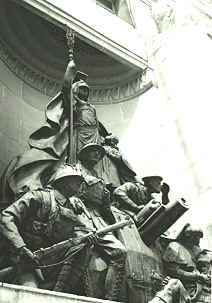 touch
him at his greatest hour. Behind Nelson stands Britannia with bowed
head. There is some confusion concerning the four manacled figures
around the pedestal with some people offended by the references to
Nelson having slaves. The "slaves" are in fact again
allegories -this time representing Nelson's four great victories ; Cape
St Vincent, The Nile, Copenhagen and Trafalgar. However, although
the "slaves" have been misrepresented it is a fact that
Liverpool played a part in the slave trade and it was on this site that
the traders would exchange business cards with the flag of their slave
ship on each card ------hence Exchange Flags. touch
him at his greatest hour. Behind Nelson stands Britannia with bowed
head. There is some confusion concerning the four manacled figures
around the pedestal with some people offended by the references to
Nelson having slaves. The "slaves" are in fact again
allegories -this time representing Nelson's four great victories ; Cape
St Vincent, The Nile, Copenhagen and Trafalgar. However, although
the "slaves" have been misrepresented it is a fact that
Liverpool played a part in the slave trade and it was on this site that
the traders would exchange business cards with the flag of their slave
ship on each card ------hence Exchange Flags.
Banastre Tarleton lived just around the corner. Having successfully survived the American War of Independence he took a dreadful mauling at the hands of Mel Gibson in "The Patriot". Mel's History teacher has a lot to answer for. To the rear of the Nelson monument and set into a niche in the wall is the Newsroom Memorial. The surrounding buildings were at one time the media headquarters in the city and the tableau of World War 1 figures commemorates the media people who died in that holocaust. The siting
of the Nelson statue and the First World War memorial has proven to be
most appropriate because 150 years later this area was the nerve centre
for the Battle of the Atlantic and the once top-secret, underground
war-rooms are now open to the public. Right in the
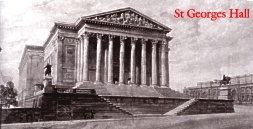
city centre stands the neo - classical St. Georges Hall, erected circa
1840. This whole area is now a World Heritage site. Behind
St. Georges Hall is St. John's Gardens which contains so many statues
that it could easily be construed as a plein-air sculpture area
as opposed to a garden. Once known as Liverpool's Valhalla it
contains statues of the great and the good who have served the city well
over the The gardens
were once the cemetery for French prisoners of the Napoleonic Wars. On
the reverse side of the wall is The Drummer Boy, dressed in the uniform
of 1743 at the battle of Dettingen where the regiment distinguished
itself. A scale model of
the Drummer Boy vanished years ago and will probably resurface from some
private collection at some time in the future.
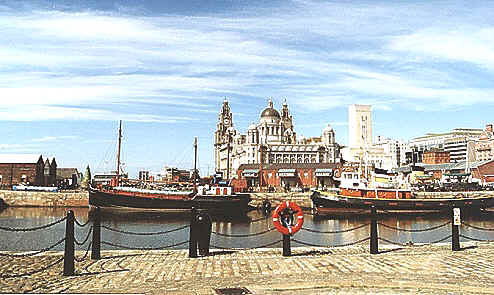
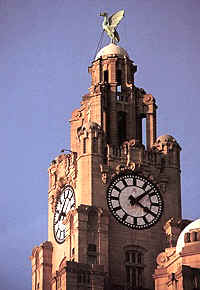
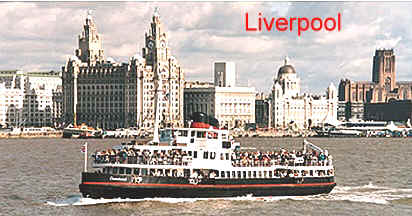
There are no statues on the last picture unless you count the Liver Birds on the top of the Three Graces --I just thought it was a nice picture.
|
 years ; Gladstone is the only Liverpool Prime Minister and
Earle is the only Liverpool General, while other benefactors are
probably known only to Liverpudlians although the great Frampton saw fit
to sculpt at least three of them.
years ; Gladstone is the only Liverpool Prime Minister and
Earle is the only Liverpool General, while other benefactors are
probably known only to Liverpudlians although the great Frampton saw fit
to sculpt at least three of them.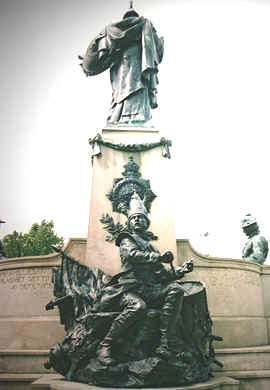

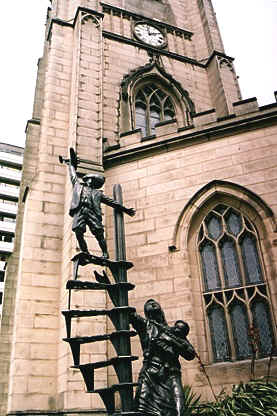
 One
thing about statues is that although there are ones that you
may have been familiar with for a lifetime there are always others coming
along. This one shown here is a real late entry having just been
sited in the last year or two. It is quite monumental in its own way
and stands at the entrance to the Women's Hospital. I
don't suppose there a a great number of women who take much notice as they
enter the hospital ---many for the birth of their babies --- but I think
it could inspire maternal pride
as they leave. I think it's good anyway and it could not have been
sited in a better position.
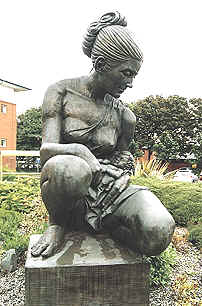
One
thing about statues is that although there are ones that you
may have been familiar with for a lifetime there are always others coming
along. This one shown here is a real late entry having just been
sited in the last year or two. It is quite monumental in its own way
and stands at the entrance to the Women's Hospital. I
don't suppose there a a great number of women who take much notice as they
enter the hospital ---many for the birth of their babies --- but I think
it could inspire maternal pride
as they leave. I think it's good anyway and it could not have been
sited in a better position.