Dublin
 I
quite like wandering around Dublin-it has a certain carefree ambiance
and a pub on every corner which are probably the same qualities which
attracted the Vikings 1,000 years ago. The last time I was
in Dubli
I
quite like wandering around Dublin-it has a certain carefree ambiance
and a pub on every corner which are probably the same qualities which
attracted the Vikings 1,000 years ago. The last time I was
in Dubli n
the rain came down like stair-rods. You can only spend so many
hours drinking Guinness as hard as you try so we ended up going to watch
" Far and Away" where Tom Cruise's depiction of a "top o'
the morning to ye" Irish bhoy adopted every cliche ever given to
the Irish race and while his cocky, joking and fighting Irish lad is
immensely entertaining it must put a terrible strain on any Irish wimps
that are knocking about having to live up to that image. Anyway,
the Dublin audience thought it was a documentary and clapped
when Tom got the girl, his land and just about anything else that was going in
the promised land of America.
n
the rain came down like stair-rods. You can only spend so many
hours drinking Guinness as hard as you try so we ended up going to watch
" Far and Away" where Tom Cruise's depiction of a "top o'
the morning to ye" Irish bhoy adopted every cliche ever given to
the Irish race and while his cocky, joking and fighting Irish lad is
immensely entertaining it must put a terrible strain on any Irish wimps
that are knocking about having to live up to that image. Anyway,
the Dublin audience thought it was a documentary and clapped
when Tom got the girl, his land and just about anything else that was going in
the promised land of America.
There's never any shortage of American accents in Dublin so the
Irish/American love affair lives on and why not.
Anyway,
as far as the statues of Dublin are concerned, there’s a noticeable
absence of conquering heroes on horseback which are present in most
European cities and it says a lot about Dublin that the greater part of
the statuary in the city is devoted to the great literary figures who
have lived there.
James
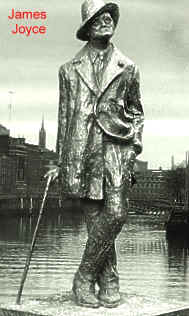
Joyce figures high in the pantheon of Dublin literary figures but I must
confess that I could never get past the first page of Ulysses and take
it on trust that this is one of the great books of all time.
The statue here has the great man standing by the Liffey but in
actuality it is just off O'Connell St outside a tavern which would
not have upset Joyce by all accounts.
What might have upset him though is the Dubliner's nickname for his
statue:
The
Prick with the Stick.

Molly Malone
stands at the bottom of Grafton St
right outside Trinity College. Legend has it that Molly sold her
" Cockles 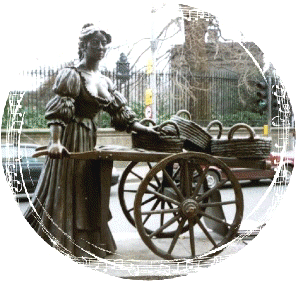 and
Mussels " by day and her body by night. Judging by the size
of her bosom it can only be a blessing that it wasn't melons that
she sold and before anyone starts in about sexism and all that, this
portrayal of Molly was by a l
and
Mussels " by day and her body by night. Judging by the size
of her bosom it can only be a blessing that it wasn't melons that
she sold and before anyone starts in about sexism and all that, this
portrayal of Molly was by a l ady
sculptor --Jeanne Rynhart.
ady
sculptor --Jeanne Rynhart.
The story of Molly has been lost in the
mists of time but she is generally placed as a 17th Century lady who
plied her trade roughly in the area around where the statue is situated.
The story has its detractors and there are people who have spent a
lifetime investigating the
story but I prefer the legend.
Jeanne Rynhart has also sculpted another famous Irish girl. She
stands in an alcove carrying a suitcase onto Ellis Island ---the first
immigrant to the United States.
Dublin has
many similarities to Liverpool and for many reasons ---- one of them is
that Liverpool
has an alter ego
to Molly called Maggie May. Maggie also has a famous ballad
dedicated to her carryings -on but unlike Molly, Maggie May's
story is well documented.
There is no statue of Maggie but it is reasonably certain that no
Scouser would ever be so irreverent to nickname it in the way the
Dubliners have poor Molly who is commonly called;
THE
TART WITH THE CART.
And just when you think that
things can't get any worse, one day this apparition appeared at the top
of O'Connell St which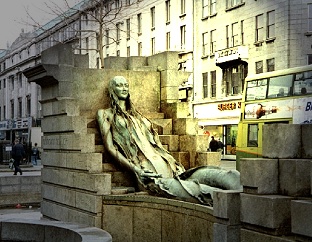 the Dublin public at large promptly called:
THE
FLOOZY IN THE JACUZZI
which really says it all.
In reality, it is a representation of Anna Livia which in turn is
James Joyce's representation of The Spirit of The Liffey.
Nelson's
Column, blown up by Republicans in 1966, stood in O'Connell St and there
must have been some pangs of remorse when the floozy appeared.
Liffey.
Nelson's
Column, blown up by Republicans in 1966, stood in O'Connell St and there
must have been some pangs of remorse when the floozy appeared.
I have to say that if any Republicans did have to take it upon
themselves to remove Nelson from their midst it is a puzzle as to why
they didn't remove just the statue and top the column with an Irish
patriot such as Daniel O'Donnell or Christy Moore. The other thing
is that if the English blew up every statue of everyone with Irish
connections then the streets would be noticeably bare.
By the way, the fountain running at the back is known as
Viagra
Falls.
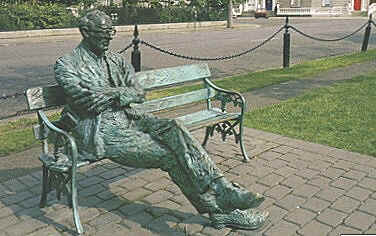


The
gent deep in thought is the poet Patrick Kavanagh seated by the
Grand Canal close to Baggot Street bridge.
The statue is typical of the way Dublin characters are portrayed in their
favourite haunts posed in just the way they would have appeared in real
life. Nobody knows who his mate is.
Interestingly, this statue is based on a true
incident in the life of the great poet when he sat on this very
bench for the whole of three days trying to think of a word to rhyme with
Guinness. After a passerby had fished him out of the canal his wife
was reported as saying, quote: " It's the last time I send you out
for a loaf Patrick Kavanagh ! : unquote.
I
have to say that I don't really like this depiction of the 18th
century Republican, Wolfe Tone whi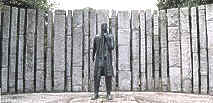 ch stands
on the corner of St Stephens green and the only reason I have included it
is as an example of modern art which just doesn't work
ch stands
on the corner of St Stephens green and the only reason I have included it
is as an example of modern art which just doesn't work
{ more about this later }. The front of the work which is not in
sight here is also in stone and all in all the whole thing takes up a
massive corner of this beautiful Georgian square. The locals
call it Tonehenge
but that's about the only
thing
of merit in the whole piece.
Right across the road is the house where Bram Stoker lived and fittingly
there is also a small Huguenot cemetery dating back to the 16th
century which make the Wolfe Tone monument even more incongruous.
St Stephens
green is right in the centre of Dublin comprising a beautiful garden full
of ponds and fountains and dotted 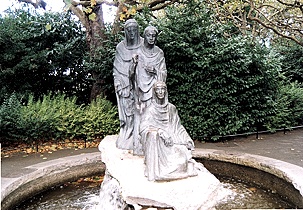 around
with statues. The whole of the garden is surrounded by Georgian
houses and the overall effect is of
around
with statues. The whole of the garden is surrounded by Georgian
houses and the overall effect is of
an opulence of yesteryear which is very much valued today.
The statue above is at the southern entrance and was a donation from the
German government. It is called " The Fates" and refers to
the Greek fates who held the threads of life. Deadly Nightshade has
the Latin name Atropa Belladonna after one of the three innocents depicted
here.
Just
around the corner and totally out of context, stands this statue
of an Indian brandishing what used to be a bow.The word Remington is
chiselled into the base and when I first came across this statue
I thought I had found a genuine Remington Indian on the streets of Dublin
and became quite beside myself. Frederic Remington, for those who don't know
is acknowledged as the greatest
of the Western artists and sculptors and his work is very much
in demand -- there is even a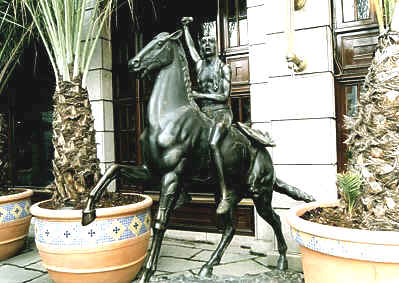
miniature bronze in the White House.
Sadly, this one is just a replica but it shows a rare taste for
the unusual and has scared a few late-night revellers.
The
tourist carriages at the entrance to the Green offering trips around the
city are in stiff competition with the shops in Grafton Street.
In particular, the famed Dunns has seen many a shopper enter its hallowed
halls ---not to re-emerge for days afterwards.
Just across the halfpe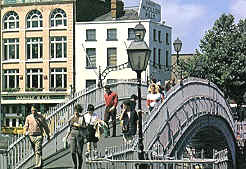 nny
bridge is the statue of the Hags With The
Bags which I thin
nny
bridge is the statue of the Hags With The
Bags which I thin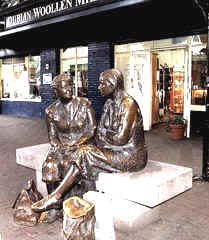 k is a bit cruel considering they could be anyone's Mum and Gran anywhere
---shame on you Dubliners. Wouldn't something like Mum
With Her Chum be a bit more acceptable.
k is a bit cruel considering they could be anyone's Mum and Gran anywhere
---shame on you Dubliners. Wouldn't something like Mum
With Her Chum be a bit more acceptable.
I suppose they are chatting about whatever women chat about everywhere
but rumour has it that one said to the other ;"Jeez Mary, These
new bags from Tescos are a bit on the heavy side" but one
thing's for sure -- they'll never have to worry about bag-snatchers. 
For anyone interested there's one of those old-fashioned, dusty bookshops just across
the Halfpenny bridge on the quay. The Halfpenny Bridge was built in 1816 and originally named the Wellington Bridge but even then the Dublin penchant for nicknames was apparent and Dubliners called it the Halfpenny Bridge for the toll which was levied for crossing. The toll was in place for over a century and only removed in 1919 but by this time the name was entrenched in Dublin folklore.
Whilst trying to keep an open mind and well aware
that most innovative art is always viewed with suspicion, I must admit
that I have a modicum of cynicism for so called
Modern Art. Of course, any debate on the su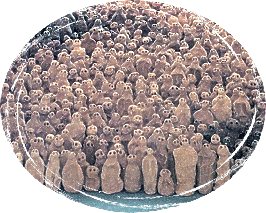 bject
must first of all establish what constitutes Modern Art -- for instance I
love Salvador Dali stuff but does his art fall into the parameters
of Modern Art given that his best work was carried out over 40 years ago
? I don't think so ---- -----the so-called Modern Art I
am referring to comes under the heading of works such as a heap of
bricks artfully placed which any brickie could manage quite easily or a
dead sheep in formaldehyde which wouldn't tax the average butcher and
Tracy Emin's bedroom which looks like she needs a smack off her Mum -- and so
on. I think that these things are pretentious at best and
exploitative at worst but I don't think either applies to the 35,000 clay
figures on the floor of the Tate by Anthony Gormley. They are simple and child-like and
they make me laugh so does that make them good art ?
bject
must first of all establish what constitutes Modern Art -- for instance I
love Salvador Dali stuff but does his art fall into the parameters
of Modern Art given that his best work was carried out over 40 years ago
? I don't think so ---- -----the so-called Modern Art I
am referring to comes under the heading of works such as a heap of
bricks artfully placed which any brickie could manage quite easily or a
dead sheep in formaldehyde which wouldn't tax the average butcher and
Tracy Emin's bedroom which looks like she needs a smack off her Mum -- and so
on. I think that these things are pretentious at best and
exploitative at worst but I don't think either applies to the 35,000 clay
figures on the floor of the Tate by Anthony Gormley. They are simple and child-like and
they make me laugh so does that make them good art ?
And in the context of this debate does it make them good Modern Art ?
So, although many innovative paintings have an obvious merit,
one or two of the colourful
daubings appear to be no more than just that -colourful daubings -
but I will mention no names because beauty is truly in the eye of the
beholder and worthy of respect for that reason alone. In respect of
sculpture, there is a trend to metal figures which appear to have been
welded together with bits from a scrap metal yard and melted in a
fire. There is a suspicion that the sculptor is unable
to reproduce the sleek and life-like lines of the traditional
classical statues and therefore extols the virtues of a lesser skill
in the name of Modernity. However, the sculptor who produced The
Immigrants has made a mockery of this viewpoint and employing all the
artifice of so-called Modern Art has produced an extremely moving interpretation of
a group of sufferers from the Famine. The bedraggled men and women
shuffle along the Dublin quay carrying their
pathetic possessions, moving from a dreadful past towards
an uncertain future invoking memories of the Irish holocaust.
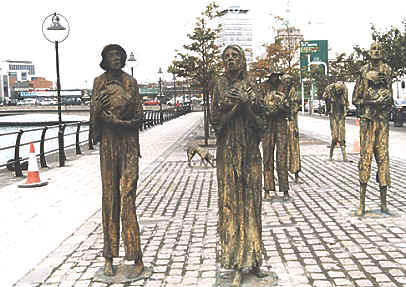
A plaque at the side of the scupture has been
signed by dozens of Irish notables from Daniel Day-Lewis to Liam Neeson.
The Great Famine
wasn't the first time that Ireland has suffered in this way --- in
1317 the population was reduced to cannibalism. The famine of the
1840's was caused primarily by potato blight [ a fungus disease} where the crops withered in
the fields. There was very little Poor Relief and Dublin was packed
with refugees looking for work and food. Many of them spilled over
into Liverpool and many managed to get a passage to America. Over
one million people died during the Famine and even now the population has
never full recovered.
After
the Great Famine of 1840, most of the Irish immigrants left for America on
the ships from Liverpool do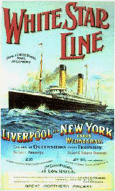 cks.
cks.
 Many of them never made it to the promised land and remained in Liverpool
; some of them were fleeced, some fell ill, others could not find work and
didn't go while others did find work and decided to remain.
Many of them never made it to the promised land and remained in Liverpool
; some of them were fleeced, some fell ill, others could not find work and
didn't go while others did find work and decided to remain.
The Irish immigrants who did stay enhanced the City of Liverpool in many
ways too complex to describe here but as a small example- just around the
corner from where I live are the cottages of Irish immigrants who quarried
the stone for Liverpool Cathedral. In the middle of them until quite
recently there was a large allotment where they grew vegetables and
livestock. This was owned and provided by the Sisters of Dublin who
never forgot their own even though they had moved away.
During
the late 1700's The British Empire was in its heyday and wherever there
was a British
co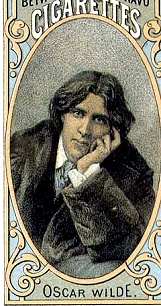 lony
then the British built a Little England. The remnants of these
can still be seen all over the world but some of the finest examples are
in Dublin and Merrion Square is one of the greatest examples of Georgian
architecture anywhere. Even the most biased Dubliner would admit to
the quality of architecture the British brought to the city. The square
consists of a central park surrounded by beautifully preserved
Georgian terraces immediately recognizable by their porticos and
distinctive and colourful, front doors. The Duke of Wellington lived
there as did W.B.Yeats and Bram Stoker was just around the corner.
And of course Oscar Wilde spent his childhood and formative years there in
No.1 { now the American College } and the park in the centre was his
playground where no doubt he often heard the clarion call of mother's
everywhere ;
lony
then the British built a Little England. The remnants of these
can still be seen all over the world but some of the finest examples are
in Dublin and Merrion Square is one of the greatest examples of Georgian
architecture anywhere. Even the most biased Dubliner would admit to
the quality of architecture the British brought to the city. The square
consists of a central park surrounded by beautifully preserved
Georgian terraces immediately recognizable by their porticos and
distinctive and colourful, front doors. The Duke of Wellington lived
there as did W.B.Yeats and Bram Stoker was just around the corner.
And of course Oscar Wilde spent his childhood and formative years there in
No.1 { now the American College } and the park in the centre was his
playground where no doubt he often heard the clarion call of mother's
everywhere ;
"Oscar, will
you get in here before your tea gets cold
!" ---or maybe not.
Merrion
Square is just littered with statues ----there's Bernardo O'Higgins, the
Irish Napoleon, Liam Neeson 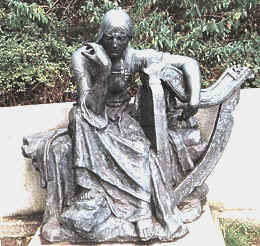 looking
remarkably like Michael Collins and the group below looking like refugees
from the ghost train.
The forlorn looking harpist in
the above shot is just one of the many statues to be found in Merrion
Square. When I first came across it tucked away in a corner I
new nothing about it at all and assumed the subject was a girl { say
what you like but I don't think its sexist to assume a skirt and long
hair add up to" female"} and gave it a ten
looking
remarkably like Michael Collins and the group below looking like refugees
from the ghost train.
The forlorn looking harpist in
the above shot is just one of the many statues to be found in Merrion
Square. When I first came across it tucked away in a corner I
new nothing about it at all and assumed the subject was a girl { say
what you like but I don't think its sexist to assume a skirt and long
hair add up to" female"} and gave it a ten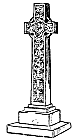 tative title of Reflections
On a Broken
Finger Nail
but it just goes to show how wrong you can be. The subject is
in fact Turlough OCarolan who lost his sight to smallpoxat the age of 18
but went on to become a famous Irish composer under the patronage of Mrs
MacDermott Roe of County Roscommon. He lived from1670 to 1738 so he
must have been an exceptional talent to be remembered after all these
years even if his records aren't exactly flying off the shelves at H.M.V.
Sorry about the mistake Turlough--------- but if you will insist on a
dress ....
tative title of Reflections
On a Broken
Finger Nail
but it just goes to show how wrong you can be. The subject is
in fact Turlough OCarolan who lost his sight to smallpoxat the age of 18
but went on to become a famous Irish composer under the patronage of Mrs
MacDermott Roe of County Roscommon. He lived from1670 to 1738 so he
must have been an exceptional talent to be remembered after all these
years even if his records aren't exactly flying off the shelves at H.M.V.
Sorry about the mistake Turlough--------- but if you will insist on a
dress ....
 The bust of
Constance Markievicz { difficult to say this without a double-entendre
} states
The bust of
Constance Markievicz { difficult to say this without a double-entendre
} states 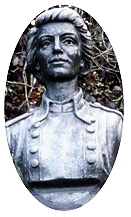 on
the plinth that she became a major in the " Irish Citizen Army
1910". More than that it is difficult to ascertain but I
suspect that
on
the plinth that she became a major in the " Irish Citizen Army
1910". More than that it is difficult to ascertain but I
suspect that
she was a Russian fellow-traveller in the days of Bolshevism.
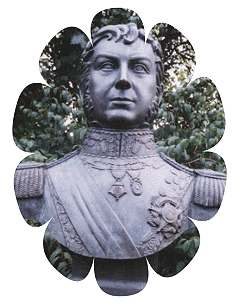
The other bust is
of Bernardo O'Higgins { circa 1778 ----1842 } who is revered in Chile for
being instrumental in the creation of an independent Chile. In this
representation the modest array of medals so becoming of all South
American Generals is apparent and despite his nebulous links with Ireland
he is celebrated as an Irish hero.
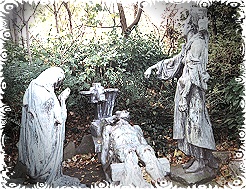
The other group
looking like refugees from the ghost train are another set of "melted
down" statues. I don't know why I put them in really
----I just remember them as being really scary. They are set back in an
alcove and coming across them unexpectedly at dusk is not to be
recommended.
I can resist
everything but temptation
The
American College at No .1 Merrion Square is right on the corner of the
square and was for many years home to Oscar Wilde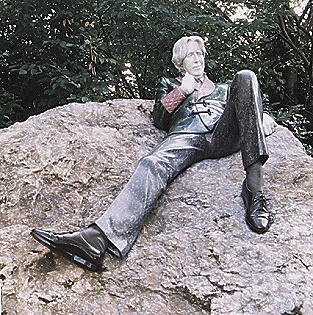 and his family. There is a huge blow-up picture of his mother
Speranza in the lobby and the College are busy renovating the whole house
with respect to the way it was when the Wildes lived there.
and his family. There is a huge blow-up picture of his mother
Speranza in the lobby and the College are busy renovating the whole house
with respect to the way it was when the Wildes lived there.
Right across the road is where Oscar used to play as a young boy and it is
here that the sculptor Danny Osborne has so fittingly sited his collage of
sculptures.
The first time I came
across Oscar's colourful figure reclining on a rock I was slightly
disappointed as I mistakenly thought the artist had reverted back to the
age-old artifice of embellishing his subject with paint which would
have been fair enough but a closer inspection reveals what makes this
statue so special and a unique work of art ; each of the elements
that go to make up the statue are carved in a different stone.
The trio of statues are full
of detail and there is a great deal of symbolism which is open to
interpretation ---there is a suspicion that the artist has been
capricious deliberately à la Oscar himself.
The statuary consists of not just Oscar but two bronzes on plinths --one
is a torso and the other a pregnant girl looking reproachfully back at the
reclining Oscar.
We are all in the gutter but
some of us are looking at the stars.
Before starting his work,
the artist Danny Osborne travelled extensively for several years to gather
the stone required and the resulting work of art has well justified his
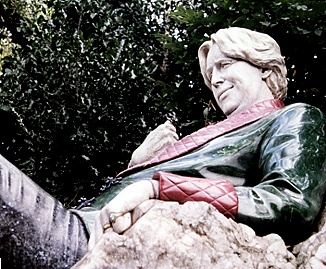
odyssey. Oscar is depicted at around 40 years of age. His face
is sculpted in porcelain and has an odd twisted look --- one side has been
sculpted sad and the other happy reflecting the duality of his nature.
His smoking jacket is Green Jade with the collar and cuffs made of the
very rare Pink Thulite { the rich colours are deliberate, simulating the
richness of Oscar's persona }. His trousers are Blue Pearl Granite
and his shoes are Black Pearl Indian Granite while his shoelaces { yes, it
is that detailed }, buttons and carnation are of bronze. The
carnation itself is an emblem of the amoral conventions of the era.
His shirt is porcelain as is his Trinity Old Boys tie while his porcelain
fingers boast the three rings that Oscar always wore ; his wedding ring
and two emerald scarabs, one representing joy and the other misfortune
One cannot have joy without
misfortune.
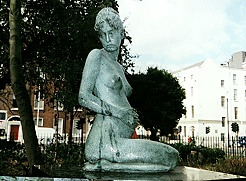
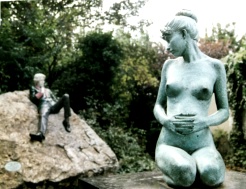 The two bronze nudes, one a
pregnant girl and the other a torso both seated on plinths
have been interpreted in several ways-- one theory has it that the girl is
Oscar's mother Speranza, Lady Francesca Wilde. A more complicated
theory has it that one pillar represents Art with the torso being
Dionysus or Bacchus and the other representing Life with a 6 month
pregnant Constance looking over her shoulder at Oscar ---his first
homosexual relationship took place at this time when she was carrying her
second child.
The two bronze nudes, one a
pregnant girl and the other a torso both seated on plinths
have been interpreted in several ways-- one theory has it that the girl is
Oscar's mother Speranza, Lady Francesca Wilde. A more complicated
theory has it that one pillar represents Art with the torso being
Dionysus or Bacchus and the other representing Life with a 6 month
pregnant Constance looking over her shoulder at Oscar ---his first
homosexual relationship took place at this time when she was carrying her
second child.
Oscar is looking through the two figures to the door of his home and it
could be said that he is looking through his present and into his past.
I think that God in creating
man somewhat overestimated his abilities.