 |
 |
 |
If you are not partial 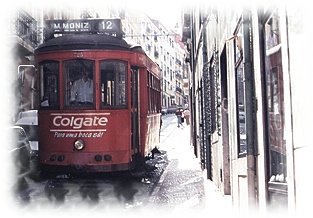 to
anything more strenuous than clambering upstairs to bed then Lisbon is
not the place for you. Most of the more interesting bits like the
Alfama district or St. Georges Castle involve ropes and pitons and in
the case of the Alfama are mostly inaccessible to traffic. The
lines of washing waving in the breeze have been put out by Lisboan
housewives with the agility of mountain goats but if you do fancy a
stroll through this beguiling quarter dating back to the M to
anything more strenuous than clambering upstairs to bed then Lisbon is
not the place for you. Most of the more interesting bits like the
Alfama district or St. Georges Castle involve ropes and pitons and in
the case of the Alfama are mostly inaccessible to traffic. The
lines of washing waving in the breeze have been put out by Lisboan
housewives with the agility of mountain goats but if you do fancy a
stroll through this beguiling quarter dating back to the M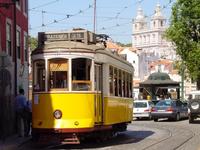 oorish
occupation then you will experience the nearest thing to a North African
medina outside Tangier { the "Al" part gives the clue to the
Arabic origins }. However, what you won't find are statues ---most
of the interesting ones are down on the waterfront. Anyway, round
about the end of the 19th century the whole of Lisbon must have
rejoiced when a comprehensive tramway system was introduced covering
nearly all of the city. Small brass plates screwed into the window
surrounds confirm that the tram cars were made in England and their
pristine condition testifies to the engineering skills of the late
Victorians. It's worth going to Lisbon just to see these remnants
from a byegone age trundling around the city, scaling the steepest
slopes and rounding the hairpin bends and in my own case it brings on a
severe attack of nostalgia for the times when I used to travel to school
in Liverpool on one of the "Green Goddesses" as they
were called after the Council livery. The City Council in it's
infinite wisdom did away with the Liverpool tram system in the 60's and
most of the citizens have mourned their passing { or non-passing }ever
since --- but that's another story. oorish
occupation then you will experience the nearest thing to a North African
medina outside Tangier { the "Al" part gives the clue to the
Arabic origins }. However, what you won't find are statues ---most
of the interesting ones are down on the waterfront. Anyway, round
about the end of the 19th century the whole of Lisbon must have
rejoiced when a comprehensive tramway system was introduced covering
nearly all of the city. Small brass plates screwed into the window
surrounds confirm that the tram cars were made in England and their
pristine condition testifies to the engineering skills of the late
Victorians. It's worth going to Lisbon just to see these remnants
from a byegone age trundling around the city, scaling the steepest
slopes and rounding the hairpin bends and in my own case it brings on a
severe attack of nostalgia for the times when I used to travel to school
in Liverpool on one of the "Green Goddesses" as they
were called after the Council livery. The City Council in it's
infinite wisdom did away with the Liverpool tram system in the 60's and
most of the citizens have mourned their passing { or non-passing }ever
since --- but that's another story.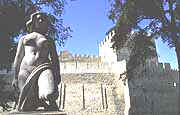 There must have been a city ordinance in place to combat the hills at
that time because not content with their shiny, new trams the Lisbon
council employed a certain Gustave Eiffel to construct an elevator in
the city centre where it still is today working as well as the day it
was opened.
There must have been a city ordinance in place to combat the hills at
that time because not content with their shiny, new trams the Lisbon
council employed a certain Gustave Eiffel to construct an elevator in
the city centre where it still is today working as well as the day it
was opened.The first fortification on this site was built by the Visigoths in the 5th Century. The Moors built over it in the 9th Century and the present castle of St.George was built after the capture of Lisbon from the Moors in 1147 by Afonso Henriques I have no idea who the brazen Amazon on the left is meant to represent but am not anticipating many complaints. |
|
Lisbon waterfront stretches for miles
alongside the River Tagus until it finally opens out into the Atlantic
and it is down here that most of the monuments are to be found.
Fittingly, they nearly all have some reference to exploration for it was
from here that many of the great explorations began and the Golden Age
of Portuguese colonialism had its foundation. The Padrão Dos
Descobrimentos { I only put that in to show off } or The Monum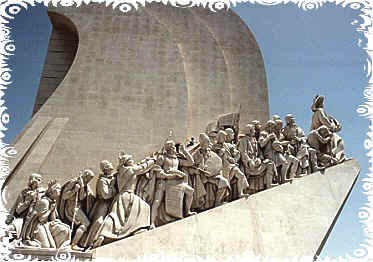 ent
to the Discoveries to you and me, dominates the river walk and is truly
splendid in every way. The monument was sculpted in 1960 and
commemorates the 500th anniversary of the death of Prince Henry the
Navigator. Henry was born in 1394 and was more of an entrepreneur
than a voyager. He sponsored voyages to the Indies, Africa and
possibly North America and combined a love of geography with the
acquisition of treasure from his discoveries. His School of
Navigation at Sagres w ent
to the Discoveries to you and me, dominates the river walk and is truly
splendid in every way. The monument was sculpted in 1960 and
commemorates the 500th anniversary of the death of Prince Henry the
Navigator. Henry was born in 1394 and was more of an entrepreneur
than a voyager. He sponsored voyages to the Indies, Africa and
possibly North America and combined a love of geography with the
acquisition of treasure from his discoveries. His School of
Navigation at Sagres w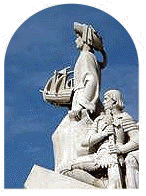 as
unique at that time. as
unique at that time.Henry was also fond of sailing small boats on the local pond as this close up of the Monument shows. The monument itself represents the prow of a ship
with Henry the
|
|
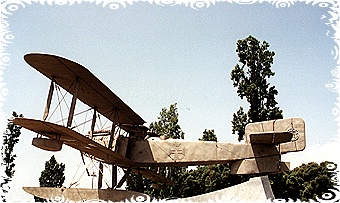 All
the great Portuguese explorers set off from this part of the river Tagus
where the Belem Tower stands and in 1922 Lt Commander Artur
Sacadura Cabral and Captain Carlos Gago Coutinho kept faith with
tradition when they set out to cross the Atlantic with no radio
aboard. The flight from Lisbon to Rio de Janeiro was the first air
crossing of the South Atlantic and their wood and canvas Fairey Seaplane
is reproduced here. All
the great Portuguese explorers set off from this part of the river Tagus
where the Belem Tower stands and in 1922 Lt Commander Artur
Sacadura Cabral and Captain Carlos Gago Coutinho kept faith with
tradition when they set out to cross the Atlantic with no radio
aboard. The flight from Lisbon to Rio de Janeiro was the first air
crossing of the South Atlantic and their wood and canvas Fairey Seaplane
is reproduced here. The 16th century Belem Tower was originally built as a fortress but it became a symbol to the early explorers of the place where they set off and the place where 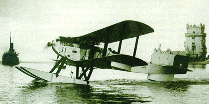 they would return. It was soon realised that it was more of a
folly than a fortress
they would return. It was soon realised that it was more of a
folly than a fortress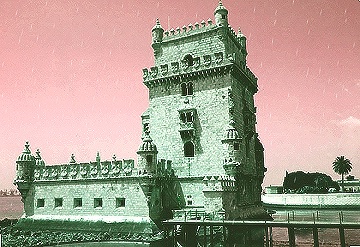 but the Lisboans took it to their hearts and that's how it remains to
this day ---beauty for it's own sake.
but the Lisboans took it to their hearts and that's how it remains to
this day ---beauty for it's own sake.And just to prove it here is a 1922 sepia showing the Fairey Seaplane about to take off with the Belem Tower on the right. |
|
Sintra
|
|
MafraAnyone who
loves the countryside will find it difficult to tear themselves away
from Sintra as it is jus
|
|
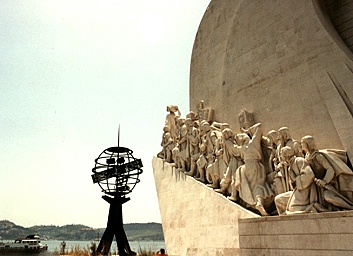 Navigator
looking out to sea followed by the varied knights and priests and
discoverers who followed him. In the foreground of the picture
next to the compass you can get some idea of the size of the sculpture
by the man looking out on the Tagus.
Navigator
looking out to sea followed by the varied knights and priests and
discoverers who followed him. In the foreground of the picture
next to the compass you can get some idea of the size of the sculpture
by the man looking out on the Tagus.
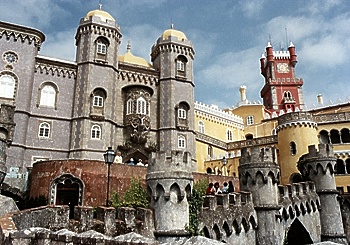
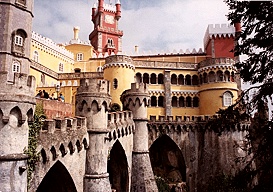
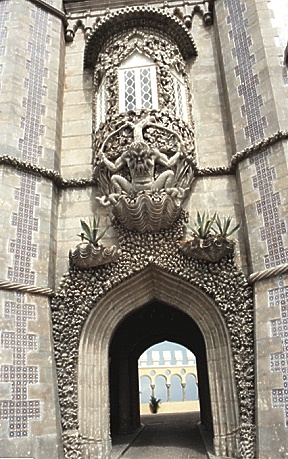 While
Sintra town is quite pretty, it is in the surrounding hills of the Serra
de Sintra that the real interest lies. There are three castles in
those hills, each from a different era and each with a totally unique
architecture. The one at the very summit, 1500 feet above sea
level, was once the site of a monastery built in 1511 and destroyed by
the great earthquake of 1755. The castle that stands there now is
the outrageously eccentric folly built in 1839 by King Consort,
Ferdinand of Saxe-Gotha for his queen, Maria the Second. The
architect was a Baron von Eschwege who borrowed heavily from those other
extravaganzas in his native Bavaria, added a spice of Camelot, Hollywood
style, and topped it off with a dash of Snow White's castle in
Disneyland. The resulting mish-ash would never have
repelled any even half-hearted invaders but perhaps Ferdinand hoped they
would laugh themselves to death.
While
Sintra town is quite pretty, it is in the surrounding hills of the Serra
de Sintra that the real interest lies. There are three castles in
those hills, each from a different era and each with a totally unique
architecture. The one at the very summit, 1500 feet above sea
level, was once the site of a monastery built in 1511 and destroyed by
the great earthquake of 1755. The castle that stands there now is
the outrageously eccentric folly built in 1839 by King Consort,
Ferdinand of Saxe-Gotha for his queen, Maria the Second. The
architect was a Baron von Eschwege who borrowed heavily from those other
extravaganzas in his native Bavaria, added a spice of Camelot, Hollywood
style, and topped it off with a dash of Snow White's castle in
Disneyland. The resulting mish-ash would never have
repelled any even half-hearted invaders but perhaps Ferdinand hoped they
would laugh themselves to death.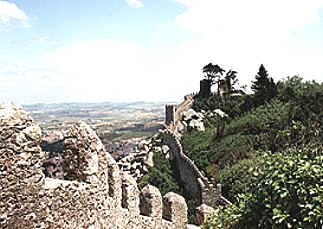
 t
on the edge of a beautiful and vast National Park which can be seen from
the ramparts of the Pena Palace. But we are supposed to be looking
for statues and the next one of any note is about 20 kilometres up the
road in a place called Mafra. The tiny town is dominated by
an absolutely monolithic monastery, dating from 1711 --- there were four
and a half thousand windows at the last count which gives some idea of
the size of this place. During the Peninsular War this whole area
was teeming with with the comings and goings of French and British
troops and the monastery was for a short time a barracks for the French
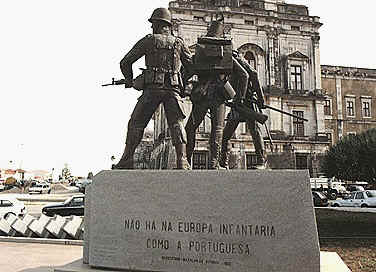
troops. The British and Portuguese alliance was always a feature
in any of the battles of the Peninsular War and the defence of Lisbon
was just another example of this cooperation. Wellington's genius
for creating a defensive position was never more in evidence than in the
defence of Lisbon and his strategy required the use of British and P
t
on the edge of a beautiful and vast National Park which can be seen from
the ramparts of the Pena Palace. But we are supposed to be looking
for statues and the next one of any note is about 20 kilometres up the
road in a place called Mafra. The tiny town is dominated by
an absolutely monolithic monastery, dating from 1711 --- there were four
and a half thousand windows at the last count which gives some idea of
the size of this place. During the Peninsular War this whole area
was teeming with with the comings and goings of French and British
troops and the monastery was for a short time a barracks for the French
troops. The British and Portuguese alliance was always a feature
in any of the battles of the Peninsular War and the defence of Lisbon
was just another example of this cooperation. Wellington's genius
for creating a defensive position was never more in evidence than in the
defence of Lisbon and his strategy required the use of British and P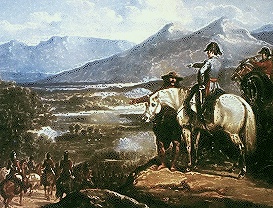 ortuguese
troops and civilians in the creation of the earthworks known forever as
The Lines of Torres Vedras. The defences began at Mafra and
stretched north in a series of concentric lines reaching from the
Atlantic to the Tagus. The redoubts and bulwarks were so thorough
and so large that they changed the contours of the land forever and many
of the redoubts and trenches can still be seen today.
ortuguese
troops and civilians in the creation of the earthworks known forever as
The Lines of Torres Vedras. The defences began at Mafra and
stretched north in a series of concentric lines reaching from the
Atlantic to the Tagus. The redoubts and bulwarks were so thorough
and so large that they changed the contours of the land forever and many
of the redoubts and trenches can still be seen today. 
 I'm
always glad to hear from fellow travellers
so if you
have any comments to make or have a question I may be able to answer or
know of statues I should be looking at then e-mail at ;
I'm
always glad to hear from fellow travellers
so if you
have any comments to make or have a question I may be able to answer or
know of statues I should be looking at then e-mail at ;