|
Much of the charm and architectural heritage of this
unique city is derived from the craggy nature of the hills and valleys
it is based upon. Steep and winding roads end in precipitous
drops, enticing wynds { courtyards } all have intriguing steps up or
inviting steps down, winding to who knows where, while the valleys look
up to impossibly high escarpments up in the clouds. A cursory
visitor might think that the whole conglomeration has been laid down
upon the most inhospitable chunk of realty in the whole of Scotland but
with the realisation that the whole area was once a cluster of volcanoes
{
now extinct } the topography of Edinburgh becomes immediately clear.
 On the very pinnacle of the tallest of these ancient volcanoes the
Castle dominates the area for miles around while the buildings below the
summit cling to the rocky slopes where nature allows -- lean over
the wall to the rear of the Castle and it's a vertical cliff face all
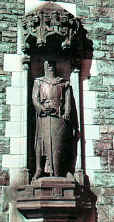
the way to the bottom. Visitors to the Castle must first pass the
stern gaze of William Wallace and Robert the Bruce who have stood in
their niches either side of the gate since 1929. The Castle itself is a fascinating
repository of historical events and memorabilia while still retaining a
viable military
On the very pinnacle of the tallest of these ancient volcanoes the
Castle dominates the area for miles around while the buildings below the
summit cling to the rocky slopes where nature allows -- lean over
the wall to the rear of the Castle and it's a vertical cliff face all
the way to the bottom. Visitors to the Castle must first pass the
stern gaze of William Wallace and Robert the Bruce who have stood in
their niches either side of the gate since 1929. The Castle itself is a fascinating
repository of historical events and memorabilia while still retaining a
viable military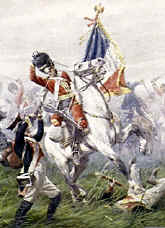 presence. The several regimental museums are
superb and jam-packed with valuable objects from the many wars that
Scottish regiments have always distinguished themselves in. The
value of the artifacts is not always of a pecuniary nature ----how do
you put a price on a jacket from the field of Waterloo with two bullet
holes in the back and the powder burns still evident and how do you
price a saddle with a bullet still lodged in the leather? To
Scottish military historians the French Eagle and Standard carried from
the field of battle at Waterloo are priceless and they are a centre-piece
and pride of the Scots Greys exhibits. Ensign Charles Ewart's feat
of arms in capturing the Eagles is legendary and there they are as fresh
as if they had been captured yesterday. Ensign Ewart's grave on
the esplanade is marked by a granite stone and he would probably have
approved greatly of the Ensign Ewart pub just below the Castle entrance. presence. The several regimental museums are
superb and jam-packed with valuable objects from the many wars that
Scottish regiments have always distinguished themselves in. The
value of the artifacts is not always of a pecuniary nature ----how do
you put a price on a jacket from the field of Waterloo with two bullet
holes in the back and the powder burns still evident and how do you
price a saddle with a bullet still lodged in the leather? To
Scottish military historians the French Eagle and Standard carried from
the field of battle at Waterloo are priceless and they are a centre-piece
and pride of the Scots Greys exhibits. Ensign Charles Ewart's feat
of arms in capturing the Eagles is legendary and there they are as fresh
as if they had been captured yesterday. Ensign Ewart's grave on
the esplanade is marked by a granite stone and he would probably have
approved greatly of the Ensign Ewart pub just below the Castle entrance.
The number and quality of exhibits is difficult to absorb in one day but
there are particular treasures which stand above all others ---- the
French Eagles are one and the painting of The Thin Red Line is
another. What makes the painting so unique is that the museum
curators do not seem to attribute any particular importance to the
tableau and certainly don't advertise its presence, so to come across a cinemascopic and colourful work of art
so unexpectedly is stunning
to say the least. What is even more stunning is that it is not
under glass or metres away from the viewer and you can actually press
your nose up to one of the finest works of military art ever
known. The Thin Red Line was the sobriquet attributed to the
Sutherland Highlanders at Balaklava in 1854 when they averted a major
disaster by standing before a Russian Cavalry charge. Their
Colonel, Sir Colin Campbell laid down their orders in no uncertain terms
with the famous lines;
"There is no retr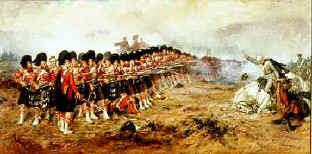 eat from here, boys. You must die where you
stand". eat from here, boys. You must die where you
stand".
Hollywood has been borrowing the phrase for years in many
different guises and unashamedly adopting the title of the work for film
titles------ some would say it was a compliment but it depends what film
you are watching.
The painting by Robert Gibbs was exhibited two
years after Balaklava and several of the participants in the battle
posed for the picture ----the last participant of the Thin Red Line died
in Chelsea Hospital in 1927.
There are other stunning paintings next to Gibbs's work with the superb
tableau of the defence of Hougoumont { again at Waterloo } outstanding.
Mons Meg, The One O'Clock Gun, cannons galore, the Scottish National war
Memorial and so much more -----it's worth coming to Edinburgh just to
see the Castle and there are many who do so.
 The famous Royal Mile runs from the Castle the whole length of the
mountainside and spills out into the valley below into the equally
The famous Royal Mile runs from the Castle the whole length of the
mountainside and spills out into the valley below into the equally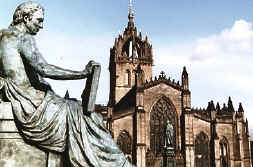 famous grounds and Palace of Holyrood House. Between Castle and
Palace, the Royal Mile can justifiably claim to be one of the finest
streets if not the finest in Europe, with a warren of medieval
buildings, courtyards, churches and artifacts second to none; there are
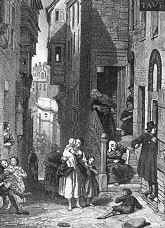
fountains where they once burnt witches and there are subterranean
houses abandoned to the plague and every tavern has its ghost and every
building has a tale to tell -- Cannonball House is just one of
many. Standing just outside the castle with a cannonball embedded
in the brickwork the story goes that when the Castle was being defended
from Bonnie Prince Charlie who was esconced in Holyrood House { 1744 }
the guns firing down the Royal Mile were less than accurate and their
handiwork is there for all to see.
famous grounds and Palace of Holyrood House. Between Castle and
Palace, the Royal Mile can justifiably claim to be one of the finest
streets if not the finest in Europe, with a warren of medieval
buildings, courtyards, churches and artifacts second to none; there are
fountains where they once burnt witches and there are subterranean
houses abandoned to the plague and every tavern has its ghost and every
building has a tale to tell -- Cannonball House is just one of
many. Standing just outside the castle with a cannonball embedded
in the brickwork the story goes that when the Castle was being defended
from Bonnie Prince Charlie who was esconced in Holyrood House { 1744 }
the guns firing down the Royal Mile were less than accurate and their
handiwork is there for all to see.
The High Kirk of St Giles has
stood near the top of the Mile for centuries. The Scottish
reformer and orator John Knox is best known of the cathedrals ministers
and his house is just a few yards across the road. The cathedral
is a living history book with a memorial window to Robert Burns, another
to Moray, the half-brother of Mary Queen of Scots and the Montrose and A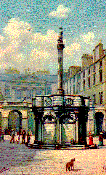 rgyll windows bear witness to the Covenanting period.
The tomb of the Marquess of Argyll can be found within a side chapel and
if you don't recall the name then think Rob Roy and Tim Roth ---he
played the part of the evil Marquess. It's
difficult to imagine the effect that religious differences made to the
lives of the highest and the lowest in medieval times but it permeated
life at every level and many lost their lives defending obscure
interpretations of text and style in the Bible and many lost their lives
resisting English dictates foisted upon the Scottish church. The
Mercat Cross, standing next to the cathedral was once a trading place
and a site of public torture ----proclamations are still made from there
on state occasions. rgyll windows bear witness to the Covenanting period.
The tomb of the Marquess of Argyll can be found within a side chapel and
if you don't recall the name then think Rob Roy and Tim Roth ---he
played the part of the evil Marquess. It's
difficult to imagine the effect that religious differences made to the
lives of the highest and the lowest in medieval times but it permeated
life at every level and many lost their lives defending obscure
interpretations of text and style in the Bible and many lost their lives
resisting English dictates foisted upon the Scottish church. The
Mercat Cross, standing next to the cathedral was once a trading place
and a site of public torture ----proclamations are still made from there
on state occasions.
The pavement in front of the Cathedral is
cobbled to represent a heart inspired by Sir Walter Scott's great novel
The Heart of Midlothian. The heart signifies the place where the Tolbooths once stood
and executions took place---- it is traditio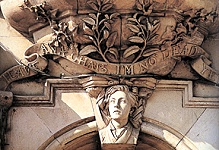 nal but not not obligatory
to spit upon the cobbles as a gesture of defiance for the institutions
which once stood here. nal but not not obligatory
to spit upon the cobbles as a gesture of defiance for the institutions
which once stood here.
Across the road is Deacon Brodie's pub which was once the home of a
pillar of the community by day and a thief by night. In the 18th
century his reputation was notorious until he was hanged across the road
in front of the Cathedral.
Robert Louis Stevenson took Brodie's
duality as a model for his novel Dr Jekyll and Mr Hyde. A little further down is a sculptured lintel over a doorway with the
strange plea chiselled underneath a head and shoulders "Heave
awa chaps, I'm not dead
yet". The sculpture is a reminder that this
section of houses once fell down and that the man chiselled into the
lintel was trapped beneath the debris.
If the Royal Mile can be described as the front of the castle then to
one side and far below is the Bohemian quarter called the Grassmarket
where chic boutiques stand cheek by jowl with ancient taverns all
looking out over the large paved square 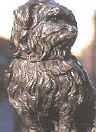 which was once a place of
butchery and torture carried out in the name of religion. There's
a stone monument recalling the dreadful ordeals of The Covenanters in
the 1600's----many of them are buried in the adjacent Kirk of the
Greyfriars cemetery where
they were imprisoned for months on end. The Covenanters were
persecuted for refusing to worship in the manner laid down by the
English and paid for it with their lives ----the Grassmarket retains a
sombre atmosphere still, despite the taverns and pubs. The
cemetery wall where hundreds of Covenanters were also imprisoned can be
seen clearly from the Grassmarket. Fortunately, there are cheerier
tales to be told behind the same walls and one of them is the story of
Greyfriars Bobby, the tiny Skye Terrier who faithfully visited his
masters grave for a whole 14 years. He was buried next to his
master in 1872 and his statue can be seen outside the gates on
Candlemaker Row. which was once a place of
butchery and torture carried out in the name of religion. There's
a stone monument recalling the dreadful ordeals of The Covenanters in
the 1600's----many of them are buried in the adjacent Kirk of the
Greyfriars cemetery where
they were imprisoned for months on end. The Covenanters were
persecuted for refusing to worship in the manner laid down by the
English and paid for it with their lives ----the Grassmarket retains a
sombre atmosphere still, despite the taverns and pubs. The
cemetery wall where hundreds of Covenanters were also imprisoned can be
seen clearly from the Grassmarket. Fortunately, there are cheerier
tales to be told behind the same walls and one of them is the story of
Greyfriars Bobby, the tiny Skye Terrier who faithfully visited his
masters grave for a whole 14 years. He was buried next to his
master in 1872 and his statue can be seen outside the gates on
Candlemaker Row.
 On the other side of the Castle is a far more pleasant place where
tourists and locals alike soak up what whatever Scotland has to offer in
the way of sunshine. Princes Gardens is the peaceful heart
and lungs of the
city and the dividing line between the Old Town and The New Town.
On the other side of the Castle is a far more pleasant place where
tourists and locals alike soak up what whatever Scotland has to offer in
the way of sunshine. Princes Gardens is the peaceful heart
and lungs of the
city and the dividing line between the Old Town and The New Town.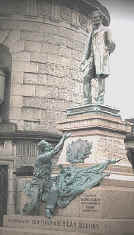
In the distance can be seen another volcanic outcrop and it would be a
jaded tourist indeed who did not find himself anxious to discover the
meanings of the strange and tantalising shapes. Edinburgh doesn't
give up its secrets easily and although Calton Hill isn't far away
there's still numerous steps to ascend before the mystery of the follies
on the hilltop can be deciphered. Surprisingly, the hill has never
been built upon and remains home to a jumble of the oddest buildings to
be found anywhere. There's an air of dereliction about Calton
----- it's the rural version of Miss Havershams, old and musty and
slowly decaying. The Observatory built in 1818 is in in
remarkably good nick but as a window on the stars is possibly now more
of a monocle on the stars, awaiting some inspirational transformation
----it's a museum piece of the world of astronomy made so not just by
the passage of time but by the smoke from the trains heading into
Waverly Station. The slimline,
circular building looking like an inverted telescope was built even
earlier, in 1807, and commemorates Nelson's victory at Trafalgar.
It's open to the public but very few accept the invitation to enter and
clamber up yet more stairs to see yet another fine view. Standing
on the very summit of the hill is the strangest of all the follies to be
seen, The National Monument. The Monument was meant to
commemorate Scottish valour during the Napoleonic Wars but it's
difficult to to work out how a replica of the
Parthenon in Athens came to represent Scotland's finest. The prime
movers for this folie de grandeur were Sir Walter Scott, Sir Henry
Cockburn and Lord Elgin and in 1822 they proposed that " a
facsimile of the Parthenon" should be built by public
subscription. Knowing his track record in Greek follies suspicions
should have been aroused when Lord Elgin threw his hat in the ring but
the good people of Edinburgh had more to do with their hard-earned
pennies than to throw it at rich man's playthings and only 12 columns were ever erected but they are truly fine
examples of the genre even if they are more of a Monument to
mismanagement than anything else. The Hellenic theme was still in
vogue when the Dugald Stewart Monument was built in the classical
circular tombs much favoured by the Greeks ---this one is a copy of the
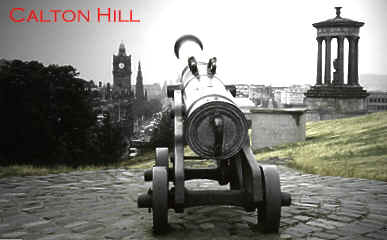
tomb of Lysicrates in Athens. And dropped among them all, a cobwebby cannon looking less
than menacing, points directly onto Princes St. And overall,
Calton Hill has the impression of a giant's playground with the toys
abandoned and littered aroun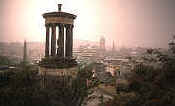 d until someone new finds a use for them. d until someone new finds a use for them.
Alexander Graham Bell went to school on the hillside at The
Edinburgh Royal High School which stands sadly abandoned like so many
things on Calton Hill ----- his school career was
undistinguished. The number of luminaries who lived and studied in
the city is incredibly varied including, Sir Walter Scott { Ivanhoe }, James Hutton { geology }, Adam Smith {
got one of his fireplaces-well a copy }, Thomas Telford { the Menai Bridge}, Robert Louis
Stevenson {Kidnapped }, Muriel Spark { The Prime of Miss Jean Brodie },
Harry Lauder { keep right on to the end of the road }, Annette Crosbie {
Queen Victoria }, Boswell { liked a pint in the Cheshire Cheese} and of
course Sean Connery who is probably more famous than all the others put
together ---quite what that says about our values is open to
interpretation. Apart from all these notables the University
boasts an incredible number of notables who have passed through its
hallowed halls from Charles Darwin onwards.
Across the road and at the base of the hill is the old burial ground
which is very little visited but has some grand views of the hill, the
tomb of David Hume and a great statue of Lincoln which deserves to be
far better sited and far better known. It commemorates the Scots
who fought in the American Civil war.
Robert Louis Stevenson spent many an hour upon Calton Hill and wrote in
fulsome praise of "forests of masts" on the Forth and the
magnificent views and so on but what he didn't tell his avid readers is
that his articles were inspired more by the assignations he had with
prostitutes on the hill far more than any aesthetic reasons he may have
given.
There is a definite sense of permanence and solidity about Edinburgh;
the ancient rocks and crags are complemented by the massive and
formidable masonry of the city and as if that's not enough the
plethora of Victorian artifacts scattered around further reinforces the
air of indestructibility. Before eyebrows are raised at the very
idea of Victorian buildings in such a Scottish stronghold it
should be recalled that Victorian heritage and values were never
confined to London or England ---- Victoriana can still be seen
throughout what was once the British Empire and everywhere that the map
was coloured pink there are statues of Victoria herself and examples of
Victorian building techniques. In fact, I would go so far as to
say that there are more statues of Victoria, seated, standing, or
on horseback than of anyone else I can think of and they can be
found in Australia, Canada, India and anywhere that the Empire
flourished.
The mixture of Scottish heritage and architecture melded with Victorian
heritage and architecture works very well in Edinburgh 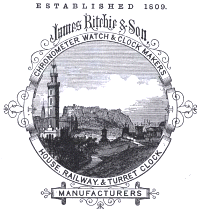 and although
there are many who would deny it there is a great similarity between the
two. Princes Street Gardens are a fine example of archetypal
Victorian gardens, combining bedding schemes, shrubberies and statuary
interspersed with cunningly sited pathways leading the promenader
unwittingly to all of them. The floral clock is renowned as the
oldest in the world and the timepiece is maintained by the venerable
firm of James Ritchie and Sons who also maintain every other timepiece
of any note in the city. It was the firm of Ritchie which
installed the Time Ball in the Nelson Monument on Calton Hill which
drops each day at precisely 1p.m and connects with the Castle to fire
the one o'clock gun at the correct time. The floral clock is an
intricate arrangement of thousands of plants which can be
trimmed and planted to form a picture or theme and examples can be found
in Niagara, Dieppe, Liverpool and many other places willing to take the
time and trouble to create them. The plants are one thing but the
clockwork is another and this was installed originally by the ubiquitous
firm of James Ritchie consisting of an intricate arrangement of
incredibly heavy weights and pulleys ---quite enough to kill a man if
handled wrongly. Just recently, the ancient works have been
replaced by an electric motor to the relief of anyone who has ever had
to maneouvre the original weights. Princes Street was just one of
the places that Madame Tussaud exhibited her wax figures in the days
when Tussaud's was a travelling show and it was to James Ritchie and
Sons that MadameTussaud went to have her watch mended circa 1805.
and although
there are many who would deny it there is a great similarity between the
two. Princes Street Gardens are a fine example of archetypal
Victorian gardens, combining bedding schemes, shrubberies and statuary
interspersed with cunningly sited pathways leading the promenader
unwittingly to all of them. The floral clock is renowned as the
oldest in the world and the timepiece is maintained by the venerable
firm of James Ritchie and Sons who also maintain every other timepiece
of any note in the city. It was the firm of Ritchie which
installed the Time Ball in the Nelson Monument on Calton Hill which
drops each day at precisely 1p.m and connects with the Castle to fire
the one o'clock gun at the correct time. The floral clock is an
intricate arrangement of thousands of plants which can be
trimmed and planted to form a picture or theme and examples can be found
in Niagara, Dieppe, Liverpool and many other places willing to take the
time and trouble to create them. The plants are one thing but the
clockwork is another and this was installed originally by the ubiquitous
firm of James Ritchie consisting of an intricate arrangement of
incredibly heavy weights and pulleys ---quite enough to kill a man if
handled wrongly. Just recently, the ancient works have been
replaced by an electric motor to the relief of anyone who has ever had
to maneouvre the original weights. Princes Street was just one of
the places that Madame Tussaud exhibited her wax figures in the days
when Tussaud's was a travelling show and it was to James Ritchie and
Sons that MadameTussaud went to have her watch mended circa 1805.
There are numerous statues in the gardens but the crowning glory is at
the furthest end and could be easily missed by the less intrepid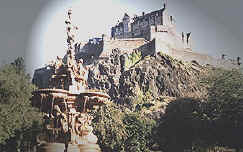 tourist
---this is the Ross Fountain. When Napoleon the Third and his
Empress Eugénie were in power in France they vied with Victorian
England in many ways and one of them was the series of Great
Exhibitions both countries held { these also spread throughout the
Empire and the remnants of Great Exhibitions can be seen in many
Commonwealth countries today, notably Toronto and India }. The
Great Exhibition of Paris in 1862 was a grand affair with many works of
art on show. The statuary was particularly excellent and after the
Exhibition was over many of them found other homes throughout Paris
where they can be seen today outside the Biblioteche Nationale and the
Musee D'Orsay among others but The Ross Fountain is probably the
furthest travelled from its original home in Paris where it had been
cast in iron by Durenne especially for the tourist
---this is the Ross Fountain. When Napoleon the Third and his
Empress Eugénie were in power in France they vied with Victorian
England in many ways and one of them was the series of Great
Exhibitions both countries held { these also spread throughout the
Empire and the remnants of Great Exhibitions can be seen in many
Commonwealth countries today, notably Toronto and India }. The
Great Exhibition of Paris in 1862 was a grand affair with many works of
art on show. The statuary was particularly excellent and after the
Exhibition was over many of them found other homes throughout Paris
where they can be seen today outside the Biblioteche Nationale and the
Musee D'Orsay among others but The Ross Fountain is probably the
furthest travelled from its original home in Paris where it had been
cast in iron by Durenne especially for the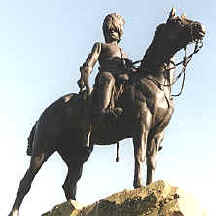 Exhibition. Scottish
gunsmith Daniel Ross of Scotland was much taken with the fountain and
purchased it and had it transported to Edinburgh where he donated it to
the city and it has stood in its present home since 1870 --- as a
holiday souvenir it takes some beating and leaves my tiny Eiffel Tower
looking just a little paltry. Exhibition. Scottish
gunsmith Daniel Ross of Scotland was much taken with the fountain and
purchased it and had it transported to Edinburgh where he donated it to
the city and it has stood in its present home since 1870 --- as a
holiday souvenir it takes some beating and leaves my tiny Eiffel Tower
looking just a little paltry.
Throughout the world, War Memorials are almost always sited within
beautiful settings and by their very nature they inspire moving and
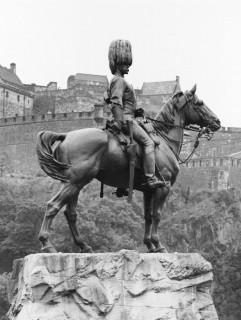
inspirational sculpture. Princes St Gardens contains several excellent
War Memorials but the majestic equestrian figure atop the Scots Grey
memorial to the Boer war is outstanding.
The Memorial to the First World War is excellent also and the sculptor
has managed to avoid the usual cliched scenarios but the imperious Scots
Greys equestrian statue overlooking Princes St would take some beating.
There is a Black Watch Memorial on the curved slope up towards the
University but I was too busy administering first-aid to out-of -breath
Japanese tourists to raise my camera. Its a great position to site
a statue but getting pictures are tough enough when you're knackered without the danger of being knocked over by a bus as well.
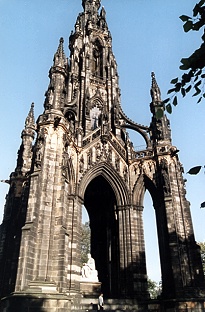
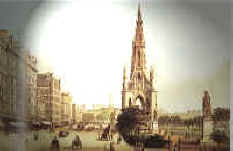
At the opposite end of the gardens stands the Scott Memorial, the very
epitome of Gothic Victoriana commemorating one of Edinburgh's greatest
literary figures, Sir Walter Scott, who lived jut a stone's throw away
as a child. The Memorial was erected in 1840, just 8 years after
the death of the great man. The Monument is to all intents and
purposes a cathedral in miniature devoted to one man and his works, with
a latticework of stone plinths and a steeple reaching to the stars
looking like a Jules Verne rocketship in stone.
Beneath the canopy, a statue of Scott is seated with his faithful
staghound Maida by his side and secreted in every corner of the masonry
are 60 statuettes from his works. These can be seen in more detail by
climbing the winding staircase within the building ----- a little
reminder for the city fathers that anyone arriving in Edinburgh should be issued with a piton and
climbing boots to comply with the national compulsion for clambering up
things. George Meikle Kemp was the architect who unfortunately
never saw his creation come to fruition as he drowned in the Union Canal
during construction leaving others to fulfil his plans. The
Monument was renovated in recent years but the work never included a
clean up of the stonework and the black masonry remains as a reminder of
why Edinburgh was called Auld Reekie.
Still in the precincts of the garden are the
neo-classical temples of The Royal Scottish Academy which is surmounted
by ---surprise, surprise, a statue of Queen Victoria--- and The National
Gallery of Scotland stands adjacent with both buildings erected
circa 1826.
 Most
tourists are so traumatised by the climb up to the north face of Calton
Hill that they rarely make it to Picardy Place which is tucked away in
the foothills which is a pity as there are a number of sculptures in
front of the old St.Mary's Roman Catholic Cathedral well wo Most
tourists are so traumatised by the climb up to the north face of Calton
Hill that they rarely make it to Picardy Place which is tucked away in
the foothills which is a pity as there are a number of sculptures in
front of the old St.Mary's Roman Catholic Cathedral well wo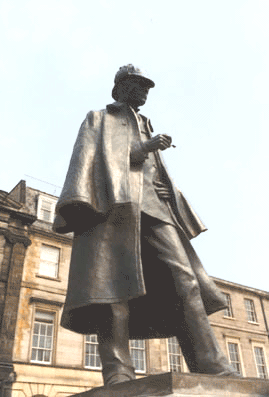 rth
the visit. Sir Eduardo Paolozzi was born in Leith in 1924 of
Italian parentage and went on to make his name with his many sculptures
dotted around London - the first thing that visitors arriving by train
into Euston station will see is Paolozzi's statue of 'Piscator'.
Paolozzi's work is difficult to define varying wildly from modernistic
to conventional---his statue of Newton outside the New British Library
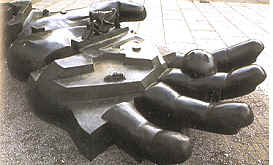
exhibits very little similarity to Piscator. His figures of a hand
and a foot in Picardy Place are modernistic ---- most people like them
or hate them. They are among the last of Paolozzi's work --- he
died in 2005. rth
the visit. Sir Eduardo Paolozzi was born in Leith in 1924 of
Italian parentage and went on to make his name with his many sculptures
dotted around London - the first thing that visitors arriving by train
into Euston station will see is Paolozzi's statue of 'Piscator'.
Paolozzi's work is difficult to define varying wildly from modernistic
to conventional---his statue of Newton outside the New British Library
exhibits very little similarity to Piscator. His figures of a hand
and a foot in Picardy Place are modernistic ---- most people like them
or hate them. They are among the last of Paolozzi's work --- he
died in 2005.
The nearby statue of Sherlock Holmes by Gerald Ogilvy Laing is a far
more conventional sculpture commemorating the birth in 1859 of Sir
Arthur Conan Doyle. The creator of the great sleuth was brought up
in a now demolished tenement in the middle of the square. Laing's
sculpture has a thoughful Holmes meditating upon the death of his
creator. At the base of the statue is a single paw-print
representing The Hound of The Baskervilles--- it's little touches like
this which give a work of art that sparkle of inspired magic.
Back in the vicinity of the Royal Mile
and right at the very bottom of the sloped and curving street stands
Holyrood House with its façade 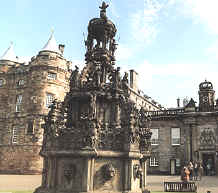 facing defiantly up towards the
castle. In complete contrast to the ancient stones of Holyrood,
history has yet to be made in the gleaming and ultra-modern Scottish
Parliament building designed by the late Enric Muralles standing just
across the road . The
building has yet to be accepted by the citizens of Edinburgh who are
quite rightly suspicious of anything which compromises or threatens the
integrity of the historical topography of the city but in fairness to
the architect his avowed intention has been to invest the building with
what he called "Scottishness". Part of that "Scottishness"reveals
itself in the form of epigrams and quotes chiselled into an eclectic
collection of marble, sandstone, granite and slate blocks on the
Canongate side of the building. Predictably, all the quotes are by
Scots, among them Robert Louis Stevenson, Charles Rennie Mackintosh, Sir
Walter Scott, Andrew Carnegie, Robbie Burns et al. There is one which stands out and for me
and Hugh Ma Diarmid's opening line; "But
Edinburgh is a mad God's dream". sums up the city
succinctly. The Parliament building of necessity integrated or one
might say "ate up" the 17th century Queensbury House which
stood on the site. It wasn't the only thing "eaten up"in
this vicinity ----- during the signing of the union in the ancient
house, Lord Drumlanrig who had escaped his customary restraints was
found in the kitchen eating the servant boy who was slowly roasting over
a spit. facing defiantly up towards the
castle. In complete contrast to the ancient stones of Holyrood,
history has yet to be made in the gleaming and ultra-modern Scottish
Parliament building designed by the late Enric Muralles standing just
across the road . The
building has yet to be accepted by the citizens of Edinburgh who are
quite rightly suspicious of anything which compromises or threatens the
integrity of the historical topography of the city but in fairness to
the architect his avowed intention has been to invest the building with
what he called "Scottishness". Part of that "Scottishness"reveals
itself in the form of epigrams and quotes chiselled into an eclectic
collection of marble, sandstone, granite and slate blocks on the
Canongate side of the building. Predictably, all the quotes are by
Scots, among them Robert Louis Stevenson, Charles Rennie Mackintosh, Sir
Walter Scott, Andrew Carnegie, Robbie Burns et al. There is one which stands out and for me
and Hugh Ma Diarmid's opening line; "But
Edinburgh is a mad God's dream". sums up the city
succinctly. The Parliament building of necessity integrated or one
might say "ate up" the 17th century Queensbury House which
stood on the site. It wasn't the only thing "eaten up"in
this vicinity ----- during the signing of the union in the ancient
house, Lord Drumlanrig who had escaped his customary restraints was
found in the kitchen eating the servant boy who was slowly roasting over
a spit.
For a palace which is regularly occupied by the Queen, Holyrood is
surprisingly lacking in opulence and is quite austere as palaces go but
it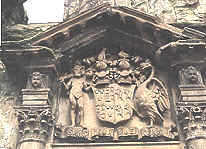 does undoubtedly retain that elusive "Scottishness" which
Muralles tried so hard to obtain. It started out life as an
Augustinian Abbey in 1128 when David1found what he called a "holy
rood" or cross in a stag's antlers and remained as such until the
Royal Palace was built onto the Abbey. the Abbey itself
became a thing of the past when it was greatly damaged in religious riot does undoubtedly retain that elusive "Scottishness" which
Muralles tried so hard to obtain. It started out life as an
Augustinian Abbey in 1128 when David1found what he called a "holy
rood" or cross in a stag's antlers and remained as such until the
Royal Palace was built onto the Abbey. the Abbey itself
became a thing of the past when it was greatly damaged in religious riot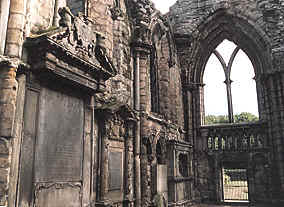 s
in 1610 and the Palace almost went the same way when it was torched by
Cromwell's troops in 1650. The palace has been restored but the
Abbey standing next to it has that haunting beauty peculiar to Gothic
buildings when they fall into decay and it is only in the dusk of
evenings when they conjure up their former glory. The baroque
tombs set in the walls and the massive slabs lying on the ground further
add to the almost Pharonic sense of antiquity. Many of the tombs
are of Scottish nobles long forgotten but a carelessly laid slab was
dedicated to the wife of the famed and controversial English Admiral
Cochrane --history can be found in the most surprising places. s
in 1610 and the Palace almost went the same way when it was torched by
Cromwell's troops in 1650. The palace has been restored but the
Abbey standing next to it has that haunting beauty peculiar to Gothic
buildings when they fall into decay and it is only in the dusk of
evenings when they conjure up their former glory. The baroque
tombs set in the walls and the massive slabs lying on the ground further
add to the almost Pharonic sense of antiquity. Many of the tombs
are of Scottish nobles long forgotten but a carelessly laid slab was
dedicated to the wife of the famed and controversial English Admiral
Cochrane --history can be found in the most surprising places.
As already stated Holyrood is bereft of any comparison to a Versailles
for instance but what it lacks in opulence it makes up for in historical
events, many of them bloody and many of them shrouded in mystery.
The name of Mary, Queen of Scots is synonymous with Holyrood and her
presence is pervasive lingering in her jewellery cases and her
apartments and her portraits ---- you can almost smell her scent wafting
from room to room. Forced to watch the murder of her secretary
David Rizzio within the Palace the reasons for his death are still
argued by historians as are the reasons for the murder of her second
husband Darnley. Even as a child Mary's life was not without
incident and Holyrood was sacked by Henry V111 in 1544 in an attempt to
force the infant Mary to marry his son Edward while her arguments with
John Knox were long and bitter. Add her subsequent execution by
Queen Elizabeth the First and Mary was nothing if not dangerous to be
around.
Bonnie Prince Charlie spent time in the Palace during the '45, gathering
the clans for his invasion of England and looking longingly up at the
castle in the distance which was impregnable to any attack. And
George 1V's attempts at Highland costume during a visit in 1822 were
nothing less than comic-opera but preferable to the blood-letting that
had gone before.
The surrounds to Holyrood House are as dramatic as can be seen anywhere;
sculpted by nature rather than by the hand of man the brooding, ancient
volcanoes surround the Castle and are a stark reminder that all things
are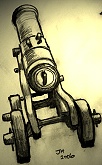 ephemeral.
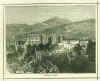
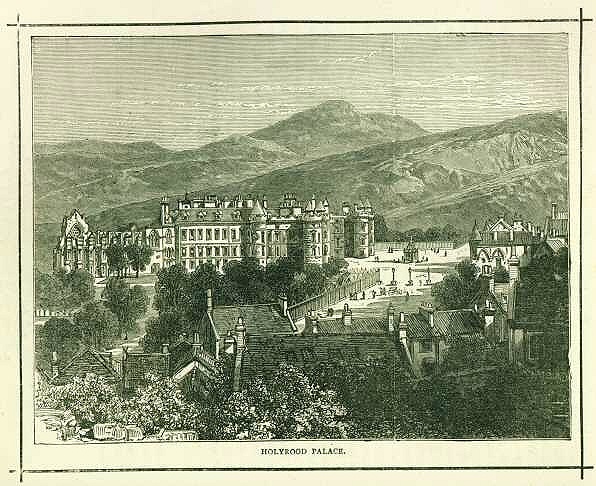
The accompanying old map shows
Holyrood House and its surrounds as very little changed today; Arthur's
Seat can be seen in the background, the Abbey is in ruins and the
forecourt to the Palace is the same.
Calton Hill is a photographers dream having many moods according to
weather and time of day and light conditions.
The statue of the Scots Greys Memorial in Princes gardens is superb and
this view shows the castle in the background.
 Overall
if you like art, sculpture, photography and history then Edinburgh will
not disappoint in any way and you will need two to three days simply to
absorb the city itself without seeing its surroundings. Overall
if you like art, sculpture, photography and history then Edinburgh will
not disappoint in any way and you will need two to three days simply to
absorb the city itself without seeing its surroundings.

|