 |
|
 |

    |
||





| Belur Math | |||
|
|
|
||
|
After
his death
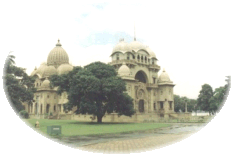
in 1886, his disciple Swami Vivekananda established the
Ramakrishna Mission in 1887 all around the country and abroad to preach
the teaching of his Guru. The headquarter of his international movement
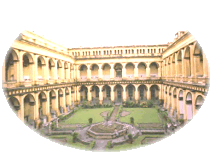
was set up at Belur Math 1899. The most fascinating idea about the
architecture is that from which ever angle you look, it resembles a
temple, a mosque or a church depending the way you look at the
temple. Spread over several acres of land, this is a ideal place
of pilgrimage for people from the globe professing different religious
belief, faith and religion. The premises of the Belur Math includes the
main monastery and several temples. It also includes a sprawling prayer hall with a statue of Ramakrishna
Paramhansa. Math is open from 6:30 to 11:00 Hrs and from 3:30 to 7:00 Hrs daily and well connected by train and bus. |
|||
| Top | |||
| Dakhineshwar Temple | |||
|
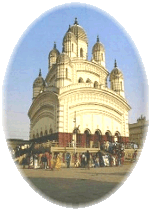
Once a wealthy widow named Rani Rashmoni had decided to visit the sacred city of Banaras to offer worship to Divine mother Goddess Kali. In those early days no proper rail or road transportation facilities was on water |
|
||
|
in luxury boats. It is said that her convoy consisted of twenty four boats with relatives, servants and enough supply of ration. Suddenly, the night previous to her travel, Goddess Kali appeared in her dream and instructed her that instead to going to Benaras is she could build a beautiful temple on the bank of river Ganges and arrange for her worship, then she would manifest herself in the image and accept her worship at that place only. Deeply affected by the dream she immediately procured a suitable land and promptly started constructing the temple in the year 1847. The entire temple complex was completed between 1847 and 1855 with shrine of goddess Kali at the centre alongwith temples of Shiva and Radha Krishna. It is here that Sri Ramakrishna Paramhansa the great Hindu saint and philosopher renowned for his spiritual personality served as a priest. While offering his worship to Goddess Kali, Ramakrishna would sometime overcome with such profound and ecstatic devotion that he would fall to the ground immersed in a spiritual trance losing total consciousness with the external world. Later Swami Vivekananda had worshipped the Goddess Kali, Bhaba Tarani, and did his sadhana at the Panchabati Garden adjacent to the temple. Henceforth, this has become a famous place of pilgrimage. |
|||
| Top | |||
| Kalighat Temple | |||
|
|
|
||
|
became furous that the other Gods at Heaven became
nervous. They realized that unless Shiva's dance was stopped the entire
world will be devastated by his wrath. God Vishnu, the Preserver of the
world took up his chakra and flung it at the dead body of Kali on his
shoulder. This chakra sliced the entire corpse into several 52 pieces
and these were scattered and fell across various location on the earth.
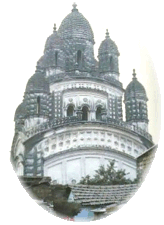
The toe of the right foot incidentally
fell by the bank Ganges. It is said that the name Kalikata meaning
piece of Kali, was derived from this and at this site, the Kali Temple
of Kalighat was erected. It is on the name of this temple that the
Britishers gave the place name Kolkata which is nothing but the
anglicized version of Kalikata. The present Kalighat Temple was built in
1809 beside the site of the ancient temple. Thereafter this temple has
become an important pilgrimage site. Every morning a common sight is
slaughtering of goats which are sacrificed to satisfy the blood lust of
Goddess Kali. |
|||
| Top | |||
| St. Paul's Cathedral | |||
|
|
|
||
|
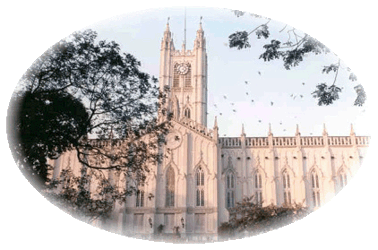
which fell during the earthquake of 1897. It was further damaged during the earthquake of 1934 but now it has been reconstructed. It is famous for the serene service conducted on Christmas Eve. |
|||
| Top | |||
| Victoria Memorial | |||
|
|
|
||
|
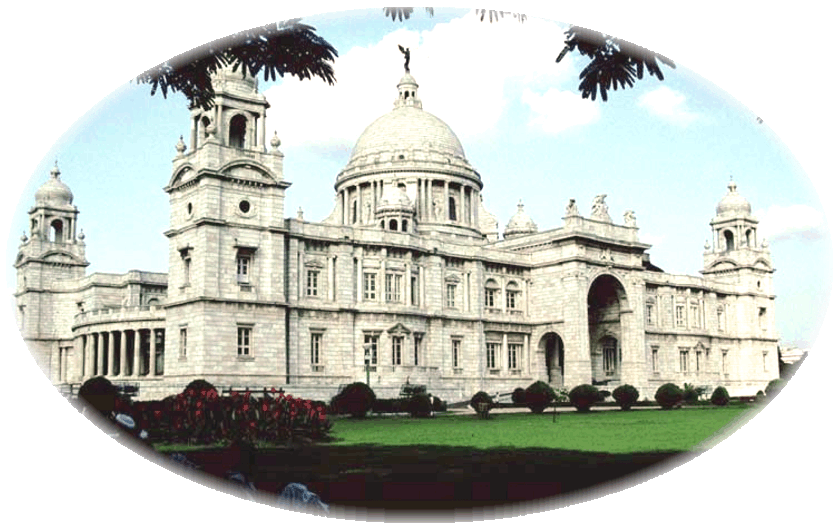
of the citys classical structure representing Classical western and Mughlai style and called Victoria Memorial. Some
also put it as an example of unhappy British attempt to build a better
Taj Mahal. When Queen Victoria expired on January 1901, the Viceroy of India Lord Curzon conceived the idea to build a monumental grand structure with an exquisite garden as a suitable memorial for the Queen. The money was raised through voluntary donation from the people of India. This was to be converted to a historical museum where one could find paintings, manuscripts, pictures and statues of all who played vital and prominent role in the development of the country. The architect of this grand architecture was the President of British Institute of Architects, Sir William Emerson and the construction was done by Messrs. Martin & Co. of Kolkata. The foundation stone was laid by Prince of Wales ( King George V), on January 4, 1906. The construction was completed in 1921 and opened to public on the same year by another Prince of Wales (Duke of Windsor). The surrounding garden, lake and specially the entrance with wrought iron gates, brass cannons, antique lamp posts and statue of Queen casts a spell of the grandeur of British Monarchy. Inside there are some eye-catching water colour painting of Indian landscape and buildings. Along with other items even the piano which was played by Queen Victoria as a little girl has been preserved inside. The Topped with a moving angel this memorial faces the Kolkata Maidan. The throne of Nawab and French guns captured by Lord Clive in the battle of Plassey are also exhibited. A major attraction to the tourist is a sound and light show in the evening. |
|||
| Top | |||
| Shahid Minar | |||
|
|
|
||
|
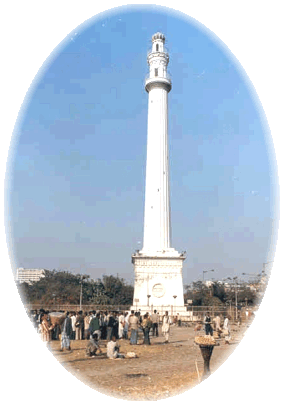
It has been renamed as Sahid Minar which means Martyrs Tower since August 9, 1969. One can have a spectacular of Kolkata's landscape from the top but prior permission from the Police Headquarter at Lalbazar is mandatory. |
|||
| Top | |||
| Writers Building | |||
|
|
|
||
|
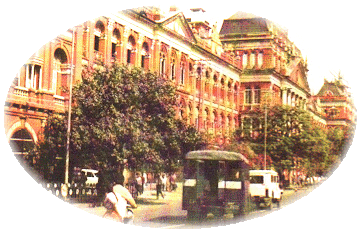
This building was a place of residence for the Writers or Junior Servants of East India Company. At present this is the seat of the West Bengal Government Secretariat. |
|||
| Top | |||
| High Court | |||
|
|
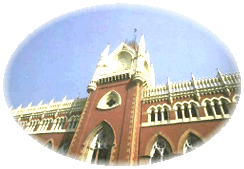
Located very close to the Eden Garden, the High Court of Kolkata was built in the year 1872 by Walter Granville, who was the architect of Government of India during that time. Built in Gothic style architecture it has a tower of nearly 60 meter tall. It is one of the oldest courts of India |
||
| and the he Highest seat of judiciary in West Bengal. An extension was added later, which retains its architectural symmetry. Near Eden Gardens. | |||
| Top | |||
| General Post Office (GPO) | |||
|
|
|
||
|
of legendry
black hole of Kolkata's has been removed since
independence, it actually stood at the north-east corner of the post
office. It is a tiny underground cellar where 146 people were forced
into it on an uncomfortable humid night when the city fell to rule of Siraj-ud-daula. Next
morning only 23 were only alive due to overnight suffocation. |
|||
| Top | |||
| National Museum | |||
|
|
|
||
|
It has a varied collection of antiques and oddities. There are meteorites, skeletons of prehistoric animals, rare armaments, fossils, stones, paintings of historic age of India, regal dresses/uniforms. Special attraction is a mummy. |
|||
| Top | |||
| National Library | |||
|
|
|
||
|
Independence this Imperial residence was named as the National Library of India. It was under the overall control of the Government of India, New Delhi since 1948. The library is the largest in India with a collection of more than one million books. It also has several collection of rare manuscripts of immense historical value. |
|||
| Top | |||