 |
|
 |
|
|
||

   
|
||

|
Calcutta renamed to Kolkata effective January 2001 |
|||
|
|
|||
|
|
|||
     |
|||
|
This information
about Kolkata (Calcutta) has been obtained from various books and sites on the net.
I have tried my level best to verify the information published on my
site. However, if any information is found to be incorrect , please feel free to
send me a mail. I shall make the necessary corrections accordingly. |
|||
Origin of name Kolkata |
History of Kolkata |
||
|
There are various opinion about the origin
of the name of this famous city. Apart from all of the above, there still exists another opinion which says that the name is actually derived form the Bengali term Kilkita which means flat area. This term has also been found in ancient Bengali literature. The
name may have also been derived from the fact that this place used to be
the home of the 'Kol' tribe known as 'Kol Hota'. |
Let us look back to the 17th. century to explore the history of Kolkata. In the year 1690 Job Charnock, an agent of East India Company came to the bank of the river Hooghly. Earlier he had various disputes with officials of Mughal empire at the port of river Hooghly and was forced to abandon his plan of establishing his settlement. His repeated attempts to establish his plan at other places down the river also turned futile. However, Mughal empire finally did not want to lose the benefit they had gained from the British company's commerce and at last decided to permit him to return once again. Job Charnock carefully choose a site which was being protected by the river Hooghly on the West, a creek to the north and by lakes (presently called Salt Lake) about few miles to the east. He also took lease of three villages Sutanuti, Govindapur and Kalikata in pursuit of establishing a trading post of the British East India Company. In 1756 the city became famous in when
Siraj-Ud-Dullah, last independent nawab of Bengal captured the city.
The British regained power of Bengal and the city was recaptured in 1757
by Robert Clive. |
||
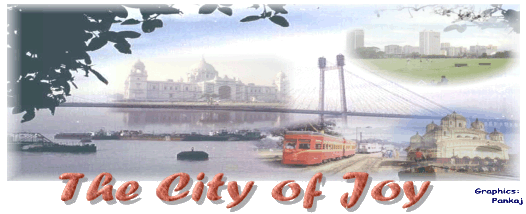
| Kolkata the city of Joy | |||
|
|
|||