


















|
"And so I say to you, you are Peter, and upon this rock I will build my church, and the gates of the netherworld shall not prevail against it. I will give you the keys to the kingdom of heaven. Whatever you bind on earth shall be bound in heaven; and whatever you loose on earth shall be loosed in heaven."
--Matthew 16: 18-19 |
|
When Christ instituted the Twelve, "he constituted [them] in the form of a college or permanent assembly, at the head of which he placed Peter, chosen from among them." Just as, "by the Lord's institution, St. Peter and the rest of the apostles constitute a single apostolic college, so in like fashion the Roman Pontiff, Peter's successor, and the bishops, the successors of the apostles, are related with and united to one another."
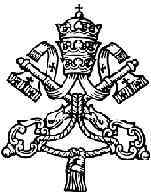
The Lord made Simon alone, whom he named Peter, the "rock" of his Church. He gave him the keys of his Church and instituted him shepherd of the whole flock. "The office of binding and loosing which was given to Peter was also assigned to the college of apostles united to its head." This pastoral office of Peter and the other apostles belongs to the Church's very foundation and is continued by the bishops under the primacy of the Pope.
The Pope, Bishop of Rome and Peter's successor, "is the perpetual and visible source and foundation both of the bishops and of the whole community of the faithful." "For the Roman Pontiff, by reason of his office as Vicar of Christ, and as pastor of the entire Church has full, supreme and universal power over the whole Church, a power which he can always exercise unhindered."
In order to preserve the Church in the purity of the faith handed on by the apostles, Christ who is the Truth willed to confer on her a share in his own infallibility. By a "supernatural sense of faith," the People of God, under the guidance of the Church's living Magisterium, "unfailingly adheres to this faith."
The mission of the Magisterium is linked to the definitive nature of the covenant established by God with his people in Christ. It is this Magisterium's task to preserve God's people from deviations and defections and to guarantee them the objective possibility of professing the true faith without error. Thus, the pastoral duty of the Magisterium is aimed at seeing to it that People of God abides in the truth that liberates. To fulfill this service, Christ endowed the Church's shepherds with the charism of infallibility in matters of faith and morals.
"The Roman Pontiff, head of the college of bishops, enjoys this infallibility in virtue of his office, when, as supreme pastor and teacher of all the faithful - who confirms his brethren in the faith - he proclaims by a definite act a doctrine pertaining to faith or morals.... The infallibility promised to the Church is also present in the body of bishops when, together with Peter's successor, they exercise the supreme Magisterium," above all, in an Ecumenical Council. When the Church through its supreme Magisterium proposes a doctrine "for belief as being divinely revealed," and as the teaching of Christ, the definitions "must be adhered to with the obedience of faith." This infallibility extends as far as the deposit of divine Revelation itself.
paragraphs 880 - 882 and 889 - 891.
| Pope | Name | Birth | Death | Pontificate |
|---|---|---|---|---|
| Leo XIII | Gioacchino Vincenzo Raffaele Luigi |
March 2, 1810 | July 20, 1903 | 1878 - 1903 |
| St. Pius X | Giuseppe Melchiorre Sarto | June 2, 1835 | August 20, 1914 | 1903 - 1914 |
| Benedict XV | Giacomo della Chiesa | November 21, 1854 | January 22, 1922 | 1915 - 1922 |
| Pius XI | Achille Ratti | May 31, 1857 | February 10, 1939 | 1922 - 1939 |
| Pius XII | Eugenio Pacelli | March 2, 1876 | October 9, 1958 | 1939 - 1958 |
| Bl. John XXIII | Angelo Roncalli | November 25, 1881 | June 3, 1963 | October 28, 1958 - June 3, 1963 |
| Paul VI | Giovanni Battista Montini | September 27, 1897 | August 6, 1978 | June 21, 1963 - August 6, 1978 |
| John Paul I | Albino Luciani | October 17, 1912 | September 28, 1978 | August, 1978 - September 28, 1978 |
| John Paul II | Karol Wojtyla | May 18, 1920 | --- | October 22, 1978 - Present |