



















|
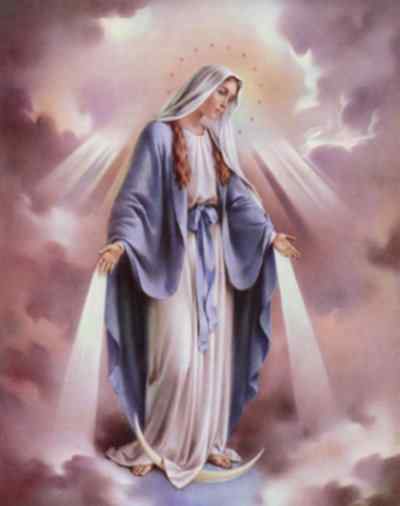
"In the sixth month, the angel Gabriel was sent to a town of Galiliee called Nazareth, to a virgin betrothed to a man named Joseph, of the house of David, and the virgin's name was Mary. And coming to her, he said, "Hail, favored one! The Lord is with you." --Luke 1: 26-28 |
|
"'God sent forth his Son,' but to prepare a body for him, he wanted the free cooperation of a creature. From this, from all eternity, God chose for the mother of his Son a daughter of Israel, a young Jewish woman of Nazareth in Galilee, 'a virgin betrothed to a man whose name was Joseph, of the house of David; and the virgin's name was Mary.'
'The Father of mercies willed that the Incarnation should be preceded by assent on the part of the predestined mother, so that just as a woman had a share in the coming of death. so also should a woman contribute to the coming of life.'
Throughout the Old Covenant the mission of many holy women prepared for that of Mary. At the very beginning there was Eve; despite her disobedience, she receives the promise of a posterity that will be victorious over the evil one, as well as the promise that she will be the mother of all the living. By virtue of this promise, Sarah conceives a son in spite of her old age. Against all human expectation God chooses those who were considered powerless and weak to show forth his faithfulness to his promises: Hannah, the mother of Samuel; Deborah; Ruth; Judith and Esther; and many other women. Mary 'stands out among the poor and humble of the Lord, who confidently hope for a receive salvation from him. After a long period of waiting the times are fulfilled in her, the exalted Daughter of Sion, and the new plan of salvation is established.'"
paragraphs 488 and 489.
"Mary has by grace been exalted above all angels and men to a place second only to her Son, as the most holy mother of God who was involved in the mysteries of Christ: She is rightly honored by a special cult in the Church. From the earliest times the Blessed Virgin is honored under the title of Mother of God, whose protection the faithful take refuge together in prayer in all their perils and needs."
Lumen Gentium
Article 66
November 21, 1964
From the earliest ages of the Catholic Church a Christian people, whether in time of triumph or more especially in time of crisis, has addressed prayers of petition and hymns of praise and veneration to the Queen of Heaven. And never has that hope wavered which they placed in the Mother of the Divine King, Jesus Christ; nor has that faith ever failed by which we are taught that Mary, the Virgin Mother of God, reigns with a mother's solicitude over the entire world, just as she is crowned in heavenly blessedness with the glory of a Queen.
From early times Christians have believed, and not without reason, that she of whom was born the Son of the Most High received privileges of grace above all other beings created by God. He "will reign in the house of Jacob forever," "the Prince of Peace," the "King of Kings and Lord of Lords." And when Christians reflected upon the intimate connection that obtains between a mother and a son, they readily acknowledged the supreme royal dignity of the Mother of God.
...according to ancient tradition and the sacred liturgy the main principle on which the royal dignity of Mary rests is without doubt her Divine Motherhood. In Holy Writ, concerning the Son whom Mary will conceive, We read this sentence: "He shall be called the Son of the most High, and the Lord God shall give unto him the throne of David his father, and he shall reign in the house of Jacob forever, and of his kingdom there will be no end," and in addition Mary is called "Mother of the Lord"; from this it is easily concluded that she is a Queen, since she bore a son who, at the very moment of His conception, because of the hypostatic union of the human nature with the Word, was also as man King and Lord of all things. So with complete justice St. John Damascene could write: "When she became Mother of the Creator, she truly became Queen of every creature."
Encyclical, Ad Caeli Reginam
articles 1, 8 and 34
October 11, 1954
When we have recourse to Mary in prayer, we are having recourse to the Mother of mercy, who is so well disposed toward us that, whatever the necessity that presses upon us especially in attaining eternal life, she is instantly at our side of her own accord, even though she has not been invoked. She dispenses grace with a generous hand from that treasure with which from the beginning she was divinely endowed in fullest abundance that she might be worthy to be the Mother of God. By the fullness of grace which confers on her the most illustrious of her many titles, the Blessed Virgin is infinitely superior to all the hierarchies of men and angels, the one creature who is closest of all to Christ. "It is a great thing in any saint to have grace sufficient for the salvation of many souls; but to have enough to suffice for the salvation of everybody in the world, is the greatest of all; and this is found in Christ and in the Blessed Virgin."
In Mary we see how a truly good and provident God has established for us a most suitable example of every virtue. As we look upon her and think about her we are nor cast down as though stricken by the overpowering splendor of God's power; but, on the contrary, attracted by the closeness of the common nature we share with her, we strive with greater confidence to imitate her. If we, with her powerful help, should dedicate ourselves wholly and entirely to this undertaking, we can portray at least an outline of such great virtue and sanctity, and reproducing that perfect conformity of our lives to all God's designs which she possessed in so marvelous a degree, we shall follow her into heaven.
Encyclical, Magnae Dei Matris
articles 9 and 26
September 8, 1892