
|
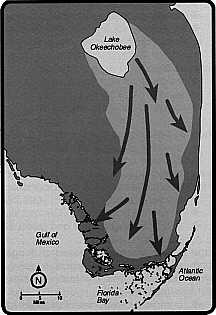 THE ORIGINAL EVERGLADES
The original flow of water started at the Kissimmee Basin and then went through Lake Okeechobee. From Lake Okeechobee, the water meandered to the south-southeast into the area now occupied by the Water Conservation Areas and on into what is now the Everglades National Park. The flow of water ends in Florida Bay, south of the Everglades. This shallow sheet of water flowed at a slow enough pace to create a contiguous wetland for much of the year. The term "Everglades" means "river of grass," which refers to the sawgrass that grows in much of the region. Sawgrass absorbs natural organic and mineral material as the water flowed south, creating an oligotrophic environment. (3) In 1850 the federal government passed the Swamp and Overflowed Lands Act, which granted the State of Florida the right to do what it wanted with the Everglades. Private organizations tried to drain the Everglades to make the land "useful," but these attempts failed. Public works projects were eventually successful and managed to create 400 miles of drainage canals by the 1930s.
Main |
History |
Restoration ©2001 All rights reserved. All data sources have been documented. |