
| � |
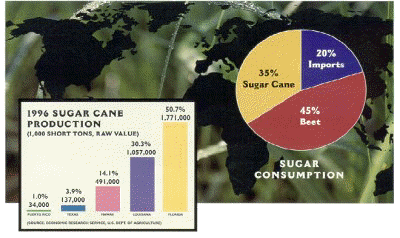 NEEDS OF SUGAR INDUSTRY The sugar industry needs to have lands on which to plant crops, water with which to maintain the crops, the ability to control water levels in crop areas, and the security that their lands will not be taken away, with an understanding of the increased legal responsibilities that have now been mandated by the Everglades Forever Act. The sugar industry in Florida provides thousands of jobs, and is crucial to the state economy. Without taking the proper steps to secure the interests of the sugar industry, the state could be damaging a valuable resource of another sort: economic growth. EFFORTS OF FARMERS TO PRESERVE EVERGLADES Because of the concerns raised in previous years over the effects on the land of using chemical additives to crops, farmers have re-evaluated their use of chemical additives. Most sugar crops in the EAA (over 80%) are now being grown without the use of pesticides, and the other 20% use drastically fewer amounts than before. In response to the high concentration of phosphorus in the EAA lands and water, fertilizers with less phosphorus than what the plants need are being used, so that the growing of cane can actually lower the phosphorus level in the water table. Quite possibly the best example of how biological engineering has assisted in the preservation of the Everglades, the varieties of cane grown in the EAA do not require any form of Fungicides, as they are all extremely resistant to most common fungal, bacterial, and viral attacks. The less the amount of chemicals that farmers use, the better for the environment in the Everglades.  EVERGLADES FOREVER ACT: Effects on Agriculture The Everglades Forever Act of 1994 significantly changed the way that business is handled in the EAA. Aside from making official the sentiments of both environmentalists and agriculturalists alike, that the Everglades must be preserved and restored, the Act set into motion several mechanisms towards the actualization of said goal. Included in the act were provisions for assistance on the part of the Agriculture sector, particularly sugar croppers (as sugar is by far the most common crop in the EAA), in terms of finances. Over the next 20 years, the sugar industry will commit $320 million towards the restoration of lands. Water flow to the Everglades will by increased by 28% through re-routing of rivers and release of stored waters. Also, 40,000 acres of now-EAA lands will be converted into an artificial filtering marsh, so as to cleanse the water that leaves the EAA before it reaches the water table. While the water runoff from farms is currently treated to a level twice as pure as rainwater, the goal has been set to where the water runoff will be 10 times as pure as rainwater by 2006 CE. Urban runoff, which contains four times as much phosphorus as agricultural runoff does, will also be treated under the new law. And, often noted as the most important change, the timing and quantity of water released into the Everglades Water Table will be regulated, so that natural patterns can be enhanced and the Everglades will be able to revitalize. BENEFITS OF SUGAR CANE TO FLORIDA In terms of benefits, the sugar industry provides many. Sugar cultivation provides jobs for over 40,000 people, many of them migrant workers. Also, because of the amount of sugar produced, sugar has become a crucial portion of the state economy, right alongside tourism. Aside from being the largest sugar-producing state, Florida also produces most of the country's domestic vegetables during the winter season. Possibly the greatest benefit of the sugar cane industry in Florida is that because of the abundance of sugar produced, prices on sugar nation-wide are always relatively low. And as mentioned before, Florida produces much of the vegetables consumed in the winter months, also keeping the prices of other vegetables low. DESIRABILITY OF EAA FOR SUGAR CANE The EAA is in a location where the soil, nutrients, and water availability lend themselves perfectly for the cultivation of sugar cane. Sugar cane traditionally grows in areas with an abundance of water: Hawaii, Louisiana, Alabama, Puerto Rico, and Florida. Florida produces over half of the sugar cane in the United States, yielding 1,771,000 short tons (1996 estimate); per capita consumption of sugar by Americans is roughly 67 pounds per year.
Main |
History |
Restoration ©2001 All rights reserved. All data sources have been documented. |
� |