Chess is a game for two players, one with the "White" pieces and
one with the "Black" pieces. At the beginning of the game, the
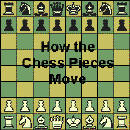
pieces are set up as pictured at right. (See diagrams below to
identify pieces.) These hints will help you to remember the proper
board setup:
-
- 1. Opposing Kings and Queens go directly opposite each other.
-
- 2. The square in the lower right hand corner is a light one
("light on right").
-
- 3. The White Queen goes on a light square, the Black Queen on
a dark square ("Queen on color").
White always
moves first, and then the players take turns moving. Only one piece
may be moved at each turn (except for "castling," a special move
that is explained later). The Knight is the only piece that can jump
over other pieces. All other pieces move only along unblocked lines.
You may not move a piece to a square already occupied by one of your
own pieces. But you can capture an enemy piece that stands on a
square where one of your pieces can move. Simply remove the enemy
piece from the board and put your own piece in its place.
The Pieces and How They Move
The Queen
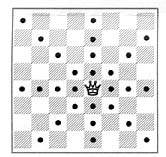
The Queen is
the most powerful piece. She can move any number of squares in any
direction — horizontal, vertical, or diagonal — if her path is not
blocked. She can reach any of the squares with dots in this diagram.
The Rook
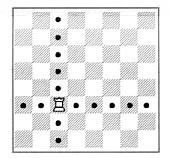
The Rook is
the next most powerful piece. The Rook can move any number of
squares vertically or horizontally if its path is not blocked.
The Bishop
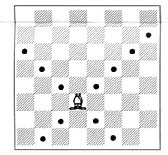
The Bishop
can move any number of squares diagonally if its path is not
blocked. Note that this Bishop starts on a light square and can
reach only other light squares. At the beginning of the game, you
have one "dark-square" Bishop and one "light-square" Bishop.
The Knight
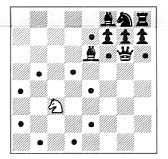
The Knight's
move is special. It hops directly from its old square to its new
square. The Knight can jump over other pieces between its old and
new squares. Think of the Knight's move as an "L." It moves two
squares horizontally or vertically and then makes a right-angle turn
for one more square. The Knight always lands on a square opposite in
color from its old square.
The King
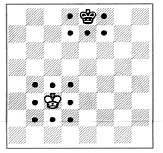
The King is
the most important piece. When he is trapped, his whole army loses.
The King can move one square in any direction — for example, to any
of the squares with dots in this diagram. (An exception is castling,
which is explained later.) The King may never move into check — that
is, onto a square attacked by an opponent's piece.
The Pawn
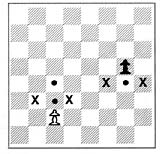
The pawn
moves straight ahead (never backward), but it captures diagonally.
It moves one square at a time, but on its first move it has the
option of moving forward one or two squares. In the diagram, the
squares with dots indicate possible destinations for the pawns. The
White pawn is on its original square, so it may move ahead either
one or two squares. The Black pawn has already moved, so it may move
ahead only one square at a time. The squares on which these pawns
may capture are indicated by an X.
If a pawn advances all the way to the opposite end of the board,
it is immediately "promoted" to another piece, usually a Queen. It
may not remain a pawn or become a King. Therefore, it is possible
for each player to have more than one Queen or more than two Rooks,
Bishops, or Knights on the board at the same time.
Special Moves
Castling
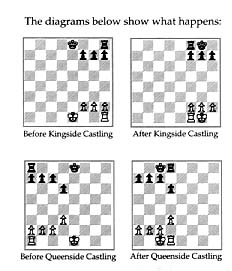
Each player may "castle" only once during a game and when
conditions are met. Castling is a special move that lets a player
move two pieces at once — the King and one Rook. In castling, the
player moves his King two squares to its left or right toward one of
his Rooks. At the same time, the Rook involved goes to the square
beside the King and toward the center of the board (see
illustrations at left). In order to castle, neither the King nor the
Rook involved may have moved before. Also, the King may not castle
out of check, into check, or through check. Further, there may not
be pieces of either color between the King and the Rook involved in
castling.
Castling is often a very important move because it allows you to
place your King in a safe location and also allows the Rook to
become more active.
When the move is legal, each player has the choice of castling
Kingside or Queenside or not at all, no matter what the other player
chooses to do.
En Passant
This French phrase is used for a special pawn capture. It means
"in passing," and it occurs when one player moves a pawn two squares
forward to try to avoid capture by the opponent's pawn. The capture
is made exactly as if the player had moved the pawn only one square
forward.
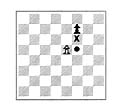
In the
diagram, the Black pawn moves up two squares to the square with the
dot. On its turn the White pawn may capture the Black one on the
square marked with the X. If the White player does not exercise this
option immediately — before playing some other move — the Black pawn
is safe from "en passant" capture for the rest of the game. But new
opportunities may arise for each pawn in similar circumstances.
Back to top
|