NEWS
Home
Novitiate in Mexico
Investiture
Shrine
Br. John Ordained
Recent Deaths
New Blesseds
Assisi Exhibit
Br. Alejandro Honored
Old Mission Honored
Bend, OR
Valley Friars
Provincial Chapter
Next Issue
Other Provincial Publications
Past Issues
CAPUCHIN LINKS
Vocations
Capuchin General Curia in Rome
Solanis Casey Guild
Official Padre Pio site
Australia
Mid-America
St Joseph Province
St. Augustine
International SFO
USA SFO
Capuchin Youth and Family
Capuchin Youth and Family (New York)
Webmaster
Editor
The Portiuncula
Newsletter of the Capuchin Franciscan Province of Our Lady of the Angels
Vol.XXII, No.1
Mission Receives National Honor
With Church and State dignitaries in attendance, Mission Santa Inés celebrated its new status as a National Historic Landmark on September 17, the 195th anniversary of the founding of the mission by Friar Estevan Tapis. The distinction is bestowed by the National Park Service, part of the U.S. Department of the Interior, in recognition that the mission makes a "substantial contribution to understanding the history of the United States" and retains historical integrity in its buildings. The Church and convento portions of the mission date back to the early 1800s. Included in the designation were also the mission's mills, about a half a mile east of the church. "The fulling mill was built in 1820 by Joseph Chapman," explained Br. Robert Barbato, Mission pastor. "It was used to make wool more wearable and thus ready for export. It was one of the earliest industrial sites in California."
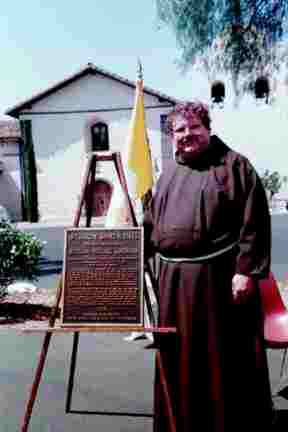
New Mission Status Plaque The process of becoming a national historic landmark was not a simple one. It was begun by Br. Donal Burke several years ago. He discovered that such status might help the mission obtain grant monies needed for maintenance and restoration of the historic buildings. Applying for landmark status meant commissioning a very thorough report, which included history, archeology, and other information. This report was completed in 1997 and submitted. By this time Br. Robert was pastor, and found that he had to convince the Archdiocese of Los Angeles, which owns the mission, to allow the process.
"The Archdiocese is understandably wary of such designations," Br. Robert said, "Especially with their experience with St. Vibiana�s Cathedral. However, I was able to show them that this new status would not put any new burden on the mission, and could help us greatly in preservation."
The ceremonies on September 17 included the presence of Los Angeles Auxiliary Bishop Thomas Curry as well as state and local officials. Santa Barbara County Supervisor Gail Marshall presented the mission with a resolution marking the occasion. Then Mr. Tim Sednicka, a representative from the National Park Service, joined Bishop Curry in unveiling a bronze plaque given by the NPS to Mission Santa Inés which will be on permanent display outside the mission. The plaque reads (in English and Spanish):
Mission Santa Inés has been designated a National Historic Landmark. This religious complex possesses national significance in commemorating the history of the United States of America.
Mission Santa Inés, founded in 1804, is one of the finest examples of a mission complex containing buildings, structures, archeological sites, ruins, and artwork important for understanding the Hispanic and Native American heritage of California. The Fulling Mill, build in 1821 by Joseph Chapman, is one of the earliest industrial sites in California.
The Capuchin friars will be marking 75 years of service to the Mission and the Santa Ynez valley on November 20 of this year, the anniversary of the day Br. Albert Bibby arrived as the first Capuchin pastor.