|
Overview

In
today’s global economy, organizations are increasingly
called upon to demonstrate sound management of economic,
social, and environmental issues. Evidence suggests that
a focus on this “ triple bottom line ” results in
advantages in financing, insurance, marketing,
regulatory treatment, and other areas. An Environmental management system
(EMS) is structured approach to addressing the environmental
bottom line to such as ISO 14001 world's
most reorganized EMS frame work .
Benefits of registration are:
-
reduced
raw material/resource use ;
-
reduced
energy consumption ;
-
improved
process efficiency ;
-
reduced
waste generation and disposal costs, and utilization
of recoverable resources.
What is a
EMS?
A
environmental management system is a common sense, The
overall management system that includes organizational
structure, planning activities, responsibilities,
practices, procedures, processes and resources for
developing, implementing, achieving, reviewing and
maintaining the environmental policy. They are based on standards, which specify a
procedure for achieving effective Environmental management. ISO
14000 is the most commonly used international standard that
provides a framework for a environmental management system
What is
ISO 14000?
ISO
14000 is a generic name given to a family of standards
developed to provide a framework around which a
environmental management system can effectively be based.
The
ISO 14000 family of standards was published in December
1996.
ISO
14001:1996, the requirement standard, includes the
following main sections:
-
Environmental
Management System
-
EMS
Policy
-
Environmental
Planning
-
Implementation
and operation
-
Checking
and corrective action
-
Management
Review
What
does it mean to me?
In
order to use ISO 14000 to the fullest in helping you to
manage your organization's processes there are a number of
steps to take:
-
first
you need to define what you do and how your
organization goes about its business,
-
then
capture this in a documented system,
-
and
you have to do what you say you do,
-
then
make sure you do it effectively,
-
and
lastly demonstrate this to your stakeholders through
registration.
Implementing
a Environmental Management System
There
are key steps that every company implementing a EMS will
need to consider:
Purchase
the Standard
Before you can begin preparing for your application, you
will require a copy of the standard. You should read
this and make yourself familiar with it.
Review support literature and software
There are a wide range of environmental publications and
software tools designed to help you understand,
implement and become registered to a environmental management
system.
Assemble a team and agree on your strategy
You should begin the entire implementation process by
preparing your organizational strategy with top
management. Responsibility for a EMS lies with Senior
Management, therefore it is vital that Senior Management
is involved from the beginning of the process.
Consider Training
Whether you are the environmental officer seeking to implement
a environmental management system or a Senior Manager who
would like to increase your general awareness of ISO
14001:1996, there are a range of workshops, seminars and
training courses available.
Review Consultancy Options
The consultancy is the 3rd party like NUCLEUS, You can receive advice from independent consultants on
how best to implement your environmental management system.
They will have the experience in implementing a EMS and
can ensure you avoid costly mistakes.
Choose a registrar
The registrar is the 3rd party, like BSI,BVQI,TUV,KPMG,RINA,DNV
etc, who come and
assess the effectiveness of your quality management
system, and issue a certificate if it meets the
requirements of the standard. Choosing a registrar
can be a complex issue as there are so many operating in
the market. Factors to consider include industry
experience, geographic coverage, price and service level
offered. The key is to find the registrar who can
best meet your requirements. A great place to
start is by contacting us.
Develop a
Environmental manual
A Environmental manual is a high level document that outlines
your intention to operate in a clean manner. It
outlines why you are in business, what your intentions
are, how you are applying the standard and how your
business operates.
Develop support documentation
This is typically a procedures manual that supports the
Environmental manual. Quite simply, it outlines what you do to
complete a task. It describes who does what, in what
order and to what standard.
Implement your Environmental Management System
The key to implementation is communication and training.
During the implementation phase everyone operates to the
procedures and collects records that demonstrate you are
doing what you say you are doing.
Consider a pre-assessment
A pre-assessment by your registrar normally takes place
about 6 weeks into the implementation of the
environmental system. The purpose of the pre-assessment is to identify
areas where you may not be operating to the standard.
This allows you to correct any areas of concern you may
have before the initial assessment.
Gain registration
You should arrange your initial assessment with your
registrar. At this point the registrar will review your
EMS and determine whether you should be recommended for
registration.
Continual assessment
Once you have received registration and been awarded
your certificate, you can begin to advertise your
success and promote your business. To maintain your
registration, all you need to do is continue to use your
quality system. This will be periodically checked by
your registrar to ensure that your Quality System
continues to meet the requirements of the standard.
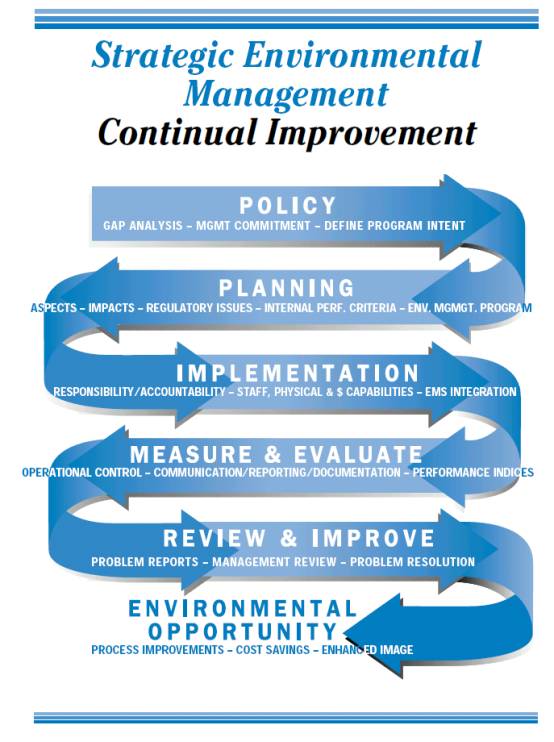
EMS
Approach
EMS
Registration
Registration
to ISO 14001 takes place when an accredited 3rd party such
as BSI,BVQI,TUV,KPMG,RINA,DNV
etc visits an organization,
assesses the management system and issues a certificate to
show that the organization abides by to the principles set
out in ISO 14001:1996.
Your
Environmental Management Systems certificate is a sign of
acceptability which saves you having to prove your environmental
standards to discriminating customers. ISO 14001 speaks an
international language.
Why do I need registration?
Gaining
registration to ISO 14001 through BSI,BVQI,TUV,KPMG,RINA,DNV
etc will help your organization flourish. Whether you are
looking to operate internationally or to expand locally to
accommodate new business, ISO 14001 will help you
demonstrate to customers that you have a commitment to
quality.
The
regular assessment process will ensure you continually
use, monitor and improve your processes.
Registration
can improve overall performance, remove uncertainty and
widen market opportunities.

Download
the NUCLEUS brochure for ISO
14001:1996
- Environmental Management System
|