| flooding
of the fields with water from the annual
inundation of the Nile flooded the fields,
a large labor force would appear at Giza
to put in time on the pyramids. These
farmers and local villagers gathered at
Giza to work for their god kings, to build
their monuments to the hereafter. This
would ensure their own afterlife and would
also benefit the future and prosperity of
Egypt as a whole. They may well have been
willing workers, a labor force working for
ample rations, for the benefit of man,
king, and country.
The following interviews with Mark
Lehner and Zahi Hawass address the
controversial question of who actually
built the pyramids at Giza:
MARK LEHNER, Archaeologist, Oriental
Institute of the University of Chicago,
and Harvard Semitic Museum
Nile Tours & Cruises: In your extensive work
and research at Giza have you ever once
questioned whether humans built the
pyramids?
LEHNER: No. But have I ever questioned
whether they had divine or super
intelligent inspiration? I first went to
Egypt in 1972 and ended up living there 13
years. I was imbued with ideas of Atlantis
and Edgar Cayce and so on. So I went over,
starting from that point of view, but
everything I saw told me, day by day, year
by year, that they were very human and the
marks of humanity are everywhere on them.
And you see there's this curious reversal
where sometimes New Age theorists say that
Egyptologists and archaeologists are
denigrating the ancient culture. They
sometimes put up a scarecrow argument that
we say they were primitive. And the New
Agers sometimes want to say these were
very sophisticated, technologically
sophisticated people who built these
things, they were not primitive. Well,
actually there's a certain irony here,
because they say they were very
sophisticated technological civilizations
and societies that built the pyramids and
the Sphinx, and yet they weren't the ones
that we find. So to me, it's these
suggestions that are really denigrating
the people whose names, bodies, family
relationships, tools, bakeries that we
actually find.
Everything that I have found convinces
me more and more that indeed it is this
society that built the Sphinx and the
pyramids. Every time I go back to Giza my
respect increases for those people and
that society, that they could do it. You
see, to me it's even more fascinating that
they did this. And that by doing this they
contributed something to the human career
and its overall development actually.
Rather than just saying, you know copping
out and saying, there's no way they could
have done this. I think that denigrates
the people whose evidence we actually
find.
Nile Tours & Cruises: Herodotus, the Greek
historian, wrote that 100,000 workers
built the pyramids and modern
Egyptologists come up with a figure more
like 20,000 workers. Can you explain that
for us?
LEHNER: Yeah, well, first of all
Herodotus just claims he was told that. He
said, 100,000 men working in three shifts,
which raises some doubt, I guess if you
read it in the original Greek as to
whether it's three shifts of 100,000 men
each or whether you subdivide, you know,
the 100,000 men. But my own approach to
this stems to some extent from This old
Pyramids You
know, the popular film that was done by
NOVA [where we attempted to build a small
pyramid at Giza]. And certainly we didn't
replicate ancient technology 100 percent
because there's no way we could replicate
the entire ancient society that surrounded
this technology. So our stones were
delivered by a flatbed truck as opposed to
barges. You know, we didn't reconstruct
the barges that brought the 60-ton granite
blocks from Aswan. So basically what we
were doing is, as we say in the film and
in the accompanying book, that we're
setting up the ability to test particular
tools, techniques and operations, without
testing the entire building project.
One of the things that most impressed
me, though, was the fact that in 21 days,
12 men in bare feet, living out in the
eastern desert, opened a new quarry in
about the time we needed stone for our
NOVA Pyramid, and in 21 days they quarried
186 stones. Now they did it with an iron
winch, you know, an iron cable and a winch
that pulled the stone away from the quarry
wall, and all their tools were iron. But
other than that they did it by hand. So I
said, taking just a raw figure, if 12 men
in bare feet -- they lived in a lean-to
shelter, day and night out there -- if
they can quarry 186 stones in 21 days,
let's do the simple math and see, just in
a very raw simplistic calculation, how
many men were required to deliver 340
stones a day, which is what you would have
to deliver to the Khufu Pyramid to build
it in 20 years. And it comes out somewhere
between -- I've got this all written down
-- but it comes out in the hundreds of
men. Now I was bothered by the iron tools,
like 400 men, 4 to 500 men. I was bothered
by the iron tools, especially the iron
winch that pulled the stone away from the
quarry walls, so I said, let's put in a
team of men, of about say 20 men, so that
12 men become 32. And now let's run the
equation. Well, it turns out that even if
you give great leeway for the iron tools,
all 340 stones could have been quarried in
a day by something like 1,200 men. And
that's quarried locally at Giza. You see
most of the stone is local stone.
So then because of our mapping and
because of our approach where we looked
at, what is the shape of the ground here,
where's the quarry, where is the pyramid,
let's see, where would the ramp have run,
we could come up with a figure of how many
men it would take to schlep the stones up
to the pyramid. Now it's often said that
the stones were delivered at a rate of one
every two minutes or so. And New Agers
sometimes point that out as an
impossibility for the Egyptians of Khufu's
day. But the stones didn't go in one after
another, you see. And you can actually
work out the coefficient of friction or
glide on a slick surface, how much an
average stone weighed, how many men it
would take to pull that. And in a NOVA
experiment we found that 12 men could pull
a 1.5 ton block over a slick surface with
great ease. And then you could come up
with very conservative estimates as to the
number of men it would take to pull an
average size block the distance from the
quarry, which we know, to the pyramid. And
you could even factor in different
configurations of the ramp which would
give you a different length.
Well, working in such ways, and I
challenge anybody to join in the
challenge, it comes out that you can
actually get the delivery that you need.
You need 340 stones delivered you see,
every day, and that's 34 stones every hour
in a ten hour day, right. Thirty-four
stones can get delivered by x number of
gangs of 20 men, and it comes out to
something like 2,000, somewhere in that
area. We can go over the exact figures. So
now we've got 1200 men in the quarry which
is a very generous estimate, 2,000 men
delivering. And so that's 3,200. OK, how
about men cutting the stones and setting
them? Well, it's different between the
core stones which were set with great slop
factor, and the casing stones which were
custom cut and set, one to another, with
so much accuracy that you can't get a
knife blade in between the joints, so
there's a difference there. But let's
gloss over that for a moment.
One of the things the NOVA experiment
showed me that no book could, is just what
is it like to have a 2 or 3-ton block --
how many men can get their hands on it?
Well, you can't have 50 men working on one
block, you see. And you can only get about
four or five, six guys at most working on
a block, say two on levers, you know,
cutters and so on. And you know, you put
pivots under it and as few as two or three
guys can pivot it around if you put a hard
cobble under it. There are all these
tricks they know. But it's just impossible
to get too many men on a block. But you
figure out how many stones have to be set
to keep up with this rate, to get in with
20 years. And it actually comes up 5,000
or less men, including the stone setters.
Now the stone setting gets a bit
complicated because of the casing, and you
have one team working from each corner,
and another team working in the middle of
each face for the casing and then the
core. And I'm going to gloss over that.
But the challenge is out there: 5,000
men to actually do the building and the
quarrying and the schlepping from the
local quarry. This doesn't count the men
cutting the granite and shipping it from
Aswan or the men over in Tura. OK, so that
increases the numbers somewhat....And
that's what things like the ancient
technologies seriesdone by NOVA really
bring home, I think. No, we're not
recreating ancient society, and ancient
pyramid building 100 percent. And probably
not even 60 percent. But we are showing
some nuts and bolts that are very useful
and insightful, far more than all the
armchair theorizing.
Now just recently I was contacted by
the construction firm DMJM -- the initials
stand for Daniel, Mann, Johnson &
Mendenhall -- it's one of the largest
construction firms, they're working right
now on the Pentagon. And one of the senior
vice presidents decided to take on for a
formal address for fellow engineers, a
program management study of the Great
Pyramid. So these are not guys lifting
boilers in Manhattan, these are senior
civil engineers with one of the largest
construction corporations in the United
States. And I'm sure they'd be happy to go
on record with their study which looked at
what they call critical path analysis.
What do you need to get the job done? What
tools did they have? And they contacted me
and other Egyptologists and we gave them
some references. Here's what we know about
their tools, the inclined plane, the lever
and so on. And without any secret
sophistication or hidden technology, just
basically what archaeologists say, this is
what these folks had. DIM JIM came up with
5,000, 4 to 5,000 men could build the
Great Pyramid within a 20 to 40 year
period. And they have very specific
calculations on every single aspect, from
the gravel, for the ramps, to baking the
bread. So I throw that out there, not
because that's gospel truth, but because
reasoned construction engineers, who plan
great projects like bridges and buildings
today and earthworks and so on, look at
the Great Pyramid and don't opt out for
lost civilizations, extraterrestrials, or
hidden technologies. No, they say it's a
very impressive job, extraordinary for the
people who lived then and there, but it
could be done. They are human monuments.
Nile Tours & Cruises: You've made reference to
inscriptions at Giza that indicate who
built the pyramids. What do the
inscriptions say?
LEHNER: One of the most compelling
pieces of evidence we have is graffiti on
ancient stone monuments in places that
they didn't mean to be shown. Like on
foundations when we dig down below the
floor level, up in the relieving chambers
above the King's chamber, and in many
monuments of the Old Kingdom, temples, the
Sun temples, other pyramids. Well, the
graffiti gives us a picture of
organization where crews, where a gang of
workmen was organized into two crews. And
the crews were subdivided into five phyles.
The word phyles is spelled p-h-y-l-e-s.
It's the Greek word for tribe. The
Egyptian word is za. They were divided
into five za's. In later times when the
Greeks came and in bilingual inscriptions,
when somebody was translating za into
Greek they used the word phyles, the word
for tribe, which is extremely interesting
actually.
Were these militaristic kinds of
conscripts? Certainly they weren't slaves.
Could they actually have been natural
communities of the Nile Valley kind of
contributing like the way the Inca build
their bridges and so on? .....So the
phyles then are subdivided into divisions.
And the divisions are identified by single
hieroglyphs with names that mean things
like endurance, perfection, strong. OK, so
how do we know this -- you come to a block
of stone in the relieving chambers above
the Great Pyramid. And first of all you
see this cartouche of a King and then some
scrawls all in red paint after it. That's
the gang name. And in the Old Kingdom in
the time of the Pyramids of Giza, the
gangs were named after kings. So for
example, we have a name, compounded with
the name of Menkaure, and it seems to
translate 'the drunks or the drunkards of
Menkaure.' There's one that's well
attested, actually in the relieving
chambers above the Great Pyramid, the
Friends of Khufu gang, the Drunks of
Menkaura gang, and then you have the green
phyles and then the powerful ones. None of
this sounds like slavery, does it?
And in fact it gets more intriguing.
Because in certain monuments you find the
name of one gang on one side of the
monument and another gang, we assume
competing on the other side of the
monument. You find that to some extent in
the temple, the Pyramid temple of Menkaure.
It's as though these gangs are competing.
So from this evidence we deduce that there
was a labor force that was assigned to
respective crew gang phyles and divisions.
Nile Tours & Cruises: Where did the gangs come
from? Were they local people or did they
travel from afar?
LEHNER: There's some evidence to
suggest that people were rotated in and
out of the raw labor force. So that you
could be a young man in a village say in
middle Egypt, and you had never seen more
than a few hundred people in your village,
maybe at market day or something. And the
King's men come and it may not have been
entirely coercion, but it seems that
everybody owed a labor tax. We don't know
if it was entirely coercive, or if in
fact, part of it was a natural community
donation as in the Incan Empire for
example, to building projects where they
had a great party and so on. But anyway
they started keeping track of people and
their time on the royal labor project. And
if you were brought from a distance you
were brought by boat. So can you imagine
floating down the Nile and say you're
working on Khafre's Pyramid, and you float
past the great pyramid of Meidum and the
Pyramids of Dashur, and my God, you've
never seen anything like this. These are
the hugest things. We're talking about a
society where they didn't have cameras,
you didn't see yourself age. You didn't
see great images. And so here are these
stupendous, gigantic things thrusted up to
the sky, polished white limestone, blazing
in the sunshine. And then they go on down
to Giza and they come around this corner,
actually the corner of the Wall of the
Crow right into the harbor, and there's
Khufu, the biggest thing on the planet
actually in the way of a building until
the turn of the century -- our century.
And you see, for the first time in your
life, not a few hundred, but thousands,
probably, of workers and people and
industries of all kinds. And you're
rotated into this experience and you serve
in your respective crew, gang, phyles and
division, and then you're rotated out and
you go back because you have your own
large household to whom you are assigned
on a kind of an estate organized society.
You have your own village, maybe you even
have your own land that you're responsible
for. So you're rotated back but you're not
the same. You have seen the central
principle of the first nation state in our
planet's history, the pyramids, the
centralization, this organization. And so
they must have been powerful socializing
forces.
Anyway, we think that that was the
experience of the raw recruits. But there
must have been a cadre of very seasoned
laborers who really knew how to cut stone
so fine that you could join them without
getting a razor blade in between. And
perhaps they were the stone cutters and
setters, and the experienced quarry men at
the quarry wall. And the people who
rotated in and out were those doing all
the different raw labor, not only the
schlepping of the stone but preparing
gypsum and we don't know to what extent
the other industries were also organized
in the phyles system. But it's quite an
amazing picture. And one of the things
that really is motivating me now is the
question of what vision of society is
suggested by a pyramid like Khufu's? Was
it in fact coercive? Was it a militaristic
kind of state WPA project? Or is it
possible that we could find evidence that
would bring Egypt into line with what we
know of other traditional ancient
societies. Like when the Inca build a
bridge, and every household winds its
twine together, and the twine of all the
households in the village are wound into
the villages' contribution to the rope.
And the rope on the great day of bridge
building is wound into a great cable. And
all the villages' cables are wound into
this virtual bridge. Or in Mesopotamia we
know that they built city walls, great mud
brick city walls, by the clans turning out
and giving their contribution, a kind of
organic, natural community involvement in
the building project. I wonder if that
wasn't the case with the Great Pyramid of
Khufu. You know, it's almost like an Amish
barn raising. But you know, the Great
Pyramid of Khufu is one hell of a barn.
Nile Tours & Cruises: Some of the theories of
who built the pyramids suggest that the
builders may not have been from Egypt. Can
you respond to that?
LEHNER: One thing that strikes me when
I read about these ideas -- that it
couldn't have been the Egyptians who built
the pyramids, it couldn't have been the
Egyptians who built the Sphinx, of the 4th
Dynasty, it had to have been an older
civilization. And I think about those
claims and then I look at the marvelous
statue of Khafre with the Horus falcon at
the back of his head. I look at the
sublime ship of Khufu that was found
buried south of the pyramid. And we know
that these objects date from the time of
Khafre and Khufu, and I think, my God,
this was a great civilization. This was as
great as it comes in terms of art and
sculpture and building ships from any
place in the planet, in the whole
repertoire of ancient cultures. Why is
there such a need to look for yet another
culture, to say 'No, it wasn't these
people, it was some civilization that's
lost, even older.' And to some extent I
think we feel the need to look for a lost
civilization on time's other horizon
because we feel lost in our civilization
and somehow we don't want to face the
little man behind the curtain as you had
in "The Wizard of Oz." We want
the great and powerful wizard with all the
sound and fury. You know, go get me the
broomstick of the wicked witch of the
west. We want that sound and fury. We
always want more out of the past than it
really is.
ZAHI HAWASS, Director General of Giza
Nile Tours & Cruises: Let's address the
question of who built the pyramids.
HAWASS: We are lucky because we found
this whole evidence of the workmen who
built the pyramids and we found the
artisans and Mark found the bakery and we
found this settlement of the camp, and all
the evidence, the hieroglyphically
inscriptions of the overseer of the site
of the Pyramid, the overseer of the west
side of the Pyramid, the craftsman we
found, the man who makes the statue of the
overseer of the craftsman, the inspector
of building tombs, director of building
tombs -- I'm telling you all the titles.
We found 25 unique new titles connected
with these people. Then who built the
pyramids? It was the Egyptians who built
the pyramids. The Great Pyramid is dated
with all the evidence, I'm telling you now
to 4,600 years, the reign of Khufu. The
Great Pyramid of Khufu is one of 104
pyramids in Egypt with superstructure. And
there are 54 pyramids with substructure.
There is support (that) the builders of
the pyramids were Egyptians. They are not
the Jews as has been said, they are not
people from a lost civilization. They are
not out of space. They are Egyptian and
their skeletons are here, and were
examined by scholars, doctors and the race
of all the people we found are completely
supporting that they are Egyptians.
Nile Tours & Cruises: The Greek historian
Herodotus claimed in 500 B.C. that 100,000
people built the pyramids, and yet modern
Egyptologists believe the figure to be
more like 20,000 to 30,000.
HAWASS: Herodotus, when he came here,
met guides who tell stories and things
like that. But I really personally believe
that based on the size of the settlement
and the whole work of an area that we
found, I believe that permanent and
temporary workmen who worked at building
the pyramid were 36,000.
Nile Tours & Cruises: And how do you come to
that number?
HAWASS: I came to that number based on
the size of the pyramid project, a
government project, the size of the tombs,
the cemetery. We know we can excavate the
cemetery for hundreds of years --
generations after generation can work in
the cemetery -- and the second is the
settlement area. I really believe there
were permanent workmen who were working
for the king. They were paid by the king
and these are the technicians who cut the
stones, and there are workmen who move the
stones and they come and work in rotation.
You have this group and another group. In
the same time there are the people who
live around the pyramids that don't need
to live in the pyramids. They come by
early in the morning and they work
fourteen hours from sunrise to sunset.
Nile Tours & Cruises: From your excavations of
the workers' cemetery you say you found
skeletons. Did you analyze the bones, and
if so, what did you learn about the
workmen?
HAWASS: We found 600 skeletons. And we
found that those people, number one, they
were Egyptians, the same like you see in
every cemetery in Egypt. Number two, we
found evidence that those people had
emergency treatment. They had accidents
during building the pyramids. And we found
12 skeletons who had accidents with their
hands. And they supported the two sides of
the hand with wood. And we have another
one, a stone fell down on his leg, and
they made a kind of operation, and they
cut his leg and he lived 14 years after
that.
Nile Tours & Cruises: How do you know that?
HAWASS: Because we have a team here
from the National Research Center who are
doctors and they use the x-ray and they
can find all the evidence about age. They
found that the age of death for those
workmen were from 30 to 35. Those are the
people who really built the pyramids, the
poor Egyptians. It's very important to
prove how the pyramid was built. The
pyramid you know, has magic, it has
mystery. It's a structure that was built,
you know, 4,600 years ago. There is no
accurate book until now that really
explained all of that. All the theorists,
in other books they say that the stones
were taken from Tura, about five miles to
the east of the pyramid. This is not true.
All the stones have been taken from the
plateau, except the casing stones that
came from Tura, and the granite in the
burial chamber that came from Aswan. But
the magic of the pyramid makes people
think about it. An amateur comes by and
looks at this structure and doesn't know
the mechanics. The cult of the Egyptians,
the religion, the pyramid, is a part of a
whole civilization.
Nile Tours & Cruises: There is an inscription
above Khufu's burial chamber that
identifies the pyramid as that of Khufu.
Some people claim that is a fake
inscription. Can you comment on that?
HAWASS: They say that the inscriptions
inside the five relieving chambers are
fake. Fine. I went last week and we
lighted all of them. It has been never
lighted before. We did beautiful lighting.
Then we can read each single inscription.
Nile Tours & Cruises: And what do they say?
HAWASS: The workmen who were involved
in building the Great Pyramid were divided
into gangs, groups, four groups, and each
group had a name, and each group had an
overseer. They wrote the names of the
gangs. And you have the names of the gangs
of Khufu as 'Friends of Khufu.' Because
they were the friends of Khufu proves that
building the pyramid was not really
something that the Egyptians would push.
You know, it's like today. If you go to
any village you will understand the system
of ancient Egyptians. When you build, I
mean a dam, or you build a big house,
people would come to help you. They would
work free for you, the households will
send food to feed the workmen. And when
they build the houses you will do the same
for them. And that's why the pyramid was
the national project of Egypt because
everyone had to participate in building
this pyramid. By food, by workmen, this
way the building of the pyramid was
something that everyone felt to
participate, and really it was love. They
are not really pushed to do it. When the
king takes the throne, the people have to
be ready in participating in building the
pyramid. And then when they finish it,
they celebrate. That's why even now in
modern Egypt we still really do
celebrations when we finish any project
because that's exactly what happened in
ancient Egypt.
Nile Tours & Cruises: But what about the inscriptions
in the relieving chambers in Khufu and the
claim that they were not written in the
time of Khufu?
HAWASS: They say that these
inscriptions have been written by people
who entered inside. And if you go and see
them they are typical graffiti that can be
seen around every pyramid in Egypt,
because the workmen around the pyramid
left this. I would like those people who
talked about this to come with me. And I
will take them personally to the rooms.
First of all they say that only inscribed
is the second room -- it's not true. All
the five relieving chambers are inscribed.
Number two, there are some inscriptions
there that cannot be written by anyone
except the workmen who put them there. You
cannot go and reach there. It has to be
the man who put the block above the other
one to do that. I think that maybe the
only few Egyptologists, the only two
Egyptologists in the world that will
really have an open mind, it's me and Mark
Lehner, because we believe the public has
the right for us to tell them the truth.
We are really working excavating around
the pyramids to tell the world the truth.
History of Giza
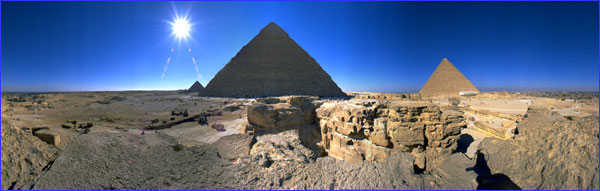
Standing at the base of the Great Pyramid,
it is hard to imagine that this monument
-- which remained the tallest building in
the world until early in this century --
was built in just under 30 years. It
presides over the plateau of Giza, on the
outskirts of Cairo, and is the last
survivor of the Seven Wonders of the
World. Five thousand years ago Giza,
situated on the Nile's west bank, became
the royal necropolis, or burial place, for
Memphis, the pharaoh's capital city.
Giza's three pyramids and the Sphinx were
constructed in the fourth dynasty of
Egypt's Old Kingdom, arguably the first
great civilization on earth. Today, Giza
is a suburb of rapidly growing Cairo, the
largest city in Africa and the fifth
largest in the world.
About 2,550 B.C., King Khufu, the
second pharaoh of the fourth dynasty,
commissioned the building of his tomb at
Giza. Some Egyptologists believe it took
10 years just to build the ramp that leads
from the Nile valley floor to the pyramid,
and 20 years to construct the pyramid
itself. On average, the over two million
blocks of stone used to build Khufus's
Pyramid weigh 2.5 tons, and the heaviest
blocks, used as the ceiling of Khufu's
burial chamber, weigh in at an estimated
40 to 60 tons.
How did the ancient Egyptians move the
massive stones used to build the pyramids
from quarries both nearby and as far away
as 500 miles? This question has long been
debated, but many Egyptologists agree the
stones were hauled up ramps using ropes of
papyrus twine. The popular belief is that
the gradually sloping ramps, built out of
mud, stone, and wood were used as
transportation causeways for moving the
large stones to their positions up and
around the four sides of the pyramids.
|