Ramses II Usermaatre
Setepenre, son of King Sethi I, was one of
the longest reigning pharaohs of Ancient
Egypt. He reigned 67 years (roughly from
1290-1224 BC), in the he was beginning co
regent with his father. He was said
to have lived for more than 80 years this
must have made him seem even more than
godly for the average life expectancy was
nearly half that.
During his life he made quite a reputation
as a builder and a warrior, but also as a
ladies man. He had 5 or 6 main wives,
foremost of all being Nefertari, but he is
also known to have had more than 100
children with all of his wives!
It seems that in Ancient Egypt people
seemed to have made fun of this fact,
since the contemporary and famous Turin
Papyrus features erotic scenes involving a
pharaoh --probably Ramses II--and several
women.
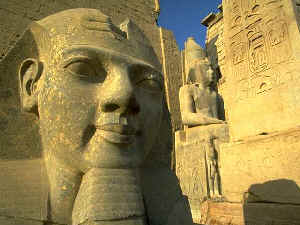
Ramses II is, however, best known for all
the buildings he had constructed in his
name across the country. Especially the
monumental temples of Karnak (near Luxor)
and Abu Simbel (in the south of the
country in so-called Nubia), and his
mortuary temple The Ramesseum (on the West
Bank near Luxor) give evidence of his love
for grandeur. In all of
his monuments he had his name cartouche
and texts engraved so deep that no
successor would be able to remove it.
Ramses' energetic building activities more
or less, led to a degrading period of
Egyptian art as far as the engraving of
texts and images on temple walls was
concerned. He demanded the monuments
to be erected with greater speed than
usual, the result was that carefully
engraved texts and images with many
beautiful details were now made more
superficially, a practice which was
unfortunately continued by his
successors. Most famous
of his military engagements is the Battle
of Kadesh against the Hittites (from
Western Asia), with whom the Egyptians had
been struggling for many years. He seems
to have escaped with nothing but pure
luck, as his main force --the pharaoh
himself commanding-- was ambushed by the
Hittites, and was only saved just in time
by reinforcements while retreating. Both
sides claimed the victory in this battle,
but it seems more likely to have ended in
a status quo. Ramses II recorded 'his'
victory on several monuments, showing him
slaying the Hittites in person. The
problems between Egyptians and Hittites
were finally settled though, several years
later, when Ramses married a Hittite
princess.
After he died, Ramses was buried in the
famous royal necropolis of the Valley of
the Kings, located in the hills on the
west bank of the Nile opposite the modern
town of Luxor.
However, the mummy of Ramses II was not
found on location in his tomb, but was
discovered in 1881 among many other royal
mummies in the so-called Royal Cache in
Deir el-Bahri on the Theban west-bank.
According to a hieroglyphic text found on
the mummy it was removed from the actual
royal tomb for safety reasons by Egyptian
priests in the 10th year of the reign of
king Pinodjem (around 1070 B.C.) after
robbers violated the burial.
Though the text stated it was placed
together with the body of his father, Seti,
in the tomb of Amenhotep I, it was
apparently later moved again to its final
resting place in the royal cache. The
mummy is now in the Egyptian Museum in
Cairo.