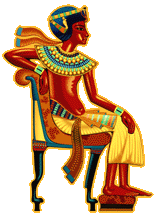
He was only about 18 years old when he died, and as a
pharaoh of Egypt he had no great claim to fame. Tutankhamun
(originally Tutankhaten) owes his place in history mostly to
the discovery of his tomb completely intact and not violated
by grave robbers in 1922. The remarkable artifacts from the
tomb, including the beautiful golden mask, are on display at
the Egyptian Museum in Cairo. Tutankhamun was possibly the son
of Amenhotep III, an earlier 18th-dynasty king, and his wife
Tiy. Tutankhamun became king after the death of Akhenaton the
religious reformer who died in 1362 BC. He married Akhenaton's
third daughter to solidify his claim to the throne. During
most of his rule he resided at ancient Memphis, near
present-day Cairo. The religious reforms of Akhenaton were
reversed, though there was no persecution of followers of Aton,
Akhenaton's god. During a war with the Hittite people,
Tutankhamun suddenly died, leaving no heirs. He was buried in
the Valley of the Tombs of the Kings in southern Egypt north
of Luxor. All tombs were meant to be secret, but of the 60
known tombs in the valley only that of Tutankhamun was not
discovered and its treasures stolen. It was not discovered
earlier in part because his name, along with that of other
pharaohs of his dynasty, was removed from the royal lists
during the 19th dynasty. In the 20th dynasty, when the tomb of
Ramses VI was carved immediately above his, rubble covered his
burial place. The burial chamber was not entered until found
in 1922 by British Egyptologist Howard Carter after several
years of searching.