|
|
|

|
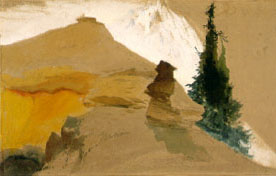
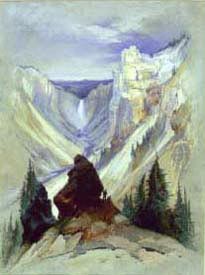
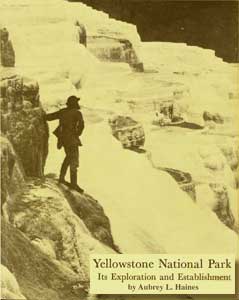
Thomas Moran
Paintings and Photo of Moran on Mammoth Terrace Courtesy of National
Park Service
NPS Patch scanned by L. M. Little
Manifest Destiny
Manifest Destiny
".....the fulfillment of our manifest destiny to
over spread the continent.....for free development of our yearly
multiplying millions." As each generation pressed the
fringes of civilization, the idea of Manifest Destiny became
a sacred quest. It was as if it was
our duty to assume ownership of unclaimed lands and make so called improvements
to the land
The Visionaries
A few people became concerned
over the loss of irreplaceable land marks and artifacts. One
of those concerned citizens was George Catlin who wrote about his concerns
after a trip through the Dakotas in 1830's. Catlin traveled
through the western territories over the period of 2 years. The
changes to the landscape that Catlin saw during his tour caused him to
fear that without federal protection that the unique features of the western
landscape would be forever altered.
An Artist's Dream
George Catlin worried
so much about the impact of America's westward expansion
on Indian civilization, wildlife, and wilderness that he wrote to
Congress about his concern and wished for some kind of federal protection
for public lands so that unique features might be preserved.
After his trip to the Dakotas 1832-1834 Catlin wrote the
following, “by some great protecting
policy of government... in a magnificent park.... A nation's
park, containing man and beast, in all the wild and freshness
of their nature's beauty!”
He didn't exactly ask for the establishment
of the National Park Service but he expressed a desire for some kind
of government protection for unique landscapes like Yellowstone
National Park.
During
the early days of the Westward Expansion it was a kind of free for
all. There were no laws or rules regarding land, wild life
and other natural resources. When the landscape started showing
the scars of humanity some people noticed and became concerned. Much
of the landscape on the East Coast had already been permanently
altered by urban development. As more people heard of the Western
Wonders more people traveled the established trails out west such
as the Oregon Trail, the Mormon Trail, & the Santa Fe Trail.
The paintings of Thomas Moran also inspired congress
to protect Yellowstone and to further explore the West. In fact
the first sketches of Yellowstone inspired Thomas Moran himself.
Years before Thomas Moran joined the first government sponsored survey team in Yellowstone in 1871, he had been asked to re-work some of the sketches submitted for an article about Yellowstone called The Wonders of Yellowstone. Reworking the sketches and drawings from Yellowstone inspired Moran to go out West and see these natural wonders for himself, which led him to join the government sponsored survey team led by the geologist, Ferdinand V. Hayden. While traveling with the survey team Thomas Moran completed numerous sketches and water colors of Yellowstone's unique features which were published in papers and magazines sold in eastern news stands.
Years before Thomas Moran joined the first government sponsored survey team in Yellowstone in 1871, he had been asked to re-work some of the sketches submitted for an article about Yellowstone called The Wonders of Yellowstone. Reworking the sketches and drawings from Yellowstone inspired Moran to go out West and see these natural wonders for himself, which led him to join the government sponsored survey team led by the geologist, Ferdinand V. Hayden. While traveling with the survey team Thomas Moran completed numerous sketches and water colors of Yellowstone's unique features which were published in papers and magazines sold in eastern news stands.
The Artist's Dream Realized
Catlin's
vision was partly realized in 1864, when Congress
donated Yosemite Valley to California for preservation as a state park. Eight years later in 1872, Congress reserved
the spectacular Yellowstone country in the Wyoming
and Montana territories “as a public park or pleasuring ground
for the benefit and enjoyment of the people.” On
March 1,1872 President Ulyisses S. Grant signed Yellowstone
into law making it the world's first National Park. With
no state government to manage it Yellowstone remained in the custody
of the U.S. Department of the Interior.
The First Keepers
of the Parks
The Department of the Interior requested the
Army to deploy troops to Yellowstone and the California
parks. Once there military engineers and cavalrymen attempted
to develop park roads and buildings, enforce regulations
against hunting, grazing, timber cutting, and vandalism,
and they did their best to serve the visiting public. However,
with the Antiquities Act of 1906 the president was granted the authority
to designate areas as National Monuments which increased the number
of areas needing protection. The Need for NPS
By 1916
the Interior Department was responsible for 14 national
parks and 21 national monuments but had no organization
to manage them. The Army could not build and maintain the needed
infrastructure (roads, visitor centers,etc.) to accommodate visitors
in addition to patrolling the Parks. Creation of the National Park
Service
The National Park Service Act was signed by
President Woodrow Wilson on August 25, 1916 (also referred to as
the Park Services "Organic Act")
Wilson actually approved legislation to create the National Park Service on 8/15/1916 and signed it on 8/25/1916.
Wilson actually approved legislation to create the National Park Service on 8/15/1916 and signed it on 8/25/1916.
NPS Trivia
August 25 is now known as National Park Day and admission is free. In Yellowstone National Park August 25 is also Celebrated as Christmas in Yellowstone. A Park tradition for over 70 years.
NPS Mission
"....to conserve the scenery and the national and historic objects and wildlife therein and to provide for the enjoyment of the same in such a manner and by such means as will leave them unimpaired for the enjoyment of future generations."
Growth and Reorganization
The National Park
System now oversees 384 units; this includes parks and preserves,
monuments, historic sites, battlefields, scenic rivers and , shorelines
and recreation areas. The National Park Service includes 15 units
that are also designated as World Heritage Site.
Click on the link to see
Click on the link below to learn more
THE NATIONAL PARK SERVICE
A Brief History
Barry Mackintosh 1999
Click to review
| Home Page | NPS Overview |
 NPS History
 |
NPS Legislation |
| NPS Units |
NPS Geology |
NPS Regions |
World Heritage Sites |
| Quiz Site |
Education Links |
Quit |