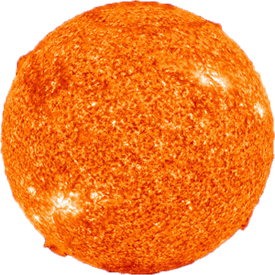
Stars
When you look at the night sky you can see many beautiful stars. If you are out in the country or camping in the mountains or the desert away from the city lights, you may see thousands of them. You may even be able to see part of the Milky Way. In a town or city, you can't see nearly as many stars because the city lights create a glow in the sky masking many of them.
What is a star?
A star is a sphere of gas held together by its own gravity. The force of gravity is continually trying to cause the star to collapse, but this is counteracted by the pressure of hot gas and/or radiation in the star's interior. This is called hydrostatic support. During most of the lifetime of a star, the interior heat and radiation is provided by nuclear reactions near the center, and this phase of the star's life is called the main sequence. Before and after the main sequence, the heat sources differ slightly. Before the main sequence, the star is contracting and is not yet hot enough or dense enough in its interior for the nuclear reactions to begin. During this phase, hydrostatic support is provided by the heat generated during contraction. After the main sequence, most of the nuclear fuel in the core has been used up. The star now requires a series of less-efficient nuclear reactions for internal heat. Eventually, when these reactions no longer generate sufficient heat to support the star against its own gravity, the star will collapse.
Why do Stars Twinkle?
The scientific name for the twinkling of stars is stellar scintillation (or astronomical scintillation). Stars twinkle when we see them from the Earth's surface because we are viewing them through thick layers of turbulent (moving) air in the Earth's atmosphere.
Stars (except for the Sun) appear as tiny dots in the sky; as their light travels through the many layers of the Earth's atmosphere, the light of the star is bent (refracted) many times and in random directions (light is bent when it hits a change in density - like a pocket of cold air or hot air). This random refraction results in the star winking out (it looks as though the star moves a bit, and our eye interprets this as twinkling).
Stars closer to the horizon appear to twinkle more than stars that are overhead - this is because the light of stars near the horizon has to travel through more air than stars overhead and subject to more refraction. Also, planets do not usually twinkle - they are big enough that this effect is not noticeable (except when the air is extremely turbulent).
Stars would not appear to twinkle if we viewed them from outer space (or from a planet/moon that didn't have an atmosphere).
Why are Stars Hot and Bright?
Stars are giant nuclear reactors. In the center of stars, atoms are taken apart by tremendous atomic collisions that alter the atomic structure and release an enormous amount of energy. This makes stars hot and bright. In most stars, the primary reaction converts hydrogen atoms into helium atoms, releasing an enormous amount of energy. This reaction is called nuclear fusion because it fused the nuclei (center) of atoms together, forming a new nucleus. The process of forming a new nucleus (and element) is nucleosynthesis.
Parts of a Star
Core
A star's core is the innermost part. It is the densest and hottest area. The sun's core has a density 10 times that of lead and a temperature of 27 million degrees Fahrenheit. Despite high density, the high temperature keeps the core in a gaseous state. In a stellar core, fusion reactions create energy that produce gamma rays and neutrinos.
Radiative and Convective Zones
Outside of the core is the radiative zone where energy is transported by radiation. According to the Contemporary Physics Education Project's sun information, "It becomes less efficient for energy to move by radiation, and heat energy starts to build up at the outside of the radiative zone. The energy begins to move by convection, in huge cells of circulating gas several hundred kilometers in diameter."
Photosphere
Outside the stellar zones is a star's photosphere, where visible light is emitted. In the case of the sun, this light can easily be detected by the naked eye. In the case of a distant star, a telescope might be required for viewing. Information about the temperature, composition and pressure of a star's photosphere is revealed by the spectrum of light.
Chromosphere
Outside the photosphere is the chromosphere. In the sun, the chromosphere is red-colored from an abundance of hydrogen gas, though this color can only be seen with special filters or during an eclipse as a red circle. Solar flares that emerge from sun spots in the photosphere shoot out through the chromosphere.
Corona
The outermost part of a star is the corona. It extends for millions of miles into space. The sun's corona can only be seen by the naked eye during a solar eclipse. Immense clouds of glowing gas called prominences erupt from the upper chromosphere and shoot into the corona.
Life Cycle of a Star
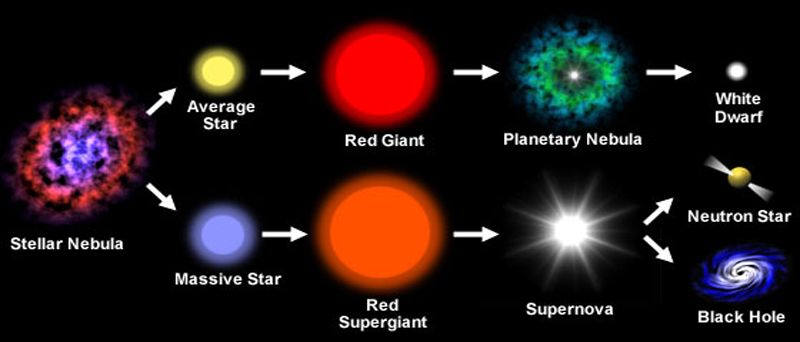
Stars are formed in clouds of gas and dust, known as nebulae. Nuclear reactions at the centre (or core) of stars provides enough energy to make them shine brightly for many years. The exact lifetime of a star depends very much on its size. Very large, massive stars burn their fuel much faster than smaller stars and may only last a few hundred thousand years. Smaller stars, however, will last for several billion years, because they burn their fuel much more slowly.
Eventually, however, the hydrogen fuel that powers the nuclear reactions within stars will begin to run out, and they will enter the final phases of their lifetime. Over time, they will expand, cool and change colour to become red giant stars. The path they follow beyond that depends on the mass of the star.
Small stars, like the Sun, will undergo a relatively peaceful and beautiful death that sees them pass through a planetary nebula phase to become a white dwarf. Massive stars, on the other hand, will experience a most energetic and violent end, which will see their remains scattered about the cosmos in a enormous explosion, called a supernova. Once the dust clears, the only thing remaining will be a rapidly spinning neutron star, or possibly even a black hole.
Different Kinds of Stars
There are several different kinds of stars in the sky. Some are very big. A couple of stars have been found that are 100 to 200 times larger than the sun. Some very old stars are smaller than the Earth. Scientists study stars and place them in groups based on how they are alike and how they are different.
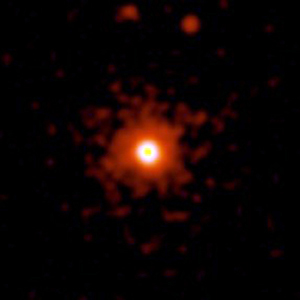
Red Dwarf Star
Red Dwarf stars are smaller than our sun. And since they are smaller, they also have less mass. Because of their small size, these stars burn their fuel very slowly, which allows them to live a very long time. This also causes these stars to not shine as brightly as others. Some red dwarf stars will live trillions of years before they run out of fuel.
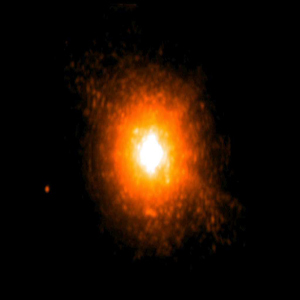
Giant Star
Giant stars are much more luminous and have shorter lifespans than the slower-burning dwarfs. The larger the giant, the shorter its lifespan; the largest stars, with solar mass of around 100, blaze at several hundred thousand times the energy of the Sun and will last only a few million years, a very brief time when compared with the Sun's 10-billion-year lifespan.
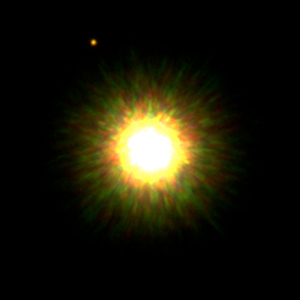
Yellow Star
Like the Sun, these medium-sized stars are yellow because they have a medium temperature. Their higher temperature causes them to burn their fuel faster. This means they will not live as long, only about 10 billion years or so. Near the end of their lives these medium-sized stars swell up, becoming very large. When this happens to the Sun, it will grow large enough to engulf even the Earth. Eventually they shrink again, leaving behind most of their gas.
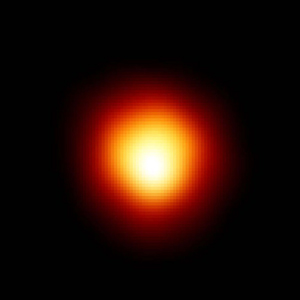
Super Giant Star
A super giant star is the exact same thing as a giant star only much bigger. Remember that as a star gets older it begins to run out of fuel. As the star runs out of fuel, it will start to burn out. Blue giant stars also begin to burn helium. As they do these stars get much hotter. This extra heat makes the outside of an old blue giant star stretch out further.