
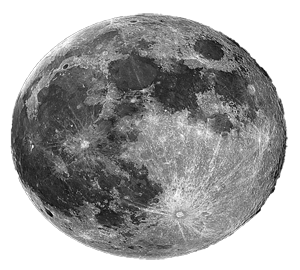
Since the moon is fairly close to the earth, it seems larger than the stars and even as large as the sun. It is 2,160 miles across and is 400 times smaller than the sun. The moon has no life on it in any form. It has not changed much over the years. The moon has no air, wind, or water. The sky is always black and the stars can always be seen. At night the temperature becomes colder than any place on earth and in the day time, the temperature of the rocks is higher than boiling water.
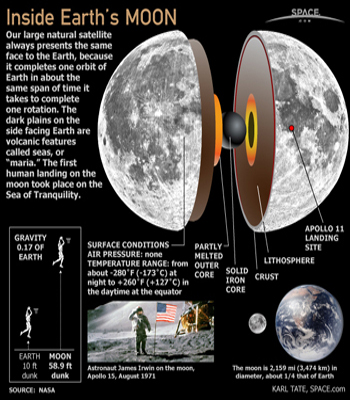
Its rocky mantle is about 825 miles (1,330 km) thick and made up of dense rocks rich in iron and magnesium. Magmas in the mantle made their way to the surface in the past and erupted volcanically for more than a billion years — from at least four billion years ago to fewer than three billion years past.
The crust on top averages some 42 miles (70 km) deep. The outermost part of the crust is broken and jumbled due to all the large impacts it has received, a shattered zone that gives way to intact material below a depth of about 6 miles (9.6 km).
The average composition of the lunar surface by weight is roughly 43 percent oxygen, 20 percent silicon, 19 percent magnesium, 10 percent iron, 3 percent calcium, 3 percent aluminum, 0.42 percent chromium, 0.18 percent titanium and 0.12 percent manganese.
The moon has a very thin atmosphere, so a layer of dust can sit undisturbed for centuries. Daytime temperatures on the sunny side of the moon reach 273 degrees F; on the dark side it gets as cold as -243.
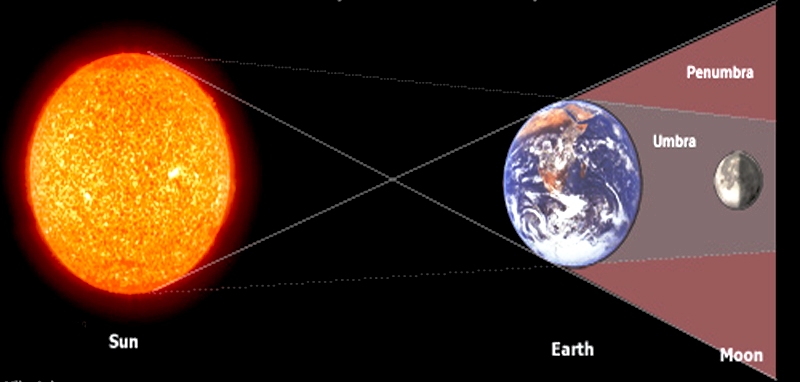
Lunar Eclipse
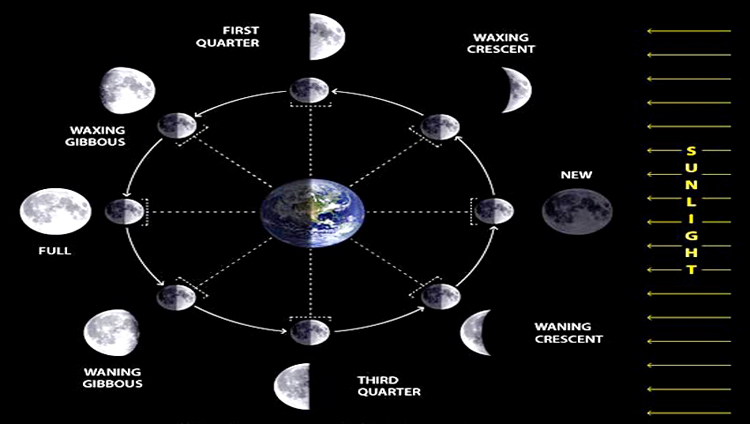
An eclipse of the Moon, or lunar eclipse, is when the Earth is between the Sun and Moon and only occurs if the Moon passes through all or some portion of Earth's umbra shadow therefore blocking sunlight directly striking the Moon’s surface. This can occur only when the Sun, Earth, and Moon are aligned exactly, or almost exactly.
A lunar eclipse occurs at night and only when there is a Full Moon. A lunar eclipse can last for many hours, and can be seen from the entire night side of the Earth.
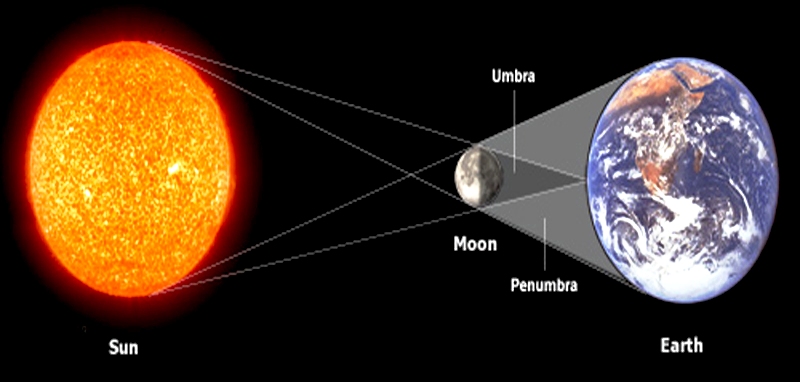
Solar Eclipse
An eclipse of the Sun, or a solar eclipse, is when the Moon is between the Sun and Earth and only occurs when the Moon is at just the right distance and angle in the sky to cover the Sun, this can only occur when the Sun, Moon and Earth are exactly aligned producing a Total Solar Eclipse. The Moon also has to be at or near one of its nodes; a node is simply the point at which the Moon crosses the eliptic from south to north or vice versa as it orbits the Earth.
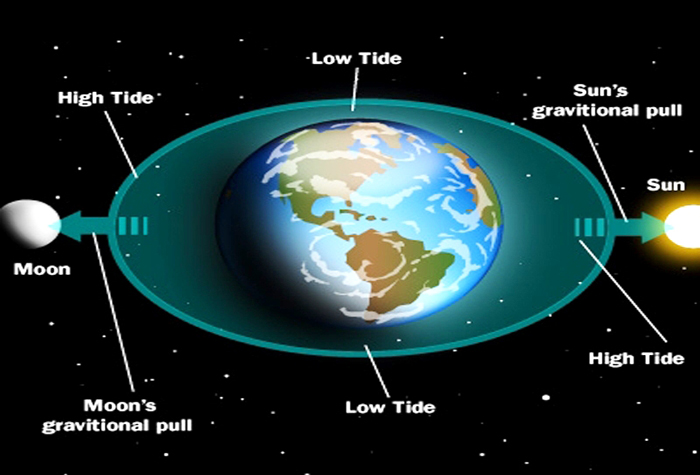
If you are on the coast and the moon is directly overhead, you should experience a high tide. If the moon is directly overhead on the opposite side of the planet, you should also experience a high tide.
During the day, the Earth rotates 180 degrees in 12 hours. The moon, meanwhile, rotates 6 degrees around the earth in 12 hours. The twin bulges and the moon's rotation mean that any given coastal city experiences a high tide every 12 hours and 25 minutes or so.