
FUEL CELL TECHNOLOGY SCAN
Fuel cells are the most efficient and extremely clean systems for generation from fossil fuels. Fuel cell is an electrochemical device that converts chemical energy of a fuel directly into electrical energy. It has two electrodes where electrochemical reactions occur in a reservoir of electrolyte that allow ions to flow between the two electrodes producing DC electricity. Fuel cells were initially used for power generation in spacecrafts. The major advantages of fuel cells are :
Constituents of a Fuel Cell Power Plant:
Fuel Cell Types :
Fuel Cells can be classified according to the type of ionic conductor they use (e.g. PAFC, MCFC, SOFC etc.) and the temperature range (i.e., high, medium & low temperature) at which they operate.
Phosphoric acid concentrated to 100% is used for the electrolyte in this fuel cell, which operates at 150 to 220 0C. At lower temperatures, phosphoric acid is a poor ionic conductor, and CO poisoning of the Pt electrocatalyst in the anode becomes severe. The relative stability of concentrated phosphoric acid is high compared to other common acids; consequently the PAFC is capable of operating at the high end of the acid temperature range (100 to 2200C). Phosphoric Acid Fuel Cells (PAFCs) are the most mature fuel cell technology. Through organizational linkages with Gas Research Institute (GRI), electric utilities, energy service companies, and user groups, DOE has helped in bringing about commercialization of the world's first fuel cell produced by ONSI. Turnkey 200-kilowatt plants are now available and have been installed at more than 100 sites in the United States, Europe, and Japan. Operating at about 2000C (4000F), the PAFC plant also produces heat for domestic hot water and space heating, and its electrical efficiency is 36-38 percent.
A molten carbonate fuel cell (MCFC) uses a carbonate electrolyte (generally of lithium and potassium carbonates) and operates at approximately 6500C (12000F). The high operating temperature is needed to achieve sufficient conductivity of the electrolyte. Because of this high temperature, noble metal catalysts are not required for the cell electrochemical oxidation and reduction processes. Molten carbonate fuel cells are being developed for natural gas and coal based power plants for the industrial and electric utility sectors. The MCFC is often referred to as a second generation fuel cell because it is expected to reach commercialization after Phosphoric Acid Fuel Cells (PAFCs) are available in the marketplace. Currently, three industrial corporations are actively pursuing the commercialization of MCFCs in the United States; these are Energy Research Corporation, International Fuel Cells Corporation, and M-C Power Corporation. Molten Carbonate Fuel Cells (MCFCs) are now being tested in full-scale demonstration plants. They offer higher fuel-to-electricity efficiencies, approaching 60%. MCFCs operate at higher temperatures, around 6500C (1,2000F), making them candidates for combined-cycle applications, in which the exhaust heat is used to generate additional electricity. When the waste heat is used for co-generation, total thermal efficiencies can approach 85%.
The solid oxide fuel cell using a ceramic electrolyte of yttria stabilized zirconia operates at about 10000C (18000F). The attractiveness of this cell relates principally to its solid state nature, its potential to reform gaseous fuel within the cells and its high operating temperature which can provide high quality heat for energy conversion or other uses. The solid electrolyte eliminates problems of electrolyte containment, electrolyte migration, and allows designs which utilize the electrolyte as part of the structural members of the cells. Solid oxide fuel cells (SOFCs) have emerged as a serious alternative high temperature technology contender. Of primary importance, is that the electrolyte is in a solid phase and not a liquid electrolyte with its attendant material corrosion and electrolyte management problems. The operating temperature of 10000C allows internal reforming, promotes rapid kinetics with nonprecious materials, and produces high quality byproduct heat for cogeneration or for use in a bottoming cycle, similar to the Molten Carbonate Fuel Cell (MCFC). However, the high temperature of the SOFC places stringent requirements on its materials. The development of suitable materials and the fabrication of ceramic structures are presently the key technical challenges facing SOFCs. Solid Oxide Fuel Cells (SOFCs) are currently being demonstrated in a 100-kilowatt plant. This fuel cell technology offers stability and reliability of all-solid-state ceramic construction. High-temperature operation, up to 1,0000C (1,8000F), allows more flexibility in the choice of fuels and can produce very good performance in combined-cycle applications. Adjusting air and fuel flows allows the SOFC to easily follow changing load requirements. Like MCFCs, SOFCs approach 60% electrical efficiency in the simple cycle system, and 85% total thermal efficiency in co-generation applications.
| Phosphoric Acid | Molten Carbonate | Solid Oxide | |
| Electrolyte | Phosphoric acid | 62% LiCO3 & 38%K2 CO3 | Yttrium - stabilised Zirconia |
| Anode | Pt/C/ | Ni-10% Cr | Ni-ZrO2 cermet |
| Cathode | Pt/C | Li-doped NiO | Sr-doped LaMn O3 |
| Pressure | 1-10 bar | 1-10 bar | 1 bar |
| Operating Temperature | 2600C | 6500C | 10000C |
| Material of Cell | Carbon | Ni, stainless steel | Ceramics |
| Fuel to Electrical Efficiency Simple Cycle (LHV) Combined Cycle (LHV) | 40% 44% | 55% 50-65% | 50% 45-65% |
| Reactant Fuels | H2 | H2 , CO | H2 , CO, natural gas |
| Applications | Power generation, transport | Power generation (base load) | Power generation, transport |
| Technology Status | nearly commercial | development stage | development stage |
Click here for a detailed comparison of all types of fuel cells.
Reformation in Fuel Cells :
Even though the electrolyte has become the predominant means of characterizing a cell, another important distinction is the method used to produce hydrogen for the cell reaction. Hydrogen can be reformed from natural gas and steam in the presence of a catalyst starting at a temperature of ~7600C. The reaction is endothermic. MCFC, ITSOFC (Intermediate Temperature Solid Oxide Fuel Cell), and TSOFC (Tubular Solid Oxide Fuel Cell) operating temperatures are high enough that reforming reactions can occur within the cell, a process referred to as internal reforming. Figures below show a comparison of internal reforming and external reforming MCFCs. The reforming reaction is driven by the decrease in hydrogen as the cell produces power. This internal reforming can be beneficial to system efficiency because there is an effective transfer of heat from the exothermic cell reaction to satisfy the endothermic reforming reaction. A reforming catalyst is needed adjacent to the anode gas chamber for the reaction to occur. The cost of an external reformer is eliminated and system efficiency is improved, but at the expense of a more complex cell configuration and increased maintenance issues. This provides developers of high-temperature cells a choice of an external reforming or internal reforming approach. The present internal reforming MCFC is limited to ambient pressure operation, whereas external reforming MCFC can operate at pressures up to 3 atmospheres. The slow rate of the reforming reaction makes internal reforming impractical in the lower temperature cells. Instead, a separate external reformer is used.
Description of a Fuel Cell based Power Plant :
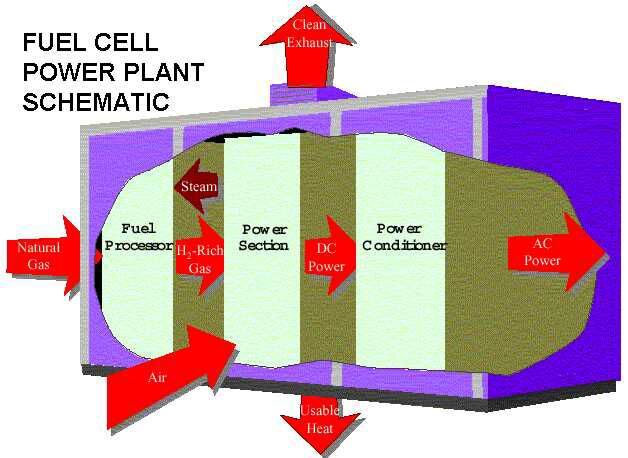
The fuel cell combines hydrogen produced from the fuel and oxygen from the air to produce dc power, water, and heat. In cases where CO and CH4 are reacted in the cell to produce hydrogen, CO2 is also a product. These reactions must be carried out at a suitable temperature and pressure for fuel cell operation. A system must be built around the fuel cells to supply air and clean fuel, convert the power to a more usable form such as grid quality ac power, and remove the depleted reactants and heat that are produced by the reactions in the cells. Figure below shows a simple representation of a fuel cell power plant. Beginning with fuel processing, a conventional fuel (natural gas, other gaseous hydrocarbons, methanol, naphtha, or coal) is cleaned, then converted into a gas containing hydrogen. Energy conversion occurs when DC electricity is generated by means of individual fuel cells combined in stacks or bundles. A varying number of cells or stacks can be matched to a particular power application. Finally, power conditioning converts the electric power from dc into regulated dc or ac for consumer use.
Status of Fuel Cell Technology :
While phosphoric acid fuel cell (PAFC) is nearest to commercialisation and has been demonstrated in 40kW to 11 MW sizes. Molten Carbonate Fuel Cell(MCFC) and Solid Oxide Fuel Cell(SOFC) are in development stage and have been demonstrated on 250kW scale.
In Japan, over 100 PAFC plants ranging from 50kW to 500 kW capacity have been developed & installed over the last six years. The largest demonstration PAFC plant is also in Japan of 11MW capacity run by Tokyo Electric Company. In Europe, there are ten International Fuel Cells Inc. (IFC) PC25 200Kw power units currently undergoing demonstration. Fuji Electric Company and Mitsubishi Electric Company are the leading manufacturers in Japan.
In the US MC-Power Corporation was set up to commercialise the MCFC technology developed by the Institute of Gas Technology(IGT) in Chicago. MC-Power is currently commissioning two major demonstration plants at 250Kw scale, one by Unocal and other by San Diego Gas & Electric Co. Energy Research Corporation, USA has provided the technology for another demonstration at 1MW scale at Santa Clara, California. Dutch Fuel Cell Corporation in an EC-Joule III programme is leading the advanced MCFC program which began in 1996. Partners in this development are British Gas, Gaz de France & Sydkraft. In Germany, a consortium led by MBB-Deutsche Aerospace is developing ERC technology for the European market. Leading developers in Japan are Mitsubishi Electric, Hitachi. Other manufacturers include IHI, Toshiba, Ebara Corp and Kawasaki Heavy Industries.
In one of the latest developments, in June 2000, a 220kW demonstration Integrated Gasification SOFC plant has been commissioned at US National Fuel Cell Research Center, Irvine, California. It consists of a Siemens-Westinghouse fuel cell integrated with a GE microturbine. Once commercialised the gasification-fuel cell hybrid systems are expected to cost around $ 1300 -1500/kW.
| S. No. | Power Plant | Capacity | Fuel Cell Type |
Year of Operation |
Remarks |
| 1. | Westervoort, Netherlands | 100 Kw | SOFC | December, 1997 | Westinghouse Commercial scale Demonstration Plant |
| 2. | Japan | 11 MW | PAFC |
|
Largest Demonstration plant |
| 3. | Chugach Electric Association, Alaska, USA | 1MW | PAFC (5 X 200kW) | August 1999 | IFC PC25 fuel cells |
| 4. | Santa Clara, California, Energy Research Corporation(ERC) | 2 MW | MCFC | April, 1996 | ERC demonstration plant. (achieved 44% efficiency) |
| 5. | US National Fuel Cell Research Centre, Irvine, California | 220 kW | Integrated Gasification SOFC | June, 2000 | Prototype, Siemens Westinghouse fuel cell, GE microturbine |
Emission Levels :
The following table compares emissions of Fuel Cells with other conventional fossil fuel power generation technologies.
|
Pollutants gm/MWh |
Pulverised coal |
Oil fired |
Gas fired |
IGCC |
Fuel cell |
| Air Particulate | 410 | 420 | 450 | 6 | 6 |
| NOx | 2890 | 1250 | 890 | 185 | 20 |
| SOx | 4950 | 3350 | ---- | 30 | 26 |
Economic Aspects :
The capital cost of PAFC is projected to be $3000/kW, while that of MOFC $1300/kW. The manufacture of hydrogen from fossil fuels is accompanied by carbon monoxide & dioxide. PAFC requires pure hydrogen while MCFC & SOFC can handle mixtures of CO & H2. The life span of a fuel cell stack is roughly 5 years while that of balance of plant is about 30 years. Therefore six sets of fuel cell sets are required during the plant life span. This increases the capital cost of fuel cell power plants considerably. Improvements in fuel cell stack life are essential for better economics.
Reference :

BACK TO MY HOME PAGE | IGCC | CFBC | PFBC | SOLAR THERMAL | WIND POWER | GEOTHERMAL | FUEL CELLS | COALBED METHANE