
COAL BED METHANE - TECHNOLOGY STATUS
Methane and coal are formed together during coalification, a process in which plant biomass is converted by biological and geological forces into coal. Methane is stored in coal seams and the surrounding strata and released during coal mining. Deeper coal seams contain much larger amounts of methane than shallow seams. Small amounts of methane are also released during the processing, transport, and storage of coal. Although the volume of methane contribution to the total GHG emissions is three times smaller than that of carbon dioxide, at the same time, methane is a particularly strong GHG, its greenhouse potential is 21 times higher than that of CO2. Over the last two centuries, methane concentrations in the atmosphere have more than doubled, largely due to human-related activities, including rice production, waste disposal, cattle ranching, large scale extraction and transportation of oil and natural gas, and mining.
GLOBAL POTENTIAL OF COAL BED METHANE
On a global basis, coalbed methane now contributes more than 1TCF (trillion cubic feet) of gas per annum. Coalbed methane accounts for between 3 percent and 4 percent of all gas production in the U.S.A.
Coalbed Methane resource appraisal, drilling and production testing are presently underway in at least a dozen other countries, and the proportion of non-US production can be expected to soar during the next 10 years. China, the world�s largest coal producer, has generated particular interest. Its coalbed methane resources are estimated to range from between 1,000 and 2,800 TCF, many times larger than its conventional gas potential. Chinese coal mine operations already extract gas from within the underground workings. In 1990, 110 mines recovered 15 BCF of coalbed methane. Although modest, this production has demonstrated to the Chinese authorities the viability of the resource. As a result a number of areas have now been joint ventured with foreign companies with initial drilling showing promising results.
India�s coalbed methane resource potential has been estimated at 280 TCF, again far surpassing its conventional gas endowment. Partnerships between U.S. and Indian companies are presently drilling and evaluating several large coalbed methane exploration permits. On the basis in initial investigations, Bangladesh, too, is regarded as having the potential to produce moderate to large volumes of coalbed methane in close proximity to major markets. In the Philippines, interest in coalbed methane is being sparked by the fact that high gas prices would compensate for the several southern African countries with extensive coal deposits. Drilling success in Zimbabwe has demonstrated the prospect of commercial coalbed methane development in the country.
In several parts of Eastern Europe, a number of coalbed methane ventures involving foreign investment and applications of U.S. technology are reported to have met with mixed success. Production tests in some regions are said to favour commercial production, which is anticipated one negotiations with regulatory authorities have been resolved.
The tempo of coalbed methane exploration has increased significantly in Australia since the entry of major international coalbed methane producers, such as Amoco and Conoco, and the involvement of major utilities such as Pacific Power and AGL, together with a number of smaller groups. These efforts are backed by a major research effort which is modifying US technologies to suit local conditions.
CHARACTERISTICS OF COAL BED METHANE RESOURCE:
In conventional sandstone and limestone reservoirs, gas occurs in a free or dissolved phase, but in CBM reservoirs, gas exists almost exclusively in a condensed, liquid-like state. Coal has high micro-porosity with large internal surface areas and, therefore, adsorbs and retains large amounts of gas.
CBM reservoirs occur at various depths, but most exploration focuses on reservoirs above 6000 ft depth. Shallow CBM reservoirs (<3000 ft) contain bacteriogenic gas. The generation of gas per ton of coal in shallow reservoirs is often low
(<50scft/ton), but the thickness and extent of some coal deposits have resulted in gigantic accumulations. This is observed in the Powder River Basin, USA with a resource between 24 and 34 Tcf of CBM. Deep CBM reservoirs (>3000 ft) contain methane generated by the cracking of kerogen and oil in coal to gas. Generation of thermogenic gas increases exponentially as vitrinite reflectance (coal rank) increases. Therefore, deep CBM reservoirs can be attractive exploration targets due to their great generation potential and low water saturation. Overpressured CBM reservoirs occur at various depths of burial; their source is thermogenic gas that has migrated up-dip from deep coal beds.The influx of meteoric water through permeable coal beds controls gas migration. This can lead to accumulations of gas at permeable barriers or the flushing of gas to the surface. The infiltration of meteoric water can also lead to the generation of bacterial gas in shallow coal beds.
COAL RESERVOIR CHARACTERISTICS
Since the beginning of the coalbed methane industry, operators have relied greatly on technology from the mining and petroleum industries to evaluate and develop coalbed methane properties. Much of this conventional oil and gas technology applies to coalbed methane operations, but often it must be modified. In some cases, coalbed methane operations require entirely different techniques. The unique characteristics of coal reservoirs often are responsible for the need to use a different engineering approach. Through coalbed methane research, producers have learned much about the unique characteristics of coal reservoirs. The most important of these characteristics are:
KEY ADVANCES IN COALBED METHANE TECHNOLOGY
The tax incentives played an important role promoting coalbed methane development in USA, however, new technology was the primary driver in making coalbed methane a commercial success. Price incentives or tax incentives were available for coalbed methane production from 1978 through the early 1980s, yet, significant development did not begin until 1987. The driving force for this growth in coalbed methane production was the development and dissemination of reservoir engineering and completion technology. In 1982, little was known about which technologies were necessary for a successful coalbed methane project. The mechanisms of producing gas from coal seams were poorly understood. Key issues such as how to characterize coal reservoirs, how to effectively complete and stimulate coalbed methane wells, and the importance of permeability and how to measure it were not well defined. To address these reservoir and production issues, GRI initiated several field based research projects and cooperative research projects with producers. Many of the early advances in reservoir characterization and completions of western coal seams were achieved at the GRI Deep Seam Project site in the Piceance Basin of Colorado. The GRI Rock Creek Project in Alabama was a key site for reservoir characterization and completions of multiple seam coals. A joint project between Amoco and GRI in the San Juan Basin, known as the COAL site, provided a research basis for understanding cavity completions. The coalbed methane research has produced three key technological advances in reservoir engineering:
Understanding the Fundamentals of Coalbed Methane Production
Initially, research focused on understanding the fundamental differences between coalbed methane and conventional reservoirs. Later work centered on developing tools for predicting coalbed methane production. The understanding of coalbed methane has advanced so that reservoir engineers can evaluate new properties and manage production from existing wells over the long term. To successfully produce coalbed methane wells, it is essential to:
1) identify factors that control production in coal reservoirs,
2) understand the relationship between gas content and sorption isotherm for specific developments, and
3) maintain low backpressure on wells to increase recovery. Each of these points is discussed below.
Factors that Control Production in Coal Reservoirs. Early work showed that gas is stored in an adsorbed state on coal, and thus for a given reservoir pressure much more gas can be stored in a coal seam than in a comparable sandstone reservoir. Production of gas is controlled by a three step process & desorption of gas from the coal matrix, diffusion to the cleat system, and flow through fractures. Many coal reservoirs are water saturated, and water provides the reservoir pressure that holds gas in the adsorbed state.
Relationship Between Gas Content and Sorption Isotherm. Another mechanism that controls production is the relationship of gas content to sorption isotherm. The sorption isotherm defines the relationship of pressure to the capacity of a given coal to hold gas at a constant temperature. Gas content is a measurement of the actual gas contained in a given coal reservoir. A coal reservoir is undersaturated if the actual gas content is less than the isotherm value at reservoir temperature and pressure. Accurate measurements of both gas content and the isotherm are required to estimate the production profile of the well.
Maintaining Low Backpressure on Wells. The ultimate recovery of gas depends on gas content and reservoir pressure. Gas production will not initiate until reservoir pressure falls below the point where the gas content of the coal is in equilibrium with the isotherm. Because most coal reservoirs are aquifers, production of water from the wellbore is the primary mechanism of pressure reduction. If the gas content of the reservoir is below the isotherm, then the reservoir will produce only water initially. After this single phase flow period, bubble flow initiates when reservoir pressure reaches the saturation point on the isotherm. Eventually, two phase flow of gas and water occurs as pressure is further reduced in the reservoir. Because of the relationship between gas desorption and reservoir pressure, it is important to produce coalbed methane wells at the lowest practical pressure.
Advances in Measuring Reservoir Properties. In 1982, few references were available on testing coalbed methane wells. Today, the results of extensive field research has greatly advanced the understanding and application of coalbed methane well testing. Much of the knowledge used to perform and interpret coalbed methane well tests has been modified from well testing technology used in the oil and gas industry. Research on coalbed methane well testing has produced several useful findings:
A wide variety of tests can be used to evaluate coalbed methane wells. These include production or injection drillstem tests, cased-hole production and injection tests, slug tests, tank tests, and tests combined with production logging. Selecting the test type depends primarily on the completion type of the well, the level of natural fracture system development, the average pressure of the natural fracture system, and the reservoir saturation conditions. Economic factors will also influence test selection. The least expensive tests are water production or injection slug tests of higher permeability under-pressured reservoirs.
Designing coalbed methane well tests requires estimates of the ranges of reservoir permeability and pressure. When testing wildcat wells in unknown areas, standard test procedures must be used and modified because permeability estimates are not available before testing. Measuring permeability from well tests can be difficult because two-phase flow of gas and water usually occurs during production. Most early coalbed methane well testing research was based on single-phase flow and standard hydrologic tests. Recently, significant advances have been made in performing and interpreting two-phase well tests for naturally fractured coal reservoirs. However, current technology in both single- and multiphase- flow can provide accurate estimates of permeability if tests are properly designed and interpreted.
Today, most coalbed methane well test interpretation is based on using diagnostic graphs and history matching measured pressure behavior. Though coalbed methane reservoirs are dual porosity systems, dual porosity models are not required to interpret well test behavior. Using single porosity models simplifies the analysis procedures. Commercially available well test analysis software can be used for interpreting coalbed methane reservoir tests by accounting for multiphase flow and including gas readsorption in the total compressibility factor. Other approaches, such as new type curves for two-phase flow conditions, are also being developed.
Despite the large number of coalbed methane wells on production, few well tests are routinely performed. It is important to understand, however, that by using current coalbed methane well testing technology, producers can obtain accurate, cost-effective estimates of permeability for evaluating existing properties and new prospects in emerging coal basins. Continued advances in interpreting multiphase flow well tests are likely in the future. These advances will be enhanced by the increased emphasis on reservoir characterization, data integration, and computer technology.
Advances in Reservoir Simulation. In 1980, GRI sponsored research to develop a coalbed methane reservoir model and define coalbed methane production mechanisms. GRI led the industry in developing a reservoir model that incorporated the unique physical properties of coal including desorption, matrix diffusion, and fluid flow through bulk coal seams. The validated GRI model was used in a study to determine optimum well spacing in the San Juan Basin. The results of this study provided industry with guidance on placing wells and improving field economics. Several coalbed methane simulators patterned after the GRI model are now commercially available.
By the mid to late 1980s, a number of organizations had modified their existing in-house black oil models or built new reservoir models specific to coalbed methane production, and several reservoir models became commercially available. Today, more than fifty coalbed methane simulators have been described in literature reviews. Simulators are grouped by how they treat the gas desorption process. Equilibrium simulators use single porosity and partial differential equation formulations to predict gas recovery. Non-equilibrium simulators are modified versions of conventional dual-porosity simulators used for naturally fractured oil and gas wells. Either type of simulator can be used successfully to model coalbed methane production. Though conventional reservoir models can be used to estimate coalbed methane production, models designed specifically for coalbed methane simulation should provide more accurate production estimates. Reservoir models provide an excellent way to organize data and assess the influence of reservoir properties on production. Often the number of variables needed is greater than those typically measured. Thus, a key to successful modeling is to history match actual production. Reservoir properties should be used on a consistent basis so the material balance criteria for gas-in-place is satisfied. For example, the gas content value used for calculating gas-in-place should be based on the same ash content value as that of the coal thickness.
Integrated GRI reservoir studies in the San Juan Basin and Black Warrior Basin have produced the following key results:
Using the coalbed methane reservoir simulation tools currently available, you can perform quick and accurate screening studies. By knowing key reservoir parameters (coal thickness, gas content, sorption isotherm, and permeability) and assuming several engineering parameters (well spacing and fracture length), you can estimate production and recovery for a particular coalbed methane property.
METHANE EMISSIONS IN MINING
Methane emissions in mining come from:
Methane recovery from coal seams provides a number of benefits. The frequent accidents occurring in mines are largely caused by the explosion of coal mine methane, which accumulates in the mining process. This methane can be recovered and sold. Methane recovered from the mining sites will not only significantly reduce greenhouse gas emissions, but could also be a substitute for fuel, which is currently being imported from outside Ukraine.
Methane emissions from coal mines can be reduced by recovering and using methane from underground mines and by oxidating of methane from ventilation air. Recent technologies make both ways easily feasible. Methane recovery technologies include vertical wells drilled from the surface or boreholes drilled from inside of the mines. Depending on gas quality, methane recovered from underground mines may be sold to natural gas companies, used to generate electricity, used on-site as fuel for drying coal, or sold to nearby industrial or commercial facilities.
The oxidization of coal mine ventilation air produces heat that can be used directly on-site or to produce electricity. Coal mines in the U.S. do not currently use the oxidization technology, but it has been successfully demonstrated in Great Britain.
Carbon dioxide emissions per unit of electricity generated are typically in the order of:
USES OF COAL BED METHANE
INDIAN SCENARIO:
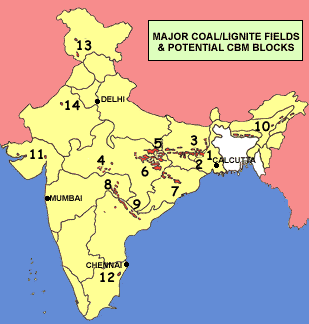 |
Fields |
No. of Blocks |
|
1. Raniganj |
(3) |
|
|
2. Jharia |
(2) |
|
|
3. E. Bokaro & W. Bokaro |
(2) |
|
|
4. Satpura |
(1) |
|
|
5. Singrauli |
- |
|
|
6. Sohagpur |
(2) |
|
|
7. Talcher |
- |
|
|
8. Chanda-Wardha |
- |
|
|
9. Godavari Valley |
- |
|
|
10. Tertiary Coal fields of NE |
- |
|
|
11. Gujarat (Sub-Surface Coal) |
- |
|
|
12. Neyveli Lignite |
- |
|
|
13. J & K Coal Fields |
- |
|
|
14. Palana-Rajasthan |
- |
Taking the cue from the development of CBM in USA as a precautionary measure for coal mining, Essar initiated the first CBM project in India. Targeting the deep coals of Cambay Basin of Gujarat, Essar started the project at Mehsana. Essar is today indigenously producing methane form one of the three wells drilled. Block CB-ON/3 will be exploited for it's CBM potential with government�s approval.
India's Directorate General of Hydrocarbon (DGH) has identified nine blocks in four states - Gujarat, Jharkhand, Madhya Pradesh and West Bengal for exploration and production of CBM that will be offered for bidding. The government is also planning to come out with the third round of exploration blocks for oil and gas under the New Exploration Licensing Policy by the end of December 2001, exactly after a year of announcing the second round of 25 blocks. The roadshows for the second round, which includes eight deepwater blocks in the west coast for the first time, and eight shallow water blocks both on east and west coast and nine blocks on land, has been very successful with government confident of an investment inflow of over $2 billion in the upstream exploration and production.
The coal-bearing formations of India occur in two distinct geological horizons : the Lower Gondwana (Permian) belts of Peninsular India and the Tertiary sediments (Eocene-Oligocene) of north-eastern India, Gujarat and Jammu-Kashmir. Entrapped within them across a wide range of subsurface depths, is methane gas whose recovery has been recognised as a viable option to enhance the natural gas potential of the country. Accordingly, a Coal Bed Methane (CBM) Exploitation Project has been formulated by the DGH with the help of the Ministry of Petroleum and Natural Gas. The project involves four phases :
In the immediate context only Phase 1 is being considered and, to start with, the shallow depth coalbeds of the Lower Gondwanas of the eastern and central parts of Peninsular India will be on offer. The areal extent of these beds is of the order of 11000 sq. kms, made up of :
ECONOMICS:
In "Technical and Economic Assessment of Potential to Upgrade Gob Gas to Pipeline Quality" published by the EPA in December 1997, the estimated cost as correlated to cost per MMBtu process is between $1.30 an $1.60.
Wellhead Gas Price = US$ 1.5/Mcf

BACK TO MY HOME PAGE | IGCC | CFBC | PFBC | SOLAR THERMAL | WIND POWER | GEOTHERMAL | FUEL CELLS | COALBED METHANE