| Index |
| True Fir |
| Spruce |
| Pine |
| Hemlock |
| False Cedar |
| Other Conifers |
| Bibliography |
True Firs
AbiesThere are three types of true fir (Abies) in Coastal British Columbia, Ambilis fir (also known as Pacific Silver fir, Abies ambilis), Grand fir (Abies grandis), and Subalpine fir (also known as Alpine fir, Abies lasiocarpa).
The name Abies is derived from Latin abeo, meaning "to rise", and refers to the great height attained by some species. Fir is derived from Old English furh or fyrh or Danish fyrr, meaning "fire", from its use as firewood. None of the true firs grow on the Queen Charlotte Islands (off the west coast of British Columbia north of Vancouver and Vancouver Island).
Jump to: Home| Projects Page| PRP Page
 |
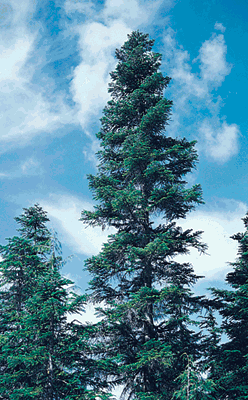 |
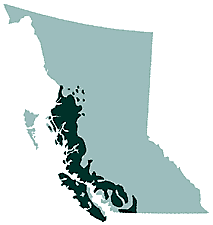
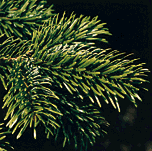
The Pacific silver fir is a straight tree with a dense cone-shaped crown, usually 50 m tall when mature, although it has been found to be 72 m. It is usually found in coastal forests above 300 m elevation in a maritime habitat with moist soils. Its needles are dark green and arranged in flattened, spray-like branches. These have blunt ends and are usually notched at the tip. The seed cones are dark purple and held upright at the top of the tree and the pollen cones are reddish.
Photos and map from Tree Book B.C. Online
Information from 2 sources
Back
Grand fir
Abies grandis
 |
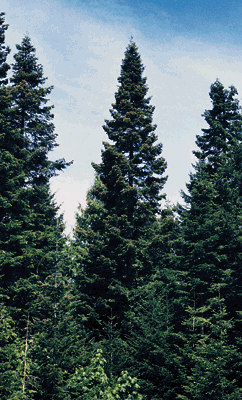 |
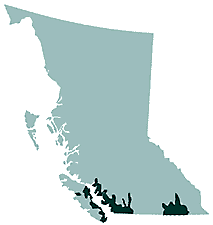
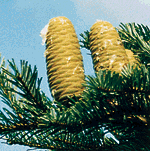
A tall, stately tree, grand fir can grow to 80 m tall when mature. It is most easily distinguished from other true firs by its sprays of lustrous needles in 2 distinct rows. These needles are usually spread so horizontally that both the upper and lower sides of the branches are clearly visible. Seed cones are barrel-shaped and yellowish to green, growing upright on the branches high in the crown. It is found from sea level to mid-elevations along the southern coast.
Photos and map from Tree Book B.C. Online
Information from 2 sources
Back
Subalpine fir
Abies lasiocarpaAlso known as Alpine fir
 |
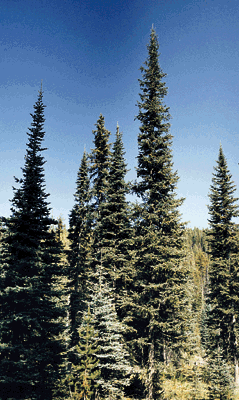 |
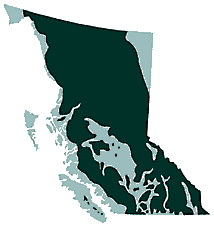
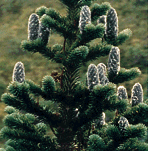
A tall, stately tree, grand fir can grow to 80 m tall when mature. It is most easily distinguished from other true firs by its sprays of lustrous needles in 2 distinct rows. These needles are usually spread so horizontally that both the upper and lower sides of the branches are clearly visible. Seed cones are barrel-shaped and yellowish to green, growing upright on the branches high in the crown. It is found from sea level to mid-elevations along the southern coast.