| Index |
| True Fir |
| Spruce |
| Pine |
| Hemlock |
| False Cedar |
| Other Conifers |
| Bibliography |
Pines
PinusWhitebark Pine (Pinus albicaulis)
Shore Pine (Pinus contorta var. contorta)
Lodgepole Pine (Pinus contorta var. latifolia)
Western White Pine (Pinus monticola)
Jump to: Home|
Projects Page|
PRP Page
Whitebark pine
Pinus albicaulis
 |
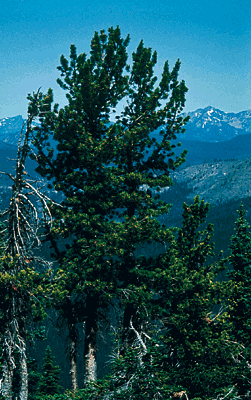 |
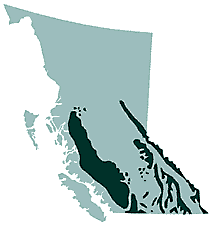
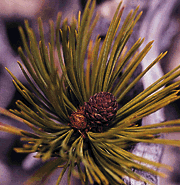
Whitebark pine is usually under 15 m tall and 60 cm in diameter and often distorted or shrub-like. Needles are 3-9 cm long and occur in bundles of 5 with faint, white lines on all surfaces. It has small, woody seed cones with thick cone scales. These fall from the tree intact although they do not have "wings". The bark is thin, smooth, and chalk white on younger trees, and becomes thicker and forms narrow, scaly, brown plates as it gets older. Found in southern British Columbia at or near timberline from 2,350 to 3,750 m elevation.
Photos and map from Tree Book B.C. Online
Information from
3 sources
Back
Shore pine is short, up to 20 m tall (sometimes straight and up to 30 m tall),
and often has a crooked trunk with moderately thick bark, which is scaly or deeply
furrowed into plates and dark brown to blackish-brown. It often has an irregular
pillow-like crown. Needles are in pairs, each 2 to 7 cm long, often curved or
twisted and deep green in colour. The pollen cones are small and reddish-green.
Shore pine is highly adaptable and tolerant of low-nutrient conditions. It is
found at low to middle elevations from dunes to bogs to rocky hilltops to exposed
outer-coast shorelines.
Shore pine
Pinus contorta var. contorta
Information from 2 sources
Back
Lodgepole Pine
Pinus contorta var. latifolia
 |
 |
 |
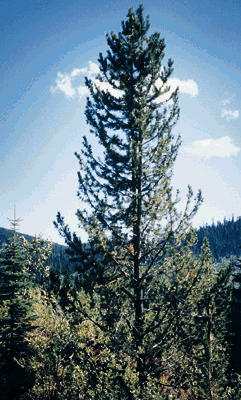 |
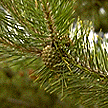
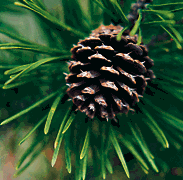
Lodgepole pine is similar to shore pine except it is taller and straighter, up to 40 m tall with thinner and redder bark.
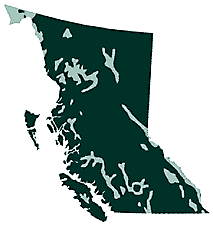
Lodgepole pine has two needles per cluster, each 2-8 cm long, and commonly twisted.Seed cones are small and egg-shaped (2-4 cm long), often with a prickle. These may remain closed on the tree for years. The bark is thin, dark, and flaky. Lodgepole pine is abundant in the northern Rocky Mountains and Pacific Coast region. Inland populations grow from sea level to elevations of 3,600 m.
Photos from Tree Book B.C. and Tree of the Pacific Northwest, map from
Tree Book B.C.
Information from 2 sources
Back
Western white pine
Pinus monticola
 |
 |
 |
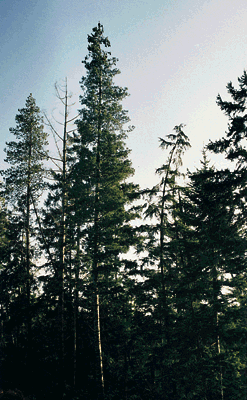 |
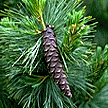
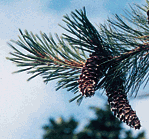
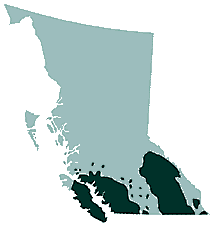
A large tree 40 m tall, Western white pine usually grows in closed groups of trees and has a short, open crown. Needles are 5-10 cm long each and occur in bundles of 5. They are bluish-green with white lines on 2 sides of each needle. Western white pine has woody seed cones, 10-25 cm long that are slender and curved with seeds that are 3 cm long inside. The bark is dark, broken into small squares or rectangles on older trees (smooth on young trees). Bark often "ringed" where a whorl of branches once grew. Occurs in southern British Columbia in moist valleys to fairly open and dry slopes, from near sea level to subalpine elevations.