
EIRENNIA SCOTIA
Information on the Hibernian State ∫ A service of the Ministry of Foreign Affairs
GET INFORMATION







HIBERNIAN CULTURE & VALUES
RELIGION
CRÌOSTAÌOCHTA
Ninety seven percent of all Hibernians follow the native religion of Hibernia, Chíostaíochta. Chíostaíochta is distinctly monotheistic. Followers of the Chíostaíochta faith believe that the world was created by the sovereign, personal, and all good God. The Hibernian God is three separate parts of a singular whole, called a trinity. Humankind has fallen from its original glory and is responsible for slow destruction of a once perfect creation. According to Hibernian religious tradition, God took human form of Chríost, born of a virgin mother, and lived amongst humankind as an example of ideal values and behavior. God, who had become whole man and whole God, was sacrificed, died, was buried, and rose again. In his resurrection, he defeated the the original sin of man and bridged the rift between God and humanity caused by the fall. God will return for judgment and resurrection on the last day. The faithful are to be delivered to a second paradise creation. The souls of those who deny God are to be extinguished.
The central points of the Hibernian religion are:
Reciprocity: Do to others as you would want done to you.
Attempt to do good and live by God's Truths.
Sin, or transgressions, are forgiven through faith in God's mercy.
Practitioners seek to develop a personal relationship with their God through prayer and reflection.
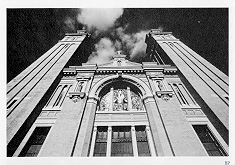
St. Padraig Cathedral, Avalon
Religious devotion is considered highly personal and attendance at religious services, called a Mass, are not required or expected. Mass is held three times daily at dawn, noon, and dusk. In between Masses, priest are available for counseling and offer religious training. The religious centers, called temples, are primarily a place of learning, however they often store local records, history, and traditions.
Pilgrimage to the St. Padraig Cathedral is common during the holy days during the spring and autumn equinox. The spring equinox is considered the day that the Hibernian God took human form and was born. The samhain festival and feast during the fall equinox celebrates the salvation of humanity through the death of Chríost and is also a celebration of the fall harvest. During samhain, a torchlight parade marches from the foothills of the poitainian mountains to St. Padraig Cathedral in Avalon. The beltane feast begins with the winter solstice and lasts until the first day of the new year. It is a feast of thanksgiving and good will. Gifts are exchanged, parades are held, charity activities common are during the beltane feast.
The Hibernians are highly tolerant of other religious views. Because the Chíostaíochta faith is common throughout Hibernia, there is little established means of conversion. As a result, there are no formal missionary or discipleship organizations in or from Hibernia.
OTHER HIBERNIAN FAITHS
Hibernians are almost interiorly followers of Chíostaíochta. However, there does exist several small regional religions. In the more traditional north, ancient tautha religions are still practiced. Most of these religions are polytheistic with a high God from whom the lesser gods derive their powers. They believe that the universe is a place animated by many spirits, some friendly and some not. Humans have a real place in the cosmos. which works by rules and cycles that can be known. Nature takes an important role in all ancient tautha religions. Approximately two percent of all Hibernians beleive in traditional tautha religions.
A small one percent of all Hibernians believe in religions not native to Hibernia.
[TECH] Chíostaíochta is a parallel to Christianity. The ancient tautha religions are a parallels to ancient Druidic and Greek religion. [/TECH]
The State of Independence