|
Ancient Greek art
progressed through five stages of refinement. The first stage was the Geometric
(900- 800 BC), during which the
Greeks remained a closed culture. Much of the
art was highly stylized and reminiscent of "primitive" art.
The second period was the
Oriental (800-650 BC) Period, which was influenced by Persian
areas.
The third period was the
Archaic (650-480 BC),
during which middle eastern cultures were further absorbed. This
period is characterized by symmetric, idealized figures and the common kouros
& kore, sculptures of the simplified forms of adolescent males
and females.
The fourth period was the
Classical (480-330 BC), when Greek art developed into a more sophisticated
and finished style. It boasted the innovation of the contrapasto
position in statuary, which allowed for greater realism, and the
development of head to body ratios. Praxiteles and Phidias, the
Parthenon sculptor, were prominent artists during this era.
The last period in
ancient Greek art was the Hellenistic (330-325 BC). Sculptures took
on a flowing grace and the art emphasized action and emotion through
elaborate detailing. Among the more famous Hellenistic pieces are the
"Apollo Belvedere" and "Nike of Samothrace."
Greek vase art had three
periods of its own: Geometric, Orientalizing (progressively narrative),
and Archaic, which emphasized balance and definition. Early vases
were "Black Figure," and, after an innovation in process
which allowed for greater detail, the Greeks developed "Red
Figure" pottery.
Vase paintings included
images of gods, scenes from myths, or scenes from daily life. Sculpture
primarily served as tribute to a particular god.
Since the Muses are not
especially prominent figures in Greek art, their forms are most often depicted
at centers of learning, at their shrines, and in the presence of Apollo. Their first shrine was built at
Askra, near Mt. Helicon. Two others were the Valley of the Muses near Helicon, and the Museum of Alexandria, founded by Ptolomy I.

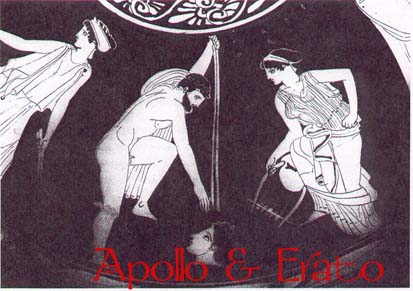
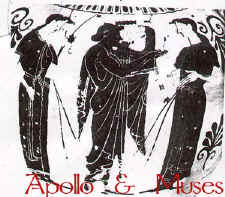
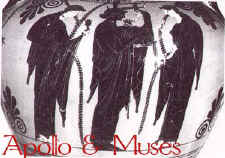
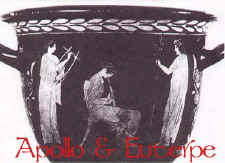
Brief descriptions of
the character & scenes on the pottery:
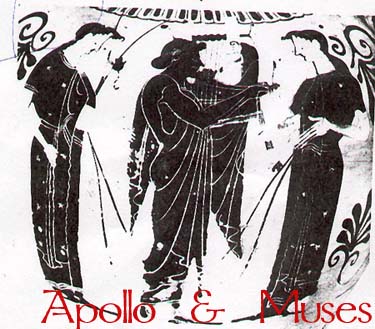
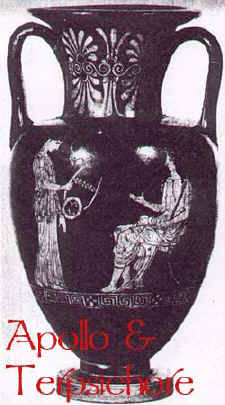
1. This image is a traditional scene where two of the
Muses (unidentifiable)
accompany Apollo.
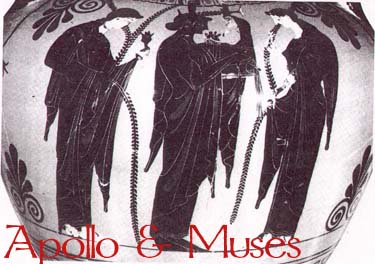
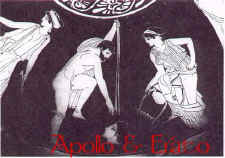
2. Again, Apollo with two Muses (unidentifiable).
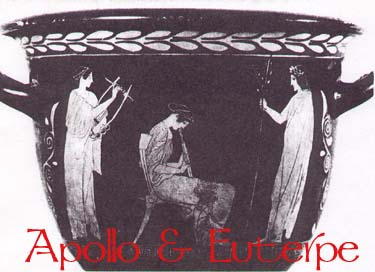
3. The Muses Erato or Terpsichore, on the left with the lyre, and Euterpe,
center with the flute, playing for Apollo.
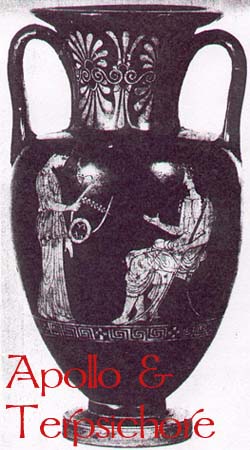
4.The Muse Terpsichore or possible Erato with the Archer Apollo.
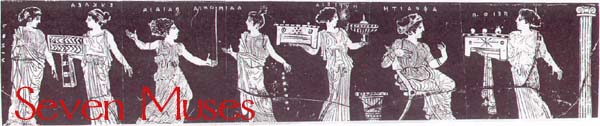
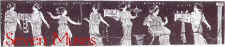
5. Seven of the Nine Muses. Among them are Clio (second in), Urania (Third in)
and Erato (Fourth in), the rest are hard to identify.
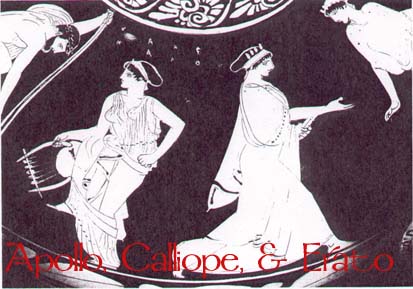
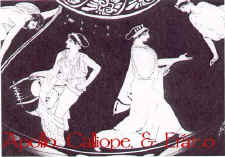
6. Erato (left) with lyre, Calliope (right) with scroll, and Apollo
with
an unidentifiable man.
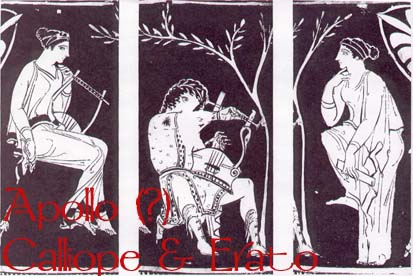
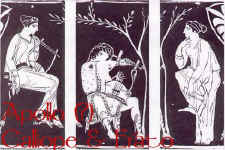
7. Calliope (with the scroll right) and Erato (with lyre left) with Apollo
or a bard (center with lyre).
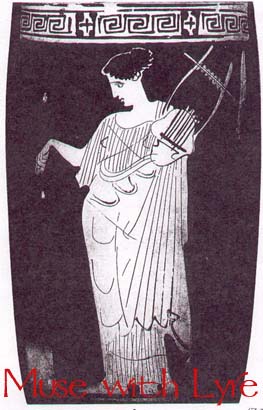
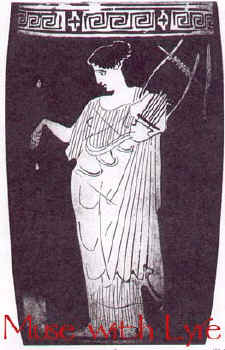
8. Terpsichore or Erato with her lyre.
9. Erato on the right, and Clio or Calliope on the right with Apollo in
the center speaking to or healing a woman.
The pottery fragments
here were scanned from various museum & archaeological catalogues as
listed in the bibliography, and neither names nor dates were given.
Following is a list of
the sources (abbr.) and plate numbers, if available, for each image:
-
Plate 16.
Los Angeles City Museum of Art.
-
Plate 9.
Badisches Landemuseum Bande 3.
-
Plate 115.
Kunst Museum Bande 3.
-
Kunsthistorisches
Museum Band 2.
-
Metropolitan Museum
of Art, The.
-
Basel Bande 3.
-
Suisse.
-
Suisse.
-
Basel Bande 3
|
Plates are in
Ascending Order:
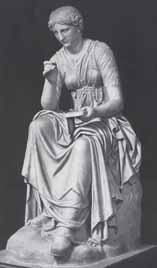
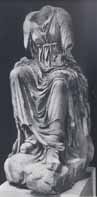
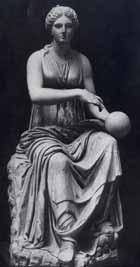
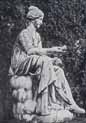
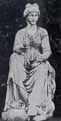
Statues of Calliope,
titles unknown.
These Images Accidentally
supplied by Andrea Wolfgang.
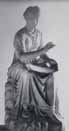
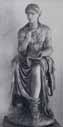
Turr.
|
|