 |
Reading Twp., Illinois Armstrong Family |
|
|
Reading Twp., Illinois Armstrong Family |
|
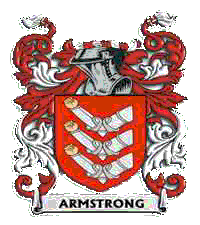
When Siward's king was dismounted in battle (reputedly the Battle of the Standard in 1138, at Northallerton in Yorkshire) Siward lifted him bodily onto his own horse. Not a mean feat considering a man in full armor weighed upwards of 300 lbs... Impressed and grateful, the king asked "What is your name, Sir Knight?" "Siward Beorn" was the reply. "No longer!" declared the king, "Henceforth you shall be known as Siward the Arm Strong!" (cf "Fortinbras"). A wonderful story which has, alas, not stood up to scrutiny. [Author's note-- I had the word "scrutiny" hyperlinked to a page that unfortunately is no longer available It documented certain descrepencies of dates that cast doubt on the Seward Beorn legend. If it is to be believed, however, the king would've been David of Scotland. Doing a Google search on "battle of the standard" produces a lot of very interesting results, none of which mention the incident with Siward. When reading them one needs to bear in mind that the Scots lost that battle and that history is written by the winners.] The origin of the clan name notwithstanding, by the 16th century the Armstrongs were indisputably the most powerful of the notorious border raider (reiver) clans that terrorized the Debatable Lands of Scotland's southern border with England. It was said that the Armstrongs could field 3,000 armed horsemen at a moment's notice. The coat of arms above is tame compared to the coat of arms which hung in the entryway of George Arlie Armstrong's home-- Three "braced arms in armor" as above, but the uppermost brandished an armored leg severed at the thigh and dripping blood. This latter coat of arms appears to have originated in Ireland. The reivers have obtained a certain romantic folk hero status, a lá Robin Hood, and are mentioned in many Scottish ballads as well as in the poems of Sir Walter Scott: "Ye need not send to Liddesdale,
Much of what is
known of the Armstrongs and the other reiving clans was recorded by English
historians who would hardly have been objective in their portrayal of a
dangerous enemy. The English of that era did not exactly fit the
picture of noble chivalrous behavior often painted in popular history either,
given to treacherous acts of betrayal and practitioners of horrific forms
of torture. This isn't to imply that they were any worse than
the rest of Europe in that regard, the Middle Ages were brutal times and
torture was a common political tool.
Johnnie's exact words to James V are reputed to have been "I am but a fool to seek grace at a graceless face, but had I known you would've taken me this day, I would've lived in the borders despite King Harry and you both". When there was no
fight to pick with the English the reiving clans feuded fiercely amongst
one another. In truth, they weren't above raiding on the Scottish
side of the border when it suited their purpose. The incessant raids
and
unrest in the borderlands made it next to impossible for the people of
the area to build or acquire much material wealth or even lay in winter
provisions-- other than the reivers themselves, of course. This,
in turn, forced otherwise peaceful clans into reiving simply to survive.
A vicious cycle that lasted for generations.
To their families and friends I can only offer the Armstrong clan motto:
|
|
"2). The First Generation...... Joseph & Jennet of Pennsylvania Joseph Armstrong was born about 1711 in North Ireland. In 1731, he emigrated from Fivemiletown, County Fermanagh (now known as Fermanagh District, Northern Ireland), about five miles from Brookeborough, settling in the Cumberland Valley, at that time in Franklin County, PA. He purchased his land from the Penn Properties. The earliest date which shows positive possession of land is 1737 but his first warrant, numbered 9, was dated August 26, 1751 and can be found in Survey Book A66, page 255, Pennsylvania Land Office, Harrisburg. This warrant antedated the town of Chambersburg, or Falling Spring, which was laid out in June 1764. He acquired other land in the vicinity as well, eventually owning over a thousand acres. That land is now part of St. Thomas Township, Franklin County and lies along the south slope of North Mountain near the present town of Edenville. It is well located, slightly rolling, very fertile soil watered by a spring fed stream then called Armstrong's Run (now known as Wilson's Run). That part which extended up the mountain was heavily wooded and was termed "mountain land". The Joseph Armstrong farm is well-marked with a roadside plaque placed by the Historical Society of Pennsylvania, just east of Edenville on the Chambersburg-Edenville road. Joseph was active on the frontiers in the French and Indian Wars and was a captain in the Provincial forces, serving almost continuously from 1755 to 1758. He was with his relative Colonel (General?) John Armstrong of Carlisle, PA at the destruction of Kittaning, was Provincial agent at the building of the Great Road from Ft Loudon to Fort Pitt (now Pittsburgh), and represented Cumberland County in the Assembly from 1756 to 1758. He also acquired a large plantation in Orange County, North Carolina (Chapel Hill is the largest city in Orange County and thus may be the county seat.). From this fact it appears that he may have been at sometime in NC where a great many Armstrongs settled and to which many of them removed from PA. Joseph's wife was Jennet Stewart. They had five sons, John, Thomas, Joseph, James and William and two daughters, Catherine and Margaret. [Jennet Armstong has long been said to have been a Stewart but as far as I know no documentation of her maiden name has been found. Jennet, or Jinnet, is a variation of Jane.] John, Thomas and Joseph were with their father, Captain Joseph, at the destruction of Kittaning in 1756. Kittaning today is a city of over 5,000 in population. It is in Armstrong County, PA, on the Allegheny River, about 35 miles northeast of Pittsburgh. In 1756, it was probably a French fort. John later removed to NC where he rose to Lt. Col. in the Continental Line of NC. William may have accompanied John because he became a Capt. in the same organization. Son Joseph became a Col (?) in the PA Forces during the Revolutionary War. (The PA militia under Col. John Armstrong? The PA Continentals under "Mad" Anthony Wayne?). Son James was killed in that war. Thomas did not fight in the Revolutionary War but remained at home. [The statement that James was killed in the Revolutionary War appears to be incorrect. He was wounded at the Battle of Stono Ferry (South Carolina) in June of 1779. In 1783 he was granted 7,200 acres of land "within the limits of the lands allotted the officers and soldiers of the Continental Line, by Law, 1783, Oct. 14: Oct. 22." for his 84 months of service.] Son Joseph is buried in the cemetery at Rocky Springs Presbyterian Church just outside the boundary fence of Letterkenny Army Depot, north of Chambersburg. That church, built about 1732 or 1733, has been preserved by the DAR and Joseph's grave has a DAR flag holder beside it. The church, as of 1978, still held religious services once a year - not really for religious reasons, but to preserve its tax free status as a church rather than as a historical site. Joseph Sr. died at his residence in January, 1767. I have no knowledge of his burial place. 3. The Second Generation. Thomas and Mary of PA Thomas Armstrong was a man of wealth and distinction in the community. He was born in 1734 and died Sept. 26, 1776. I have no record of his wife except that her first name was Mary. According to his father's will (we do have a copy), Thomas inherited "that tract of land situated lying between Robert Elliot's and William Rankin's in Hamilton Township." Thomas and Mary had five children. Their names were Jane (who married John Blackburn), Sarah (who married Hugh McClelland), Joseph, William and Thomas. 4. The Third Generation Thomas and Margaret of Ohio Judging from the date of his birth, June 16, 1775, and date of his father's death, Thomas was obviously the youngest of Thomas and Mary's five. This may also partially explain why young Thomas moved west to Ohio. "That tract of land..." his father had inherited probably was not large enough to support more than one family and, since the European custom of primogeniture was still largely adhered to at the time, the tract most likely went to the oldest son, probably Joseph. In any event it appears that Thomas moved to Ohio, somewhere near the village of Tarlton, about 12 miles east of Circleville, near the end of the 1700's or early 1800's. He married Margaret Patten in 1802 (I have been told that Thomas married Margaret as she stepped off the boat from Ireland) and they produced nine children - James, Nancy Ann, Elizabeth, William, John, Thomas, Mary, Margaret and George, in that order. [While the above may be true, my own research points to Margaret Patten being born in Chambersburg, Pennsylvania. There is a "Matthew Patton" listed in his Uncle Joseph's will, I have yet to establish if he's connected to Margaret.] I have no record of what Thomas did for a living in Ohio but it is a reasonably safe conjection that he was a farmer. That is what his forebears had been and was the principal reason for westward movement at the time. I also have little knowledge of the life and movements of the nine offspring except that some of them - Thomas, George and two or three of their sisters moved on to Illinois. [Family lore once again proves accurate-- I could only account for one sister in Livingston County, Mary M. Armstrong Bussard, until Joan Johnson of the Streatorland Historical Society discovered the story of Elizabeth Armstrong Flannigam (Flanigam), which may be found on her tombstone page (use your BACK button to return here). At least one of Elizabeth's children is buried in the Defenbaugh Cemetery.] Any farm land Thomas and Margaret may have owned in Ohio probably passed to William and/or John (the oldest son, James, died in 1827). There was a photo (daguerrotype?) of a Thomas Armstrong stored in an upstairs closet in the house where I was raised (Streator, IL) but I do not know whether it was of great-great grandfather Thomas of Ohio or his son who moved to Illinois. All I remember of it is that the subject wore a full bushy beard and moustache which seemed to be reddish brown in color. [This house burned to the ground in the 1940s, see "Mud Lane" link at the bottom of this page. I assume that the mentioned photograph burned with it. The elder Thomas was well into his 60's when Daguerrotype photography was first publicly demonstrated in 1839, I have to conclude that this photograph would have been of the younger Thomas.] Great-great grandfather Thomas died Jan. 12, 1856. His wife, Margaret, who was born June 14, 1783, died on May 5, 1866. 5.The Fourth Generation. George & Roseann of Illinois My great-grandfather, George, born on Christmas Day, 1826, was the youngest of Thomas and Margaret's nine children. I have no knowledge of when he (or his brother), Thomas, either moved to IL or how long they were there before George bought the 160 acres on Mud Lane (Streator, IL) in 1853. [See "Mud Lane" link, at the end of this narrative.
A George Armstrong purchased a 40 acre 16th section, "SWSW, Section number
15, Township 26N, Range 06E.", on July 4th, 1851. That would be located
in Indian Grove township, near the present town of Fairbury in the southern
part of Livingston county. George was a common name in the mid-1800's,
at this juncture I have no idea if this George Armstrong is the same George
Armstrong discussed here.
He married Roseann Julien on June 7, 1863 and they had one son, George [George Asa] (my grandfather) who was born April 12, 1864. Great-grandfather George went off to the Civil War (59th Illinois Infantry) for a few months but as far as I know he was never in battle. He died July 10,1864, shortly after coming home from service, when his son was about 3 months old. Roseann was born July 3, 1828 and died July 30, 1902. Both are buried in Moon's Point Cemetery, south of Streator, IL. His brother, Thomas (1815 - 1864) and Thomas's wife Maria [nee Bussard] (1815 - 1893) are also buried there. As far as I know there are no photographs of either George or Roseann so I have no idea of their descriptions. [The scant informaton I've uncovered
about George's Civil War service does not exactly fit the story above--
59th Infantry, Company F: Armstrong, Geo. D., recruit, enlisted ________,
discharged Nov. 28, 1862, disabled. This is the first and so far
only reference I've ever found that George had a middle name, I have no
idea what his disability was.
6. The Fifth Generation. George [George Asa] and Hannah M. of Ilinois My grandfather, George [George Asa] (hereafter I will refer to him as Granddad, or Grandpappy - the latter being what my sisters and I called him behind his back), was originally named Asa, if the family story about it is true. Allegedly, the name was changed to George [George Asa] after his father died. He lived on the farm with his widowed mother, Roseann, and eventually took over operation and control of the farm at age 21. [This conflicts somewhat with information found
in a document written by George Asa's granddaughter Margaret Armstrong
Covill: "{George and Roseann Julien Armstrong} had one son named
Asa but the father died during the baby's early months and the baby was
renamed George... Roseann received her dower rights of 1/3 and the
rest was put in trust for the young George who was placed under the guardianship
of Daniel Defenbaugh and {his wife} Nancy Ann Armstrong". I'm
not sure what to make of that, George Asa's aunt Nancy Ann Armstrong Defenbaugh
and her husband Daniel visited the Reading area on more than one occasion
and probably for extended periods of time, but they lived in and are buried
back in Ohio. Daniel K. Defenbaugh's flintlock rifle is in the Smithsonian
Institution in Washington DC.
His schooling took place in the one-room country school in the village of Reading, which at that time was a rather important railroad town with three hotels, some stores, a grain elevator and other business establishments. In this regard it should be borne in mind that the city of Streator was not even founded until 1867, three years after Granddad was born. I have never known why the village was called Reading while the railroad station there was called Moon. Both were always Reading to us. [One of Reading's three general stores was owned and operated by George Asa's uncle Jacob H. Bussard.] I have heard that Granddad completed six years of schooling. He certainly must have learned well because in later years I remember his working alongside a surveyor, Jim Goldsmith, and readily calculating areas and distances using mathematical formulas. [According to his son George Arlie Armstrong, George Asa dropped out of school in the 6th grade after coming to the conclusion that breathing the same air with other children in a classroom was unhealthy. My personal opinion is that he quit school shortly after his return to Illinois from Ohio.] Physically, Granddad was about 5 feet 11 inches tall and weighed 175 - 180 pounds. His wedding picture showed him with dark hair, mustache and goatee. I personally remember him as having white hair and a brush type mustache which he never shaved off as long as I knew him. On December 25, 1888 (1887?) Granddad married Hannah Margaret Plowman, who we always called Grandma. Grandma was born February 2, 1864, the oldest of three children of Apollas Findlay Plowman ("Grampa Great" to us). [Apollas Findlay "Fin" Plowman actually had 4
children, all of them with his second wife Fredrika Shoeneman Plowman.
In addition to the three discussed below, there was Edward L. Plowman,
1871-1897. Edward married Minnie E. Ryan in LaSalle Co. on 2/21/1894.
They had one daughter, Freida, 1895-1922. Three years after her husband
died, Minnie married Henry Drummet of Long Point, as far as I know they
had no children together.
Her birthplace, I think, was the village of Dimmick, IL, somewhere near the city of La Salle. A popular story in the family is that, as a youngster, Grampa Great was a playmate of Wild Bill Hickok who was also raised near Dimmick. The Hickoks were reported to have been a rather strange lot; good people but reserved and suspicious of everyone. They would pass neighbors in their buggy and exchange greetings but keep their eyes on the neighbors until they were out of sight. [Margaret Armstrong Covill used to relate that
her grandmother Hannah Margaret Plowman Armstrong had once shown her the
foundation of the Hickok's home, I believe in Troy Grove, Il. She
also said that according to Hannah "the Hickok brothers" had once escorted
the Plowman family on a trip to Peoria to provide protection from hostile
Indians. Wild Bill's father was reputed to have kept a team of very
fast Kentucky horses, just the thing for riding escort.
Granpa Great outlived three wives and is buried with them in Riverview Cemetery in Streator. I think the second wife, Fredrika Scheneman, who died in 1876 was Grandma's mother. Grandma dropped out of school after the fourth grade to keep house for her father and help raise her younger brother, William Tecumseh Sherman Plowman (Uncle Sherm, how's that for a name?) and sister Calnetta (Aunt Net). [Findlay Plowman, a diabetic, died of gangrene of the leg after refusing to have it amputated-- He told the doctors that he'd "be damned" before he'd let them cut off something he'd been born with.] A popular family story (fact? legend? myth?) has it that the Plowmans were a contrary lot. Any time one of us began acting up as youngsters we would be accused of "showing our Plowman blood." There was indeed a strong trait of contrariness in both Grandma and Aunt Net, evidenced many times in their lives. Grandma was particularly nasty with my mother, of whom she did not approve. [Although family lore tends to paint Findlay Plowman
as contrary and foul-mouthed, independent evidence indicates that he was
a charming and quite personable rascal. Accounts I've received about
"Grampa
Great" match exactly what my mother used to relate about him.
Children found him fun to be around and the fact he was married three times
indicates the ladies did too.
One of the stories about Aunt Net has it that after her husband's death (he was Robert Wreith and they farmed, unsuccessfully, near Decatur City, Iowa for some years) she came back to Illinois and hired out as a housekeeper. For a while she kept house for Jim Goldsmith, a wealthy bachelor (widower?) farmer and surveyor near Long Point, IL. One day when Jim lit up his pipe, Aunt Net informed him she did not permit smoking in "her" house - whereupon he dismissed her and continued smoking his pipe wherever he pleased. I do not personally recall any particular incidents involving Uncle Sherm, but there probably were some. I can't complain about Uncle Sherm though - he bought me my first airplane ride. Five dollars for 15 minutes over Streator in a Ford Trimotor plane about 1929. [Sherman Plowman's tombstone in Streator's
Riverview cemetery simply says Sherman
W. Plowman, but his marriage record lists him as W.T. Sherman Plowman.
He married Gertrude Lehr on Aug. 1, 1900. They had at least three
children-- Mildred, Lloyd, and Gordon.
Granddad and Grandma had 3 sons - Ronald Ray (Uncle Ray) born January 26, 1890, Cecil Wayne (Uncle Cecil) born March 26, 1892 and George Arlie (my father) born April 6, 1895. Uncle Cecil died, allegedly of tuberculosis (I personally think it was cancer of the stomach or pancreas) on June 22, 1910. Uncle Ray died July 16, 1965. [I have no idea what LtCol Armstrong based his
opinion on, George Arlie said that Cecil died of "TB" and the cause of
death listed on his death certificate was "consumption of the bone".
In the late 1960's I was prowling around in the old horse barn (torn down
circa 1980) of the Armstrong homestead and noticed something shiny in the
detritus on the floor. George Arlie almost went into shock when I
showed it to him-- It was the back to his late brother Cecil's gold pocket
watch. He recalled vividly the day his brother had dropped his watch
on the barn floor and a horse stepped on it before he could pick it up.
It had been lying there for 60 years.
Like the first Thomas Armstrong, Granddad was a man of wealth and distinction in the community. The distinction lasted but the wealth did not. In addition to being a farmer, landowner and builder, Granddad became a banker. He and two partners founded the People's Bank of Streator [I believe this became the Union National Bank of Streator]. I do not know when it was founded but in the middle to late 1920's it failed and Granddad lost most of his fortune, paying off depositors. By about 1938 or 1939, he and Grandma had to sell their beautiful brick home in Streator and move back to Mud Lane [see Mud Lane link below] where they lived in a very old house without running water or inside toilets. That house was located about where my cousins John and Ardith Armstrong (Uncle Ray's daughter) Norris later built their home." |
| George Asa's oldest
son Ronald Ray Armstrong married Lola Mortland, who was (I believe) from
Manville, Il. They had one daughter (details for this living person
withheld). She had a son and a daughter. Ray passed away in
1965, Lola in 1983, they're buried in Riverview Cemetery, Streator.
The beautiful brick house that Ray lived in, about a half mile west of
George Asa's home, still stands and is now occupied by Ray's grandson.
George Asa's youngest son George Arlie married Ethel Muriel Corron (or Kern). George and Ethel had 3 children-- Margaret Mary in 1919, George Edward ("Bud") in 1920, and another daughter (details for this living person withheld) in 1923. Margaret had 3 daughters and one son, one of the daughters died in infancy. George Edward had 2 daughters. George and Ethel's youngest daughter had one son. Their children now have grandchildren and great- grandchildren of their own. Ethel passed away in 1975, Arlie in 1985. Although George and Roseann Julien Armstrong's bloodline continues, now into the 7th generation of descendants, the Armstrong name has "daughtered out" in this line. |
["MUD LANE", the George Armstrong homestead]

|
In keeping with Armstrong tradition, it was "reived" from another Armstrong website: p://freepages.genealogy.rootsweb.com/~heffernan/ring.htm |
 From
From