The
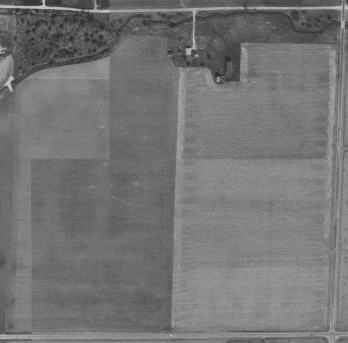
N/S road to the right of the picture is the Ancona road, Ancona is about
a mile south of the intersection at top right. The road across the
north (top) is the Reading road, Reading is about a mile east of the intersection.
These two roads predate present day routes 17 and 23 by several decades
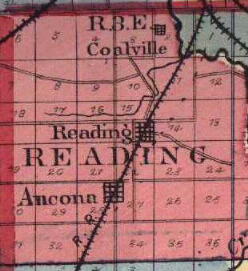
and in the 1875
map of the township appear to be the area's major thoroughfares.
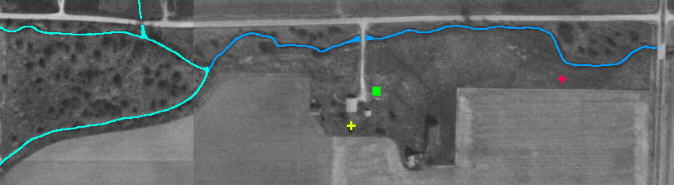
Moon Creek is highlighted in dark blue and flows east (to the right).
It officially becomes Moon Creek where the three tributary streams (light
blue) join together at left center, topographical maps call the three tributaries
upstream of this point "seasonal" and as far as I know don't have official
names. The extended Armstrong family tended to refer to Moon Creek
simply as "the creek" (pronounced "creak", not "crick"). Because
of it's proximity to the creek this stretch of the Reading road is prone
to flooding in heavy rains and has historically been known as "Mud Lane"
to the people living along it.
The one-room school where
"Miss Martin" taught George Armstrong's great-granchildren stood on the
north side of the Reading road about a half mile west of the extreme left
side of this picture. It's referred to in official documents as Mud
Lane School. The school building was torn down circa 1965, it's well
and handpump still stand in the cornfield about 75 feet north of the road
on the Ray Armstrong farm (now occupied and farmed by Ray Armstrong's grandson).
The bell that Miss Martin used to call her students to class is now in
the possession of George's descendants.
Around 1885 George's
son built a beautiful Victorian
farmhouse where the green square is. This house was built to
replace the original "L" shaped house built by George in the 1850's.
The original house stood roughly where the yellow "+" is, the remains of
its brick-lined cistern can be found in the south yard of the present house.
The L shaped house was probably occupied by Roseann Julien Armstrong until
her death in 1902, after that it was used for storage and allowed to decay.
It was finally torn down in the 1930's. I have in my possession a
desk and magazine stand built by George Armstrong's great grandson-in-law
Floyd Covill (a woodshop teacher and accomplished cabinetmaker) from quarter
sawn oak lumber salvaged from this building. That lumber was probably
cut on the property and processed at a local sawmill. This belief
is bolstered by the observation that old-growth trees are common upstream
and downstream, there are few along the creek in the vicinity of the buildings.
The structural
timbers in the buildings built in the 1800's exhibited straight sawmarks
characteristic of a water-powered reciprocating saw. The siding on
these buildings was attached to the structural timbers with square iron
nails, indicating that they were hand made by a blacksmith. It should
be noted that up until the late 1800's nails were considered more precious
than lumber and old buildings were often burnt so that the nails could
be salvaged from the ashes.
The timbers in
the still existing barn and corncrib, built around 1906 by George Asa,
largely exhibit the circular sawmarks produced by more modern electric
or possibly steam powered circular saws. These may have been produced
locally but more likely arrived via rail from the huge lumberyards that
had sprung up in Chicago to provide material for the rebuilding of the
city after the Great Fire of 1871. Some of the timbers in these buildings,
however, have straight sawmarks and other indications that they were recycled
from older structures.
It's also interesting
to note that the grain storage areas of all the outbuildings were reinforced
with hedge logs. Hedge (also known as Osage orange), is very dense,
naturally rot-resistant, and harder than oak. Now considered somewhat
of a pest, hedge was originally imported from the southwest in the 1860s
for use as fencing. Extremely fast growing, a properly pruned
hedgerow could in less than 5 years produce a natural fenceline that was
"horse high, bull strong and hog tight". It's thorns may have inspired
the barbed wire that began to replace it by the 1880s. Some of the
hedge fenceposts put in place by George's son (my great-grandfather) in
the 1800s still exist, weathered but sound.
Email received
from a Defenbaugh researcher state that George's brother-in-law Daniel
K. Defenbaugh was a millwright and helped to set up a sawmill along the
Vermillion river "near Mallory's" (probably Coalville). This is very
likely where the lumber in the older buildings was processed. Daniel's
son, George A. Defenbaugh, was a blacksmith in Reading and may have made
the nails, although they may also have been made by Ancona blacksmith and
wagonmaker Joseph Bradley.
The house that
now exists on the property was originally a garage/workshop that was converted
into living quarters when the big house burned down in 1945.
At first little more than a shanty, it was added to and remodeled over
the course of the next few years. The end result was a modest ranch-style
home that served as the locus for the extended Armstrong- Covill- McPherson
family for almost 50 years.
In the summer of
1981 I noticed an area in the pastureland where the vegetation looked subtly
different (about where the red "+" is). Roughly 15 feet on a side,
it was too regular to be natural. George Arlie Armstrong-- Popo
to his grandchildren, Arlie to friends-- explained that this had
been the location of a small structure his grandfather George had lived
in while the L shaped house was being built. According to Arlie,
the small building had originally stood "in Ancona" about 3/4ths of a mile
south of the farm and moved intact to the site. Arlie expressed surprise
that it's location could still be discerned.
The area depicted
in the above picture is about the extent of the originally untilled land.
The portions not occupied by the house and outbuildings was utilized as
pasture for livestock. The roughly 3 acre area directly south of
the yellow "+" was an orchard of about 25 black walnut trees planted by
George. A private road, known to the Armstrong family as "the lane",
once ran south from the house yard to Ill. Route 17. The tilled land
was expanded to the boundaries shown in the picture in the 1960's, the
orchard, lane, and several acres of pastureland plowed under. The
location of the lane still shows in these pictures as the light streak
that is now the dividing line between the fields.
George lived and
worked on this land from 1853 until his death in 1864. His son George
Asa lived and worked on it until around 1915 when he turned it over to
his son George Arlie. Arlie retired from active farming around 1960
but continued to live on the property until his wife Ethel passed away
in 1975. Arlie then moved to the Good Samaritan nursing home in Flanagan,
Illinois where he lived until his death in 1985. Arlie's daughter
Margaret and her husband Floyd Covill moved into the house in 1975.
Margaret passed away in 1986, Floyd continued to live there until a few
months before his death in 1994. Sadly, the land so wisely chosen
by George Armstrong in 1853 was sold in 2001, ending nearly a century and
a half of continuous family ownership. Still some of the most productive
farmland on the planet, it sold for over 2000 times its original purchase
price.
FDC, 2003, 2004,
2005
|