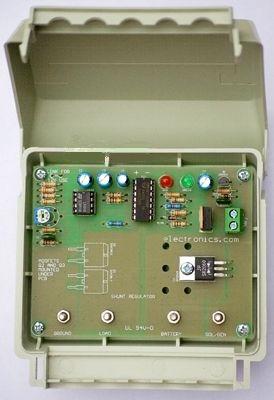
A charge controller or regulator is vital for any wind turbine used to charge a battery bank.
A typical wind turbine charge controller constantly monitors the battery voltage. If that voltage approaches a set maximum (the float voltage) then the controller turns on a dump load (aka shunt) which dissipates excess power to prevent it from over-charging the batteries.
When the battery voltage is measured to have fallen back below a set threshold (typically 0.2V-0.5V below the float voltage), the dump load will be turned off and battery charging will commence again. The most common type of dump load is a low voltage electric heater, immersion heater element for water heating, and/or high wattage car headlight bulbs.
Full instructions and diagrams are included.
State: New
Package includes : 1 Unit
Price:USD 94.95 / Shipping USD 15
|
USA( only )
|
These wind turbine regulators are rated with current handling capacities of 20 Amps (AC) and 23 Amps (DC) and can be configured for either 12V or 24V charging. The battery float voltage can be manually set to 13.2V-15.2V (12V charging) and 26.4V-30.4V (24V charging).
A switched output is provided on the DC controller which can be used to power a dump load cooling fan. This switched output turns on when the dump load is switched on, and remains on for almost a minute after the dump load is switched off in order to cool it down.
High current rated MOSFETs are used (rather than relays) which makes these regulators robust and reliable.
LEDs are used to indicate the current charging status - green LED on when batteries are fully charged and the dump load is on; red LED on when batteries are ready to accept charge.

These regulators can be configured in one of two different ways as illustrated above with the DC version - either as a simple battery shunt Dump Load, or in Diversion mode. When configured as a battery shunt, the dump load is powered directly from the battery thereby bringing down the battery's level of stored charge and preventing it being overcharged. When configured in diversion mode, the dump load is powered only by the instantaneous power generated by the generator - i.e. the battery retains whatever charge it holds, but all power from the generator is diverted to the dump load.
Small Wind Generators everyone can afford
Small Solar Generators everyone can afford
Charge Controlers everyone can afford
Battery Bank hook-ups and convert amps, volts, and watts
Special forms for alternate energy