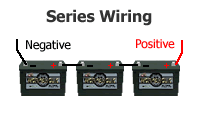
Series wiring increases voltage but NOT amp/hour capacity.
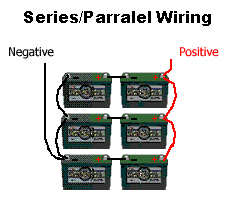
Series/Parallel wiring increases voltage and capacity.
Typical remote power battery bank using 6 volt batteries
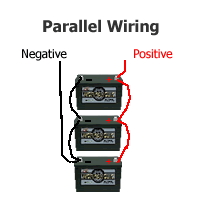
Parallel wiring increases capacity but NOT voltage.
Battery Bank
How to setup your battery bank
Battery Bank Wire Sizing
Batteries can put out a huge amount of power in a short time. It is important to use big enough wire for your series and parallel connections between the battery terminals (the interconnect wires) and to the inverter.
Note: We do not guarantee the accuracy of any of our information regarding whether it meets NEC code or not!
For BATTERY INTERCONNECT wires, use #4 gauge if you have a 500 watt or smaller inverter. Use #2 gauge for an 800 watt inverter, and go with #2/0 for larger inverters. If you can afford using #2/0 welding cable or can find a surplus deal on it, we highly recommend it for battery interconnects no matter what size inverter you have since it is flexible. Keep in mind that welding cable may not meet NEC code, even though it is clearly the best and safest choice for battery and inverter wiring.
Series and Parallel Battery Wiring
Lead-acid batteries always have 2 volt cells wired in series to give the desired voltage. Some batteries have 3 2 volt cells in the case, already wired together for 6 volts. Most battery banks use a combination of series and parallel wiring.
Series wiring increases voltage but NOT amp/hour capacity. |
Series/Parallel wiring increases voltage and capacity.
|
Parallel wiring increases capacity but NOT voltage. |
Buss Bars
It often saves some trouble to install + and - buss bars directly off of your battery bank, connected with wire thicker than what you need for your inverter. These buss bars give you extra room to hook up new windmills, solar panels, meters, loads, etc. Use rectangles of at least 1/4" thick copper, drilled with extra holes. It's easy to tap threads into copper, too--this will speed your hookup time as you do not need nuts on the back side of the buss bar. If you have an amp/hour meter, it's shunt should go between the - (negative) buss bar and the battery bank so that all power collected and used is measured.
Calculating that Power
Calculating for your wind generator or solar generator can seem confusing and overwhelming. Just remember if you have at least least two of the following three: amps, volts and watts then the missing one can be calculated. Since watts are amps multiplied by volts, there is a simple relationship between them. However, Like our wind or solar generators or hybrid systems some engineering disciplines the volts are more or less fixed, for example in house wiring, automotive wiring, or telephone wiring. In these limited fields they often have charts that relate amps to watts and this has confused people. What these charts should be titled is "conversion of amps to watts at a fixed voltage of 110 volts" or "conversion of watts to amps at 13.8 volts," etc.
Amps are how many electrons flow past a certain point per second. Volts is a measure of how much force that each electron is under. I like to use the example of water in a hose. A gallon a minute (think amps) just dribbles out if it is under low pressure (think voltage). But if you restrict the end of the hose, letting the pressure build up, the water can have more power (like watts), even though it is still only one gallon a minute. In fact the power can grow enormous as the pressure builds, to the point that a water can cut through rock. In the same manner as the voltage is increased a small amount of current can turn into a lot of watts.
The Following Equations can be used to convert between amps, volts, and watts.
Converting Watts to Amps
The conversion of Watts to Amps is governed by the equation Amps = Watts/Volts
For example 12 watts/12 volts = 1 amp
Converting Amps to Watts
The conversion of Amps to Watts is governed by the equation Watts = Amps x Volts
For example 1 amp * 110 volts = 110 watts
Converting Watts to Volts
The conversion of Watts to Volts is governed by the equation Volts = Watts/Amps
For example 100 watts/10 amps = 10 volts
Converting Volts to Watts
The conversion of Volts to Watts is governed by the equation Watts = Amps x Volts
For example 1.5 amps * 12 volts = 18 watts
Converting Volts to Amps at fixed wattage
The conversion of Volts to Amps is governed by the equations Amps = Watts/Volts
For example 120 watts/110 volts = 1.09 amps
Converting Amps to Volts at fixed wattage
The conversion of Amps to Volts is governed by the equation Volts = Watts/Amps
For Example, 48 watts / 12 Amps = 4 Volts
Let's review the idea of Amp hours as usually explained. One Amp of current for one hour is one Amp hour, Ah. By the same logic, 100 Amps for 1/100 of an hour is also 1 Ah. This definition of Ah is not complicated. The problem in understanding Ah arises when we speak about a battery of a given Ah capacity. If we have a battery rated at 100 Ah, that battery can supply 5 Amps of current for 20 hours. That same battery can't supply 100 Amps for 1 hour, however. In fact, it can only supply 100 Amps for about 1/2 an hour. What gives?
The true capacity of a battery is dependent on the rate of discharge. The faster the rate of discharge, the less total Ah capacity can be delivered. This phenomenon was described mathematically back in 1897 by a researcher named Peukert. He formulated the equation:
InT = C
In Peukert's equation, the letter I is the discharge current, letter n is a value related to battery construction, letter T is the duration of discharge, and the letter C is the capacity removed as a result of that discharge. If exponent n is equal to one, then we have the familiar circumstance where 1 Amp for 100 hours is equal to 100 Ah. (I = 1, n = 1, T = 100, so C = 100 Ah.) But, exponent n is never equal to 1, even in the best of batteries. Exponent n has normal values of 1.05 to 2, with about 1.2 being a common value. Lets use n = 1.2 in Peukert's equation with I = 100 Amps. We now find that C = 251 Ah. In other words, if we want to draw 100 Amps for 1 hour, we need a battery of 251 Ah, assuming the battery has a Peukert's exponent n = 1.2. Suppose we have an exponent of 1.1. For 100 Amps, C now equals 159 Ah considerably lower than 251 Ah. As mentioned, exponent n is related to battery construction. The lower the value, the better the battery will supply high currents.
Exponential Amp Hours Consumed
|
N = |
1.05 |
1.1 |
1.15 |
1.2 |
1.25 |
|
Amps |
EA |
EA |
EA |
EA |
EA |
|
2 |
2.1 |
2.1 |
2.2 |
2.3 |
2.4 |
|
5 |
5.4 |
5.9 |
6.4 |
6.9 |
7.5 |
|
10 |
11.2 |
12.6 |
14.1 |
15.8 |
17.8 |
|
15 |
17.2 |
19.7 |
22.5 |
25.8 |
29.5 |
|
20 |
23.2 |
27.0 |
31.4 |
36.4 |
42.3 |
|
30 |
35.6 |
42.2 |
50.0 |
59.2 |
70.2 |
|
40 |
48.1 |
57.9 |
69.6 |
83.7 |
100.6 |
|
50 |
60.8 |
73.9 |
89.9 |
109.3 |
133.0 |
|
75 |
93.1 |
115.5 |
143.3 |
177.9 |
220.7 |
|
100 |
125.9 |
158.5 |
199.5 |
251.2 |
316.2 |
In Table 1, exponential Amps are tabulated for various currents with different exponents n. For instance, 15 Amps from a battery with n = 1.2 consumes Amp hours as if 25.8 Amps is being drawn. Note that for low values of current, the value of n doesn't have much impact on capacity C. As currents increase, however, the effect of n is significant. What Table 1 demonstrates is the need to measure Ah using Peukert's equation if we really want to stop guessing about battery capacity. For a battery with an exponent of 1.2, a 2 Amp draw for an hour actually removes 2.3 Amp hours, or about 13% more than a linear measurement indicates. A 20 Amp draw for an hour results in a depletion of 36.4 Ah ...a whopping 45% more than a linear measurement would show! How accurate is Peukert's equation? Recent tests indicate that errors are in the range of 0.5-1%. Only the Ample Power monitors actually compute Amp-hours remaining from Peukert's equation.
Small Wind Generators everyone can afford
Small Solar Generators everyone can afford
Charge Controlers everyone can afford
Battery Bank hook-ups and convert amps, volts, and watts
Special forms for alternate energy