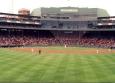
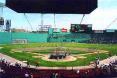
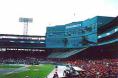
Fenway Park has been the
abode of Red Sox since its inception in 1912. Located in the
vicinity of Fenway in the hub of Boston, the ballpark is one of
the oldest and retro ballpark, which is still in active use in
the Major League Baseball. The arena has derived its name from
the nearby fens. The park has maintained its novelty and charm,
and still looks much as it did when it opened. The Red Sox prior
of becoming the tenants of Fenway Park played at Huntington
Avenue Grounds in 1901. Due to the fire devastations and
humiliations faced by the club and the City of Boston, the owner
of Red Sox, John Taylor decided get a new ballpark build for his
team to replace Huntington Avenue Grounds. The construction of
the new infrastructure initiated in September 1911, and within a
year a 27,000 seat ballpark was ready to host the matches. The
history of the magnificent park is as rich as its unique
features. A single-tiered stadium was built of steel and
concrete, and the portico was made of red bricks. The stadium
was installed with wooden bleachers in parts of left, right, and
centerfield. In 1920, the fortunes of the ballpark went astray.
The team was sold and Sox s star pitcher Babe Ruth was traded to
be acquired by the Yankees. Moreover in 1926, the wooden
bleachers that were located along the left field foul line burnt
into ashes. In 1933, Thomas A. Yawkey took the possession of the
team and backed the stadium s renovations. The most captivating
characteristic of the Fenway Park was Duffy s Cliff, a 10 foot
embankment in front of the left field. Duffy s Cliff was removed
and the wooden seats in right and center field were replaced by
concrete stands and the grandstand was expanded. Even the
seating capacity was enhanced from 27,642 to 33,817. Other
unique feature of the ballpark was the 37 foot high wall in left
field, known as the Green Monster. The Wall is what makes Fenway
so famous, as it was assumed that the Wall altered winds in
Fenway Park and also changed the course of the playoffs at
times. The wall was used for the commercial purposes. A manual
scoreboard was also installed in the stadium. But once again a
fire breakout in January 1934 ruined the up gradation.
Nevertheless, the park was streamlined once again when it
reopened on April 17, 1934. From time to time, the ballpark has
undergone some or the other changes. In 1936, to prevent the
breaking of windows by the baseballs, a 23 foot was placed on
the wall in left field. In 1940, bullpens were constructed
directly behind the right field wall. In 1947, the Green
Monster was re-erected and was painted in dark green. The
authorities also prohibited the use of wall for commercializing.
The same season the ballpark also hosted the first night game.
Following the 1975 season, a $1.3 million video/scoreboard was
put up behind the bleachers in centerfield. The tin of Green
Monster was replaced by a hard plastic surface. The seating
system was streamlined and a small upper deck was created, which
featured several rows. Following the 2002 season, with the
addition of 259 bar styled seats atop the Green Monster, a new
vista was given to the Fenway. A seat in the right field
bleachers is painted red to mark the spot where, Ted Williams
hit the longest measurable home run inside Fenway Park. Behind
the manual scoreboard in left field is a room where the walls
are covered with signatures of players that have played left
field through the years. The National Football League's Boston
Redskins played at Fenway from 1933 to 1936. The American
Football League's Boston Patriots played at Fenway from 1963 to
1968. The current ownership plans to open a new ballpark with
the same moniker whose opening is still undetermined. It would
be constructed adjacent to the current Fenway Park and would
incorporate some of the existing features of the current Red
Sox s ballpark.