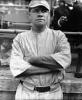
The Curse of the Bambino
was an explanation for the failure of the Boston Red Sox
baseball team to win the World Series for 86 years after they
sold Babe Ruth, sometimes called The Bambino, to the New York
Yankees. The flip side of Boston's "curse" was New York's
success after the sale, the once-lackluster Yankees became one
of the most successful franchises in North American professional
sports. The phrase ("Curse of the Bambino") already had a long
history when in 1990 Boston Globe writer Dan Shaughnessy used it
as the title of his team history. The phrase was also used as
the title of a musical play in 2001, directed by Spiro Veloudos.
As the title drought stretched on and on, national sports media
often made reference to the curse when the Red Sox were doing
notably well or notably poorly. Many serious fans considered the
"curse" just a bit of media-created fluff that was good for book
sales, television networks, and witty T-shirt slogans, but
without basis in history. At any rate, the Red Sox seem to have
exposed the so-called curse to be nothing but a piece of
speculative fiction by triumphing over the Yankees in improbable
fashion and then winning the 2004 World Series. Although the
title drought dates back to 1918, the sale of Ruth to the
Yankees was completed January 3, 1920. It is believed that Red
Sox owner Harry Frazee used the proceeds from the sale to
finance the production of a Broadway musical, No, No, Nanette.
Prior to Ruth leaving Boston, the Red Sox had won five World
Series, with Ruth as pitcher in the 1915, 1916, and 1918 teams,
whereas the Yankees hadn't been in the World Series. After the
sale, the Yankees came to win 26 World Series by the start of
the 2004 season, while the Red Sox had been to the Series only
four times - and lost each time in seven games. The Yankees'
success rate since the sale of Ruth is stunning: They have won
17 more World Series than the second-most-successful teams, the
Oakland Athletics and St. Louis Cardinals, who both won 9
championships. Ruth, by then more known for his batting than for
his pitching, was a high profile part of the 1923, 1927, 1928
and 1932 titles. And even when not winning American League
pennants and/or World Series championships, the Yankees have
been a model of consistency, finishing in the first division for
a record 39 consecutive years from 1926 through 1964, all
inclusive and suffering only two last-place finishes since the
sale (in 1966 and again in 1990). The "curse" did not always
wait for the Series, however. In 1949, the Red Sox needed to win
just one of the last two games of the season to win the pennant,
but lost both games to the Yankees. Ironically, the Red Sox were
managed by Joe McCarthy, who had previously steered the Yankees
to 7 World Series titles. In 1978, the Red Sox had a 14-game
lead over the Yankees on July 18, but by season's end, the teams
were tied. A one-game playoff took place at Fenway Park on
October 2. In the 7th inning, Boston led 2-0, but Bucky Dent, a
.240 hitter with only 4 home runs all season, hit the ball over
the Green Monster with two runners on base to secure the Yankee
win. The most dramatic defeat for the Red Sox, the one which
seemed to have "confirmed" that there truly was a "curse", came
in 1986, when Boston squandered three leads in what would have
been the deciding sixth game before losing in the 10th inning to
the New York Mets after a fielding error by first baseman Bill
Buckner. The Red Sox then lost the 7th game of the series,
blowing a 3-run lead. This marked the earliest, explicit
in-print mention of the "curse," in a New York Times article by
sports writer George Vecsy.