In 1895 after the British conquered Swat, Dir,
Chitral, Bajawar and Malakand, a collective force was established
as the Swat Levies, which included therein the Dir Levies, Chitral
Border Police and Malakand Levies. Maj. A.H. Dean who was the
first Political Agent of Malakand was assigned the task to command
the Swat Levies. The force would have to take care of Swat, Dir,
Chitral and Malakand areas. In the first batch, a total of 192
personnel were recruited as sepoys. The first Jamadar of the Swat
Levies was Mohammad Akram Khan son of Said Anwar Khan of
Temergara, Dir District.
In 1920, when the Swat Levies were reorganized,
Sadullah Khan, known as Khan Sahib was promoted as Subedar Major
and he thus became the first Subedar Major of Swat Levies. In 1950
regular police was introduced in Swat by conversion of the Levies
personnel into it. In Chitral, the border police force was
reorganised and separated from Swat Levies while in Dir district
and Malakand Agency Levies personnel were given separate
designations as Dir Levies and Malakand Levies. Those personnel of
Swat Levies who were serving in Malakand Agency, formed the
nucleus for the Malakand Levies. In Dir district, the police force
was introduced in addition to the Levies but in Malakand, no
additional police force was recruited. Thus ‘Malakand Levies’
continued to perform the dual tasks of the Levies as well as the
police in the Agency. The Malakand Levies since inception till
1977, worked on ad hoc and temporary bases and therefore were not
entitled to pension, except gratuity of a negligible amountThe
following Subedar Majors remained in charge of the Malakand
Levies:
| Name of Subedar
Major |
Duration |
|
| Sadullah Khan Khattak of
Nowshera |
1920-1925 |
| Amir Hamza of Sherey
Kera Kohat. |
1925-1927 |
| Ghulam Haider Khan of
Batal, Hazara |
1927-1930 |
| Said Faqir of Batkhela
|
1930-1935 |
| Pir Taj Mohammad Khan of
Mardan. |
1935-1940 |
| Qamar Ali Khan of Tirah
|
1940-1945 |
| Fazle Wahid Khan of
Thana |
1945-1950 |
| Abdul Wahid Khan of
Thana |
1955-1962 |
| Mir Dad Khan of
Haryankot
| 1962-1966 |
Mr.Sajid Ali
Commandant Malakand Levies. |
| Ghulam Khan Thana
|
1966-1970 |
|
| Dera Wadan of Pir Khel
|
1980-1982 |
|
| Sattar Khan of Thana
|
1982-1987 |
|
| Saeed Gul of Malakand
|
1987-1988 |
|
| Saifur Rahman of Agra
|
1988-1990 |
| Qasim Khan of
Khar |
1991-1992
|
| Behram of Kofar
|
1992-1993 |
| Noor Mohammad of Thana
|
1993-1995 |
| Fazli Habib of Kot
|
1995-1997 |
| Amir Gul of Malakand
1 |
997-2002 |
| Amir Ghulam of
Kot |
2002-2003 |
| Dilawar Khan of Matkani
|
2003 to date |
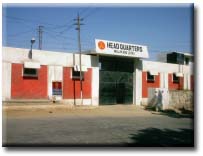
Head Quaters Malakand
Levies Malakand. |
The Malakand Levies till very late used to have a
horse troop of 30 sawars. The main duty of the sawars was to take
Dak from Malakand to the Levy Posts at Chakdara, Head Amanadara,
Batkhela, Dargai, Sakhakot, Palai and Harichand. The Political
Agents and the army officers of Malakand and Chakdara Forts would
also use their horses for polo at Khar village.
FIRST LEVIES MAN KILLED IN ACTION Back to top
The Levy posts at Kot and Agra were sanctioned in
1914 and 1934 respectively. In 1934-35, the British government had
launched an attack on Kot, Totai, Selai Patay and Agra. The reason
behind the attack was that a Hindu girl was kidnapped by the son
of Sher Malik of Dheri Jolagram to Agra and the people of Agra
were not prepared to hand her over to the Political Agent of
Malakand. All the armed forces of the British had encamped in Kot.
On the other side, one Faqir of Ali Nagar (Afghanistan) had
gathered a tribal lashkar for fighting against the British Army. A
bloody skirmish was fought at Agra in which, the tribesmen besides
other many British and Indian soldiers killed the Political Agent
of Malakand Mr. Bert.
In Selai Patai, two Malakand Levies personnel
namely Gul Hassan and Nurab Gul of Kot as well as two sepoys of
Dir Levies were killed and many others were wounded. The tribal
lashker was dispersed and the British took possession of Agra. In
the first instance, Agra post was handed over to the Frontier
Constabulary. Later in 1938, the Agra Fort was handed over to the
Malakand Levies. In 1914, the Upper Swat Canal was completed. The
lands of Sam Ranizai were given water for irrigation on payment of
water rate. In order to collect water rate from the landowners, 12
Levy men were also sanctioned. They were called Malakand police.
Their pay and allowances were the same as that of Malakand
Levies.
In 1938, the Jabban Power House was completed.
Lord Linlithgo, the then Viceroy of India performed the opening
ceremony. For watch and ward services, 30 additional Levy
personnel were sanctioned under the command of the Political Agent
of Malakand. Three piquets were also constructed around the Power
House. After the construction of Dargai Power House, more Levy men
were sanctioned.
At the end of World War II, the population of
Malakand Agency increased to a great extent resulting in jumping
up law and order situation to a high level. Thus after lengthy
correspondence, 350 Levy personnel were sanctioned.
When the
first batch of Levies was recruited in 1895, they were required to
bring their own rifles. No uniform was required. Generally, the
personnel recruited, were from the elite families of the Agency.
In some cases, direct Junior Commissioned Officers (JCOs) were
recruited amongst the said families. After World War II, rifles
were provided to the Levy personnel. It was after the creation of
Pakistan that 303 rifles were supplied to them. In the year
1991-95, the aforesaid rifles were replaced with SMGs (Sten
Machine guns).
NAIK JEHAN BAKHT SHAHEED
TAMGHA-E-SHUJAAT Back to top
Like other forces, the Malakand Levies’ history
is also replete with deeds of heroism. Many officials of the
Malakand Levies have shown distinctions while serving in the
field. Their services have been acknowledged with rewards.
In those getting honours is one Naik Jehan Bakht
Shaheed son of Mo-hammad Karim Khan of Dheri Alladand village who
had sacrificed his life but had not allowed the anti-social
elements to materialise their nefarious designs.
According to
Malakand Levies record, on December 9, 1987, the post commander of
Palai had received information that a gang of proclaimed offenders
from down district had crossed the Malakand agency border via Kohi
Barmowal and was entering Palai for carrying out their criminal
activities.
On receipt of the information, a raiding party
was detailed by the post commander under the command of Naik Jehan
Bakht, which rushed towards the area where presence of the
proclaimed offenders was tipped. On sighting the Malakand Levies
party, the POs started indiscriminate firing on the Levies
personnel and fled to the nearby hill.
Jehan Bakht Shaheed
chased the criminals and made a counter attack. In exchange of
firing two of the proclaimed offenders were killed. Naik Jehan
Bakht also received fatal bullet injury but was still chasing the
criminals until he succeeded in arresting two of them. His injury
was so fatal that he was rushed to the Lady Reading Hospital,
Peshawar where he succumbed to his injuries.
In the light of his gallantry and heroic deed the
then president of Pakistan Ghulam Ishaq Khan awarded
Tamgha-e-Shujaat (Posthumous) to the widow of Jehan Bakht
Shaheed.
REGULARIZATION OF MALAKAND LEVIES
Back to top
The Levy personnel were not entitled to pension
benefits till 1970-71 when the then government announced
regularization of the Levy force. Pensionary benefits were allowed
only to in-service personnel while about one thousand different
ranking employees were deprived of the same benefits. They were
paid gratuity of Rs. 350 each only and nothing more. The
entitlement of the remaining employees for pension was made after
lengthy discussions that were held between the high ups and a
group of retired employees of Malakand Levies, headed by Subedar
Major (Retd) Mir Dad Khan of Haryankot and Naib Subedar Alhaj
Mohammad Khan of Dheri Alladand.
Both these retired Levies men had gathered some
of their other retired colleagues and had started united
endeavours for getting the demand of pensionary benefits for the
retired employees of Malakand Levies met by the government. They
pursued the former presidents and prime ministers of the country
one after another, including General Mohammad Ziaul Haq, Waseem
Sajjad, Benazir Bhutto, Mian Nawaz Sharif and other high officials
in the provincial as well as federal government and apprised them
of the pathetic condition in which these retired levies men were
living. Subedar Major (Retd) Major Mir Dad Khan of Haryankot
village and Naib Subedar (Retd) Alhaj Mohammad Khan of Dheri
Alladand had devoted their lives to the cause of getting pension
for those retired employees who were not allowed the same benefits
after the government announced regularization of the Malakand
Levies. These remaining employees were about 1000 in number some
of whom had died and their widows were living in a very miserable
condition.
It has been learnt that several times these
employees had resorted to protest demonstrations and press
conferences. Once they gathered in front of the Peshawar Press
Club and had put their demand before the journalists of the
province.
Former President of Pakistan Waseem Sajjad in his
tenure approved pension to a few hundreds of the retired employees
but still leaving many without pension. Mir Dad Khan, Alhaj
Mohammad Khan and their colleagues were not satisfied with the
same concession and continued their struggle. During the second
tenure of Ms Benazir Bhutto as prime minister, the Levies retired
employees took their demand to her again through the then Federal
Minister Mohammad Hanif Khan (late) and apprised her of their
problem. She directed for revision of the case and ultimately the
SAFRON agreed to accept the demand of granting pension to all the
remaining employees of the Malakand Levies. Both the
above-mentioned personalities have died many years ago but their
efforts are remembered even today as most of the retired employees
and their offspring are alive and are getting pensionary benefits.
PRESENT POSITION OF MALAKAND
LEVIES Back to top
The Malakand Levies is working under the
administrative control of SAFRON Division, Government of Pakistan.
The Commandant of Malakand Levies is the commanding officer of
1325 strong force while the Subedar Major is the second
high-ranking officer after the commandant. 10 Subedars, 23 Naib
Subedars, 37 Havaldars, 39 Naiks, 60 Lance Naiks, 1040 sepoys and
constables constitute the force. When the strength of Levies was
sanctioned in the first instance, the pay of a sepoy was Rs. 9 per
month. It was increased to Rs. 121 per month later. After World
War II, Rs. 11 per month were also sanctioned as clothing
allowance.
Unlike Khasadars in other agencies, Malakand
Levies are more disciplined and have rounded up a large number of
criminals, dacoits and car lifters. At the moment, the salaries of
the Malakand Levies personnel are very meagre and pathetic,
despite the fact that they perform multi-faceted duties all the
time. A levy sepoy on his recruitment is given a maximum salary of
about Rs. 1800 per month, which is a joke in the area according to
the present day requirements. They are also not given basic
allowances as are given to the other Para Military and civil armed
forces.
The present ranks and pay scales of the Malakand
Levies personnel are appended below. A cursory look at these
leaves much to be desired.
S.No. Name of posts No. of posts
Existing pay scale
| S.No |
Designation |
Pay-Scale |
| 1. |
Subedar Major 1 |
BPS-7 |
| 2. |
Subedar 10 |
BPS-5 |
| 3. |
Naib Subedar 23 |
BPS-4 |
| 4. |
Havildar 39 |
BPS-1 |
| 5. |
Naiks 41 |
BPS-1 |
| 6. |
Lance Naiks 60 |
BPS-1 |
| 7. |
Sepoys 1064 |
BPS-1 |
| 8. |
Followers 59 |
BPS-1 |
| 9. |
Constables 16 |
BPS-1 |
| 10. |
Assistant 1 |
BPS-11 |
| 11. |
Senior Clerk 2 |
BPS-7 |
| 12. |
Junior Clerk 4 |
BPS-5 |
| 13. |
Pesh Imam 1 |
BPS-1 |
| 14. |
Ikhlasi 2 |
BPS-1 |
| 15. |
Armourer 2 |
BPS-1 |
| |
TOTAL |
1325 |
DUTIES OF MALAKAND LEVIES Back to top
The Malakand Levies personnel perform duties and
functions similar to those of the police elsewhere. Their duties
and functions, in the main, include the following:-
1. Maintaining law and order in the area.
2.
Escort/guard/protocol.
3. Traffic control.
4. Guarding of
government buildings, installations and communication routes.
5. Registration of cases and prosecution.
6. To assist the
department officials in recovery of government dues.
7. To help
in the execution of court cases.
8. Transportation of prisoners
within and outside the district.
9. Verification of the general
public and government employees.
10. Maintaining Judicial lock
up at Malakand.
11. Control of poppy cultivation in the area
and check on narcotics movement.
12. Control of smuggling of
narcotics, timber and other contraband items.
The Malakand Levies with very limited resources
has always tried to achieve all its assignments as specified in
the above lines. But in dealing with these assignments the Levy
force is confronted with too much political pressure, which always
intercepts the process of law and routine administrative matters.
Such practice needs to be curtailed through various
administrative, legislative and legal measures with emphasis on
re-organisation of the force.
There is a general complication while dealing
with Malakand Agency/Malakand District. This area had been called
an agency while it was included in PATA, with all courts working
under Civil Courts Ordinance and Session Judges and ultimately
with an elected Local District Government Ordinance 2001. SAFRON
Division, Islamabad, financially controls the Malakand Levies. The
district administration is responsible to the provincial
government, whereas Levies working under an un-cleared
administration of SAFRON+ District government and provincial
government. These anomalies need to be considered at appropriate
level so that a single source of inspiration is provided to the
force.
During the last few decades no proper attention
had been paid to provide necessary facilities to the Malakand
Levies, which has adversely affected its working and efficiency.
Due to lack of proper accommodation for the Levies posts,
transport, office equipment, stationary, riot control equipment,
adequate wireless communication system, uniform and pay and
allowances, the force is drastically handicapped to perform its
duties.
These personnel are deployed in 14 Levy thanas
(Levy Posts) within the Malakand District. Presently 10 of these
thanas (Levy Posts) have been established at 10 villages in the
Swat Ranizai Tehsil i.e. Batkhela Tehsil. These are:
| 1.Batkhela. |
6.Qalangi |
| 2.Aalladand. |
7.Agra |
| 3.PulChawki |
8.Kot |
| 4.Thana |
9.Palai |
| 5.Khar |
10. Malakand Khas |
The posts, which have been established at Sam
Ranizai Tehsil or Dargai Tehsil, are:
1. Dragai
2.
Sakhakot
3. Kopar and
4. Qaidabad.
There are two separate Levy Chawkis at Wazirabad and Garhi
Usmani Khel of Dargai tehsil in addition to the existing Levy
Posts.
There are also 18 Levy Check posts namely:
1. Pul Chawki.
|
7. Kuchyan.
|
13. Shingrai. |
2. Malakand.
|
8. Qaidabad. |
14. Saidabad |
| 3. Dargai. |
9. Brah Ghakhey. |
15. Khado Pul. |
| 4. Cherat. |
10.Kot.
|
16. Ghundo. |
5. Qalangi.
|
11. Musa Mena. |
17. Ghawar Killi Khwar |
| 6. Trai. |
12. Hari Chand. |
18. Wazirabad. |
In each Levy thana a post commander is stationed
along with a force of about one hundred Sepoys, an Additional Post
Commander, 3 Investigative Head Constables, 3 Hawaldars and a
Muharrir along with two Mudad Muharrirs. In some of the most
sensitive posts, additional staff has been deployed. The main
functions of the Malakand Levies include routine patrolling,
vehicle checking, traffic control, registration and investigation
of cases etc.
There is also a Traffic Wing in the Malakand
Levies and a Traffic Subedar each at Batkhela and Dargai tehsils
have been assigned the task of keeping smooth flow of traffic
throughout Malakand District. Both these traffic Subedars are
assisted by four Traffic Head Constables at Batkhela and three at
Dargai. The total staff along with sepoys at both the towns in the
traffic wing is 36 and 22 respectively.
Twenty seven sepoys along with a Subedar are
stationed at Jabban Power House and 31 at Dargai Power House for
security of these sensitive installations. Moreover, scores of
Levy Jawans have been deputed to the local Telecom offices,
offices and residences of the judicial community and some
important official premises. Some have been deputed to keep watch
on the irrigation projects like Amandara Head Works and AT Works
at Batkhela. A dozen Levy men are stationed at Benton Tunnel at
Khar and Irrigation Quarters at Dargai.
There are many areas where Levy Pattaks have been
installed to block the way of smugglers during night times and
also to check vehicles plying at night. The main Pattaks are
installed at:
| 1. Dargai |
6. Ghawar Kaley |
11. Musa Mena |
| 2. Pul Chawki |
7. Khadoo |
12. Kot |
| 3. Cherat |
8. Sengrai |
13. Trai and |
| 4. Thana |
9. Khushal Ghar |
14. Qalangi |
| 5. Dheri Alladand |
10. Harichand |
|
On these pattaks, a maximum number of seven and minimum of four
Levy men are performing duty round the clock in shifts.
At headquarters in Malakand, a Subedar Major, a
Subedar Headquarter , two Quarter Masters, 2 Bank Guards, an
Adjutant, one Hawaldar Major, five Inspectors, two tear gas
experts attached with the Adjutant and about 80 sepoys are
performing duty. Scores of Levy men along with two to three
officers are also performing duties at the Malakand Jail where
they are assigned the duty to look after the prisoners and other
jail inmates.
Soon after the devolution plan was introduced and
district government established in Malakand, modernization and
strengthening of the Malakand Levies was greatly felt. A proposal
to covert the Malakand Levies into police force was opposed tooth
and nail by every inhabitant of the area. Consequently the
government decided to strengthen and modernize the Malakand Levies
force on the same pattern within the category of Malakand
Police.
For this purpose, Lt.- Col. (Retd) Said Rasool
was appointed as the first commandant in November 2002. Lt.- Col.
(Retd) Said Rasool is a retired army officer with wide command and
staff experience. After assuming his new duty, Lt.- Col. (Retd)
Said Rasool has devised a planned strategy for strengthening and
modernizing the Malakand Levies. It is his inherent desire to
convert the Malakand Levies into a disciplined and hand-hitting
para-military force that could play its due role in maintaining an
exemplary law and order situation in Malakand. He has held a
series of meetings with the district, provincial and federal high
ups for solution of the existing problems of the Levy personnel.
He genuinely wishes that the Malakand Levies
should have the same monetary benefits as are available to the
other Civil Armed Forces, since the overall duties performed by
the Levies, are in no way less hazardous and multi-faceted than
others.
 DISTRICT GOVERNMENT,
MALAKAND.
DISTRICT GOVERNMENT,
MALAKAND.