 Alixinasia: this is on the original CD, has been
remixed/remastered...1 of 2 pieces on the CD that were overdubs over a
loop.
Alixinasia: this is on the original CD, has been
remixed/remastered...1 of 2 pieces on the CD that were overdubs over a
loop.
CrystalBlue
eyes:
Edited some...on the CD, was recorded live as it happened, an improv done
on the first day I brought home the GR30 as I was trying it out.
Forest
temples:
Description-Same as above.
Forest
temples part 2: Description-Same
as above.
Sunday
afternoon: Another improv loop on the EH 16, and the digitech
8....same day as the other 2...also on the CD.
Promise
kept:Title cut of the CD... old piece...My second gift from
the muse....
On
Big
Sur:
the foundation was a loop (tape to tape) done at Cleve. Inst. of Art in '83....
first time I attempted looping (improved of course)... bass and drum loop
from "Tongue N Groove" rehearsal(Nick Marino-bass, Sean Cary-drums) that
just happened to work with this ... other guitar parts added in 96.. yamaha
monophonic gtr synth was used.
Presence like
rain:
recorded on the fly as it happened...(another improv that I had the whereabouts
to turn on the recorder when I did) a percussion loop on EH16, guitar done
same time after tape was turned on. Additional percussion added in 96. The
Yamaha gtr synth used here too.
The
Moving:
recorded in 97 thank the muse for this one too...
Rememberance: dedicated to a life/perception changing
experience at a Mansion in W.Virginia with 23 others and a Great Teacher
in Nov '85...to all Crafties.
Djd
Duo:
yeah
obvious influence....Love it anyway LOL (laughing out loud)
Wounded
knee to Belfast: Improv performed live at
Cleveland Public Theatre on 5/12/00
Wounded
knee to Belfast 2: Improv performed live
at Cleveland Public Theatre on 5/12/00
Wounded
knee to Belfast 3: Improv performed live
at Cleveland Public Theatre on 5/12/00
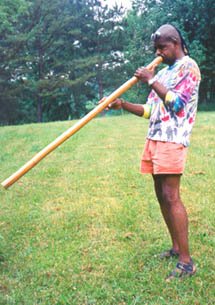 |

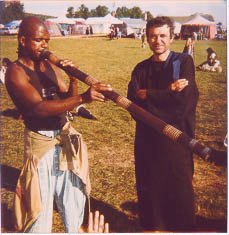
Aboriginal music is predominantly made up of the yidaki or didgeridoo (these are well-known names, among many others. Didgeridoo is also spelled as didjeridu and other variations). The didgeridoo is the oldest, not-percussion instrument in the world and and is said by the people to be 20,000 years old, though there is some discrepency over which tribe had it first. Rock paintings/drawings have been found with images of didjeridoo's and didj-playing people verified by Carbon dating technigues |
|
 |
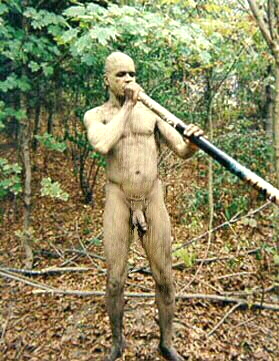 |
The didgeridoo is a branch from the eucalyptus tree, hollowed out by termites who eat the soft inside of the branch, so the hard shell is left then beeswax is usually used for the mouthpiece. It is intended to make continuous, droning sounds which are very similar to the long trumpets played by Tibetan monks. To play these trumpets they use the same technique as used to play the didgeridoo, "circular breathing". The player inhales through the nose while he exhales into the didj through the mouth. The technigue as strange as it sounds is not as hard to do as one would imagine. With a good teacher you could be doing it in minutes. Ive taught people do do it in 20. |
The People find their yidaki's by hitting the trees with sticks, to hear if they're hollow. Beeswax was not only used to make a mouthpiece, but also to repair cracks in the instrument.
Made in differing lengths and widths...the yidaki (didj) can have a variety of tones and voices...each one unigue. The lengths can be anywhere from 3 ft to 8 or 9 ft. These long ones are carried around on the shoulders of 2 or 3 men and are mostly destined for special ceremonies. The didgeridoo is traditionally only played in North Australia, with differences in the way of playing between the east and the west.
Though it is not per se a percussion instrument...it is not a melody instrument either... at least not in a "classical" sense...it is at once rythmic and harmonic making it the most unigue instrument in the world. The didgeridoo is used for ceremonies, but also as accompaniment for the 'songs' of the people. The songs may tell of the history and legends of the people, or pass on the ways and traditions of the people. One songline can have 300 different parts and describe events or places (for example 'waterholes') during the journey of the ancestors. This is a way for the people to find their way through the land. 'Songs' also can be the basis of a ceremony. The didgeridoo then represents the voices of the ancestors. With certain 'songs' and ceremonies, dance is a part of it, and this can be accompanied by clapsticks ( or 'bilma's or other names ). This way tribal traditions and laws are passed on.
 This Page is "STILL"
under
construction!!
This Page is "STILL"
under
construction!!