 |
 |
 |
| LEADERSHIP THEORIES CHAPTER 8, 9 & 10 |
 |
|
|
|
| Power, Politics and Leadership
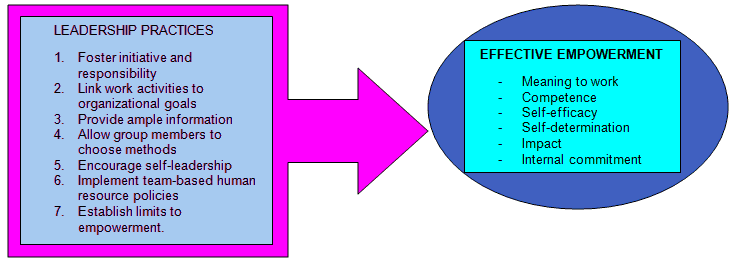
In order to acquire and retain power within an organization, a leader must skillfully use informal approaches to gain power, which is classed as organizational politics. Organizational power can be derived from many sources; such as position power (legitimate, reward, coercive, and information), personal power (expert, reference, and prestige), and ownership power (providing resources, capitalizing on opportunity, managing critical problems, and being close to power). �Empowerment refers to passing decision-making authority and responsibility from managers to group members.� (Dubrin et al, 2006) Full empowerment includes the dimensions of meaning, competence, self-determination, impact, and internal commitment. The following diagram shows the actions that can be taken to become an empowering leader. |
| An important part of empowerment is delegation. To be effective, delegation should follow certain guidelines, including assigning tasks to the right people, delegating whole tasks, stepping back from details, and evaluating and rewarding performance.
Political behaviour is caused by the quest for power. The specific contributing factors include the pyramidal shape of organizations, competition for limited resources, subjective performance standards, and environmental uncertainty. For leaders to make effective use of organizational politics they need to use methods aimed directly at gaining power, building relationships, and avoiding political blunders rather than certain dysfunctional tactics which constitute another category of political behaviour. �Carried to an extreme, organizational politics can hurt an organization and its members. Being aware of the causes and types of political behaviour can help leaders deal with the problem. Setting good examples of nonpolitical behaviour is helpful, as is achieving goal congruence and threatening to publicly expose devious potlicking.� (Dubrin et al, 2006, pg232) |
 |
| Influence Tactics of Leaders
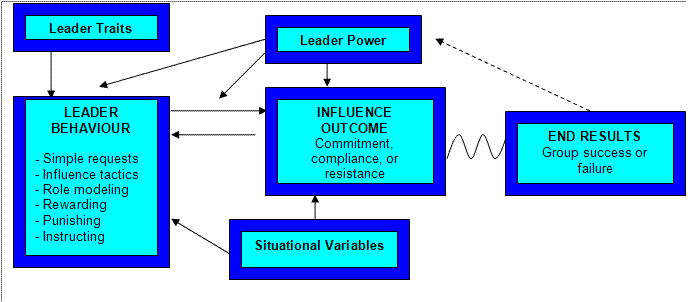
A person must be aware of specific influence tactics in order to become an effective leader. �Influence is the ability to affect the behaviour of others in a particular direction. Power, in contrast, is the potential or capacity to influence.� (Dubrin et al, 2006 pg256) The below model indicates that a leaders power, influence behaviour, and influence skills interact in various ways to determine how much influence the leader has with target people. |
 |
| Influence tactics can have an ethical dimension that needs to be considered. A study of the tactics concluded that the most effective were rational persuasion, inspirational appeal, and consultation. The least effective were pressure, coalition, and appealing to legitimate authority. Certain tactics are more effective for exerting influence upward, whereas others are better suited for downward influence.
The sequence in which the leader uses the influencing tactics is an important consideration. Begin with the most positive or least abrasive tactic. If you do not gain the advantage you are after, proceed to a stronger tactic. |
| Developing Teamwork
�Developing teamwork is such an important leadership role that team building is said to differentiate successful from unsuccessful leaders.� (Locke et al, 1991) |
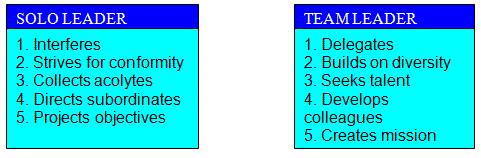 |
| Team leaders share power, de-emphasise individual glory, and understand that power sharing increases their own power. The solo style of leader is the traditional autocratic leader in a bureaucracy.
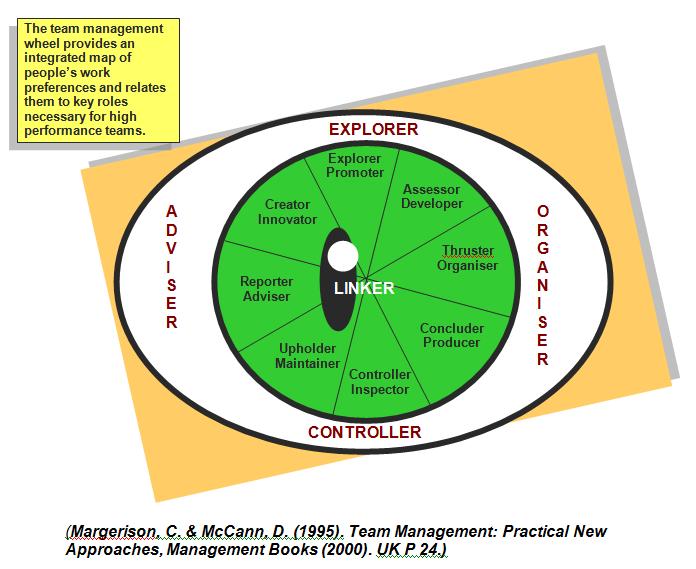
Making decisions and working in a group has some potential disadvantages such as; pressures towards conformity, social loafing, and wasting time. However, it certainly offers some advantages such as; the possibility of synergy, catching major errors, continuous improvement and innovation. It also has the potential to enhance job satisfaction, and also many personal needs. The key roles of a leader in a team based organization are as follows; - building trust and inspiring teamwork - coaching team members towards higher levels of performance - facilitating and supporting the decisions made by the team - expanding the teams capabilities - creating a team identity - anticipating and influencing change - inspiring the team toward higher levels of performance - enabling and empowering group members to accomplish their work There are actions leaders can take to encourage teamwork set out below. � Defining the teams mission � Serving as a model � Developing a norm of teamwork � Using a consensus leadership style � Emphasizing pride � Establishing urgency � Holding a pow wow � Encouraging competition � Soliciting feedback � Minimising Micromanagement � Initiating rituals � Practising open-book management |
 |
| Most workplaces in Australia have a high level of cultural diversity, which can add to the difficulty of building highly effective teams. The following are some guidelines for successfully developing culturally diverse teams; ensure that all team members have equal power and opportunity to contribute, the group goal must be clear, and there must be mutual respect. It is very important that the leader gives feedback and recognizes the value of each team members contribution, and emphasizes the benefits of cultural diversity. |
| Created by Tenille Bosley, David McCleay, Sharon Spouse & Michael Sullivan |
 |