 |
 |
 |
| LEADERSHIP THEORIES CHAPTER 11, 12 & 13 |
 |
|
|
|
| Motivation and Coaching Skills
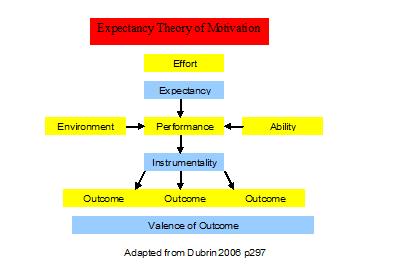
Expectancy Theory & Motivational Skills This focus of this theory is on the desires, thoughts, and judgements of the people being motivated which was developed by Vroom in 1964. They make decisions based on the outcomes they believe will have the biggest benefit to themselves. |
 |
| Goal Theory
A goal is something that a person is trying to achieve. The theory suggests that it is at the core of all theories of motivation. Behaviour Modification This principle relies on the �law of effect�; when the persons� behaviour leads to a good outcome it will be repeated and vice versa. |
 |
| Coaching Skills & Techniques
� Clear Expectations � Active Listening � Emotional Support � Reiterate Message � Gain Pledge to Change � Praise Good Results � Remove Barriers � Advice & Guidance � Lead by Example � Pin Point Improvement Needed |
| Entrepreneurship, Creativity and Leadership
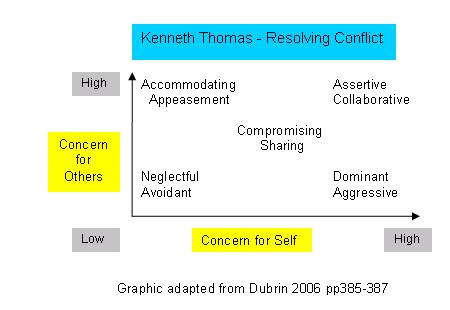
The 5 Steps in the Creative Process � Immersion � Incubation � Insight � Verification & application � Opportunity or problem recognition Characteristics of Creative Leaders � Intellectual Abilities � Broad Knowledge � Personality � Passion for the Task and Flow � Social Habits & Upbringing Entrepreneurship � High energy levels � Interest in money � Positive mental attitude � Risk taking ability � Creative attitude toward obstacles Dominant themes: � Opportunity obsession � Motivation to excel � Tolerance of risk, ambiguity and uncertainty � Leadership � Creativity, self-reliance, adaptability � Commitment and determination All ideas and theories are from: Dubrin, A. & Daglish, C. & Miller, P. (2006, pp. 326-359). Leadership (2nd ed.). Milton: John Wiley & Sons Australia, Ltd. Communication & Conflict Resolution Skills Communication is very important to all leaders and they need to be aware of how they are communicating via both verbal and non-verbal methods. To improve effectiveness and credibility a leader should ensure that both are portraying the same message. Inspirational & Powerful Communication Effective verbal and written communication skills are invaluable to a leader. To help improve these skills to become more inspirational, a leader should: � Back Up Decisions with Data � Limit Use of Poor Language � Sell Group on Benefits of Ideas � Adapt Message to Audience � Develop Influence Tactics � Be Credible (Trustworthy & Intelligent) � Write Clear & Concise Messages � Use Powerful & Emotive Words � Enhance Speaking Pattern Supportive Communication A lot of research has gone into how to augment interaction between parties using a style that conveys the intended message accurately. The 8 Principles & Characteristics of SC � Problem not person oriented � Descriptive not evaluative � Based on congruence � Focused on validating people � Specific, not global � Conjunctive / Logical � Owned, not disowned � Requires Listening |
 |
| All ideas and theories are from:
Dubrin, A. & Daglish, C. & Miller, P. (2006, pp. 362-396). Leadership (2nd ed.). Milton: John Wiley & Sons Australia, Ltd. |
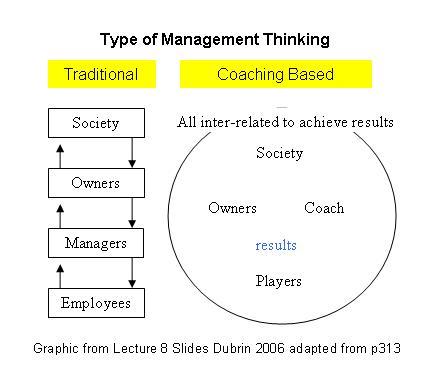
Coaching is basically the helping of others improve and devlop their strengths |
| Coaching Competencies
� Life Experience � Independence � Capacity to Learn � Problem Solving � Motivational Skills � Accountability � Listening Skills � Values All ideas and theories are from: Dubrin, A. & Daglish, C. & Miller, P. (2006, pp. 294-325). Leadership (2nd ed.). Milton: John Wiley & Sons Australia, Ltd. |
| Overcoming & Preventing Communication Barriers
9 Guidelines � Be sensitive to existence barriers � Challenge your cultural assumptions � Show respect for all workers � Speak slowly and clearly � Speak the language of the other person � Observe differences in etiquette � Do not judge a book by its cover � Avoid racial identification unless essential � Be sensitive to differences in non verbal communication |
| Created by Tenille Bosley, David McCleay, Sharon Spouse & Michael Sullivan |
 |