 BretwaldaBretwalda
by Mike Demana (article originally appeared in The Herald #29)
Autumn in Britain is when the fields turn golden and the peasant, resting on his scythe, eyes the harvest, knowing its yield determines his survival. Sacks are filled and tribute paid to the local lord. These invariably make their way to the great towns of the provinces -- storehouses for Britain's fruits, her wealth. The lord's Lords -- the monarchs of the island's warring kingdoms -- know that control of these storehouses determines their survival, too. So, before the harvest rolls in, the golden fields often turn red as armies clash for control of the provinces.
"Northumbria Rising"
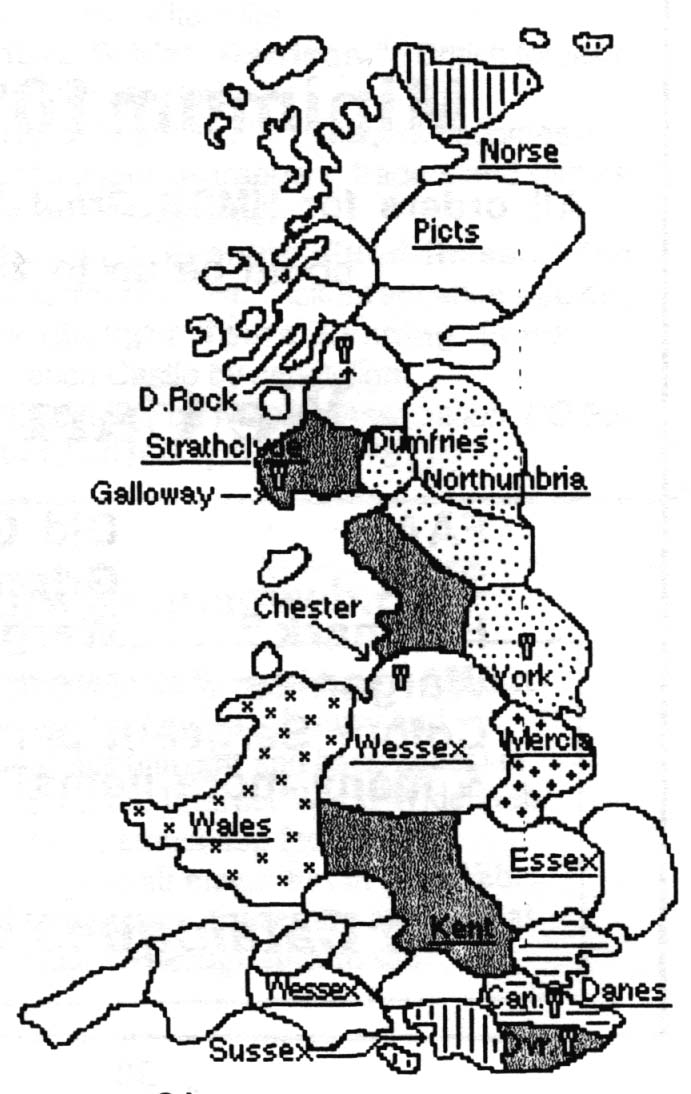
Kind Eanred of Northumbria hoped his kingdom's worst days were past. He had retaken Dumfries from Strathclyde earlier this year and now besieged York -- northern Britain's greatest city -- for six months. His general, Eorl Mundar, had ordered an assault on the walls last month, but it failed. Now, a Norse army was approaching to relieve York. Many rogue or exiled Norsemen fought in the Northumbrian ranks, and the army had skirmished with the besieged for half a year, so Mundar's men knew the Viking's mettle. They met them unafraid, traded ax blows, slew as they were themselves slain, and finally, beat them. As the Vikings retreat northwards, the dispirited Norse garrison surrendered. York was Eanred's, and his kingdom was whole again. Both provinces lost last year had been reconquered.
 "A
Change in the Weather in the North"
"A
Change in the Weather in the North"
To the north, the Pictish storm that had lashed the north for almost two years showed signs of letting up. King Ravenhawk collected scattered detachments and cohorts of Strathclyde's army on his march south, forging them into a relief army for the besieged province of Galloway. His defeat to the spears of the Picts five months ago, and the loss of his capital of Dumbarton Rock, did not deter him. He would win this time.
When the two hosts met, Ravenhawk's faced the son of the Pictish king, Prince Nechtan. After an hour of battle, the tattooed tribesmen began to break through the British lines in the center. Then, Ravenhawk's wings turned inward. The overeager Pictish pursuers were ridden down by the famous Strathclyde heavy cavalry. Imminent defeat turned to victory for the king and Galloway was saved. A month later, his forces even laid siege to Dumbarton Rock, but had to back off when Pictish King Circinn returned with another immense army. The storm had not broken up, but Ravenhawk could see the glimmerings of light between the clouds.
In the south, Eorl Aelfred, warleader of Kent/Sussex, was a beleaguered man. The lands of his king were overrun with Danes and Norsemen, and his army was their sole defense. After a failed assault on the walls of Canterbury, where the main Danish army was holed up, he lifted his siege and marched to brush aside a smaller Danish warband that had ringed Dover. The Danes of Canterbury followed him a month later, though, and trapped between two armies, Aelfred withdrew behind Dover's walls. Good news arrived, though, as the season's winds turned cold. Aelfred's Wessex allies had attacked the Norse holding their southern province of Sussex. Now, he only had two provinces to defend with one army!
"Wessex flexes its might"
Wessex was battling on its own behalf, too. With the fall of the Mercian town of Chester, Wessex gobbled up another Mercian province. She now ruled two, while her Essex and Kentish allies controlled one each. Mercia was little but a husk, with only coastal Lindsey still under its control. Autumn's only other news was the quashing of the rebellion of the Welsh subkingdom of Dyfed. King Owein ruled supreme over the Black Hills, just as Winter's rains first began to appear over the Irish Sea in the West.