 Since I am steadily
working my way through my goal of fielding all the allies and enemies of
New Kingdom, I planned to field this army all along one day. At De Bellis
Columbus 2004, I saw a packaged Early Hebrew DBA army from Venexia Miniatures.
I wanted to support the vendor for making the long drive for a two-day con
with perhaps 60 participants, so bought them on impulse.
Since I am steadily
working my way through my goal of fielding all the allies and enemies of
New Kingdom, I planned to field this army all along one day. At De Bellis
Columbus 2004, I saw a packaged Early Hebrew DBA army from Venexia Miniatures.
I wanted to support the vendor for making the long drive for a two-day con
with perhaps 60 participants, so bought them on impulse.
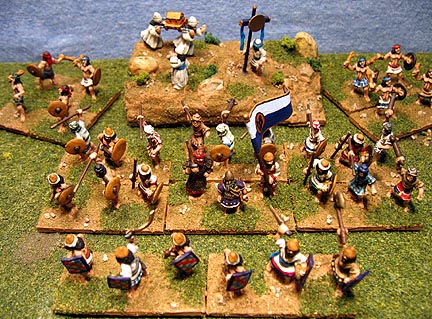
Venexia are those type of figures that don't look impressive unpainted, but show a lot of character when painted up. The separate weapons and shields allowed me to customize the troops, but boy is it a fiddly thing to glue a 15mm sword into a 15mm hand. I replaced all the spears with brass wire, as usual. With no mounted troops, this army painted up extremely quickly. I added a pack from Falcon Miniatures so I could have the Ark of the Covenant in the camp, and I was set.
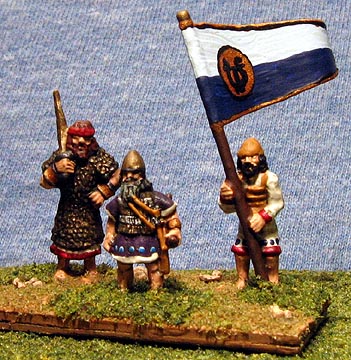
The Venexia army pack contained this giant armored guy on the left that MAY have been supposed to be the general. I prefer to think of him as a Philistine bodyguard, though. For my general, I raided the Ark of the Covenant pack I bought from Falcon for the bearded, purple-clad guy in the center. He just looked more like a general to me. The standard bearer is a converted spearman. What was my inspiration for the standard? Well, I went google searching on the internet and found the circular design on the banner on an Ancient Hebrew coin. I think it is a stylized representation of the Ark, but am not sure. Later, I found the standard that is on the camp (below), and wished I'd done that, instead. Oh, well. It still looks striking, I think...
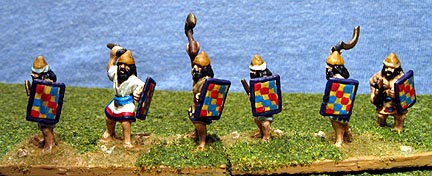
I'm not 100% sure which troops in the Early Hebrew army these two stands are supposed to represent. If you cross-reference with the more detailed DBM list, it is the Simeonites and Ephraimites who are classified as Warband. I like to think of them more as a core of "royal" troops who fought on a more permanent basis than the tribal levies that are represented as the Auxilia, below. Either way, I wanted them to show up distinctly on the battlefield, so I gave them the only rectangular shields in the army, and a distinctive "mosaic" shield pattern. From experience, I know the frustrations of an opponent who can't tell one type of troops in the other guy's army from the other. Hence, the more "uniform" appearance of the two Warband elements.
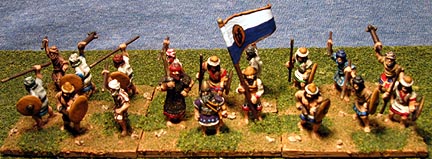
Most of the Early Hebrew army (6 stands) are Auxilia, including the general. These represent the other various tribes of the Early Hebrew nation. The Venexia army pack provided a wonderful variety of figures -- perhaps not as many as Old Glory, but enough that with customizing the weapons and paint jobs, a good irregular look could be achieved. A helpful suggestion by a member of the DBA List urged me to include blue on each figure's clothing -- even if just a barely visible fringe -- as that is purportedly proscribed by the Jewish Torah.
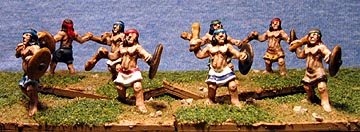
Three of the Hebrew tribes -- Benjamites, Gadites and Issacharians -- are considered "lighter" skirmishing style troops in DBA Ancients. The Benjamites were supposed to be experts with bow and sling, while the Gadites used spear and shield and were noted for their swiftness. The Isssacharians were the Hebrew nation's best scouts. Unfortunately, no bowmen were in the Venexia pack, and I couldn't spare any spearmen from the Auxilia to use as psiloi figures. Thus, all of my Early Hebrew psiloi must be Benjamites! These were the first Venexia figs I painted, and I particularly like the way my black wash pulls out the detail in their muscled chests and backs.
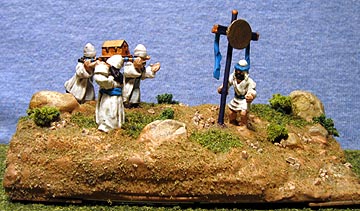 Camp
CampThere was never any doubt that I wanted to do an Ark of the Covenant as part of my Early Hebrew camp. I mean, really, how can you NOT?! I picked up this pack of priests and horn blower from Falcon Miniatures to supplement the Venexia army pack. Although I admit the casting of the Ark is pretty lacking in detail, I think the whole effect is nice. The standard bearer is a converted Venexia spearman, while his standard is scratch-built to resemble one in an image I found on a Google search.
The surface of the camp is a slope from the back left hand corner of the photo above down to the bottom right. It shows up better in person, and is scattered with various rocks and pebbles to represent the rough Judean hillsides. I picture the Early Hebrew army keeping to the hills and coming down out of them only to attack once they've decided to give battle or raid. So, the "Coming Out of the Hills" look is what I was striving for.
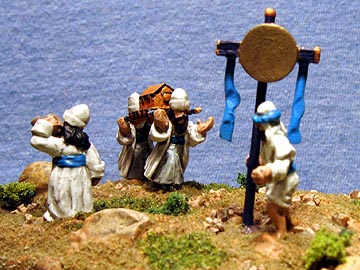 The
close-up photo to the left here shows the terraining of the camp's base
in more detail, as well as the scratch-built standard. The shaft is a piece
of brass wire, the crossbar is a Kraft Stick, and the "hangy down things"
are simply a lead spear that has been squeezed and twisted with pliers to
look like some sort of cloth suspended from the crossbar. The gold disc
on the crossbar is simply a piece of stiff cardboard cut out with a hole
puncher. I'm pretty happy with all of my Biblical era camps, and this one
is no exception.
The
close-up photo to the left here shows the terraining of the camp's base
in more detail, as well as the scratch-built standard. The shaft is a piece
of brass wire, the crossbar is a Kraft Stick, and the "hangy down things"
are simply a lead spear that has been squeezed and twisted with pliers to
look like some sort of cloth suspended from the crossbar. The gold disc
on the crossbar is simply a piece of stiff cardboard cut out with a hole
puncher. I'm pretty happy with all of my Biblical era camps, and this one
is no exception.