 |
 |
|
 |
 |
|
 |
|
|
|
|
|
|
|
|
|
|
   |
|
| Diseases of the Honey Bee |
|
|
|
| Honey Bee disease and pests |
 |
| It was introduced to the Maltese islands in 1992 and devastated many colonies, as goverment burocracy at that time didn't provide the treatment and education to beekeepers for it. Also many beekeepers still kept their colonies in clay jars. As Malta is a small island and also many beekeepers move their hives to the north of Malta for the wild thyme honey season the mite spread more quickly to all parts of the island and also to Gozo. It is the most common enemy of the honey bee in the Maltese islands |
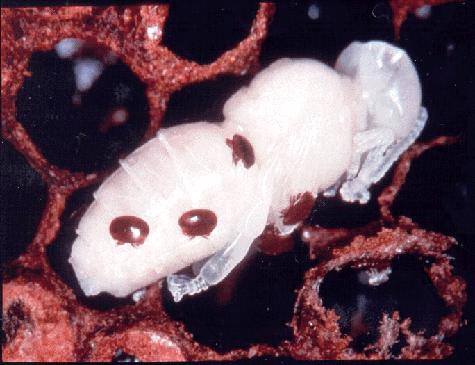
| The mite transfers a long list of viruses as it lives on the bees' blood. Many bees will be seen with shrunken wings, or deformed wings known as k-wings. Also varroa likes to lay on drone brood. If sometimes during inspections some drone pupae are removed by an uncapping fork, if there is varroa present in the hive, this can be seen on the pupae. The varroa mite if left untreated can collapse a hive in a short term. This will be done when the emerging young bees will be wekend by the mite. Treatment: The treatment used against varroa in Malta is the pyrethroid strips manufactured by Bavyrol or Apistan produced by Vita. This can lead to varroa resistance. Test by the apiculture department used to be carried out for resistance buildup, |
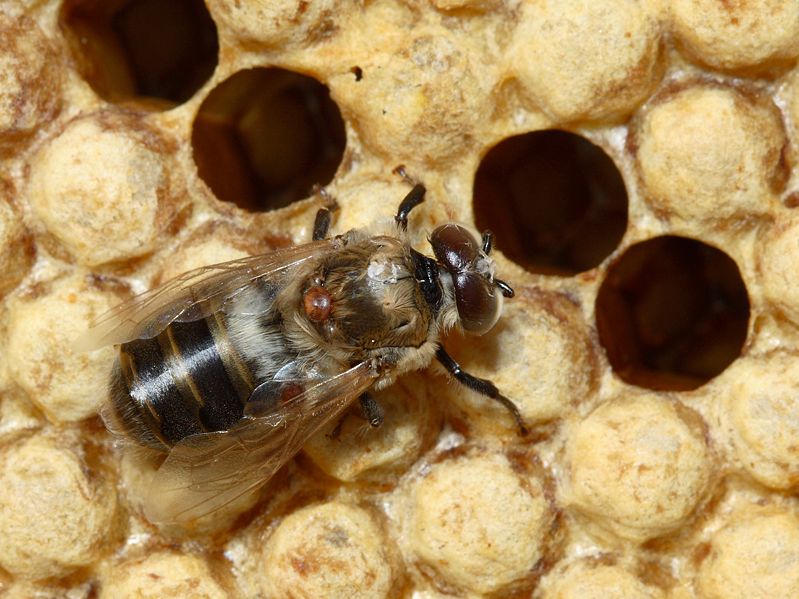 |
| The Varroa mite: The varroa mite known sientifically as Varroa Destructor, is a parasitic mite of the honey bee. The mite has a round elliptical body of reddish-brown colour. Their natural host is the Asian honey bee (Apis Cerana) which has a natural defence against varroa, but became a recent pest of the Western honey bee when these where introduced in Asia to increase honey yields of beekeepers there. From there Varroa spread to virtually all over the world. The last place to be found was the Hawaiian Islands in 2007. |
| but in the last years these where not taken. Also introduced latley is the Apiguard treatment. Personally I had not tried it yet but beekeepers who tried Apiguard say that it had good results. It is a thymol gel which is released in the hive by evaporation and cleans the bees from varroa. To date these are the common methods used for Varroa treatment. |
|
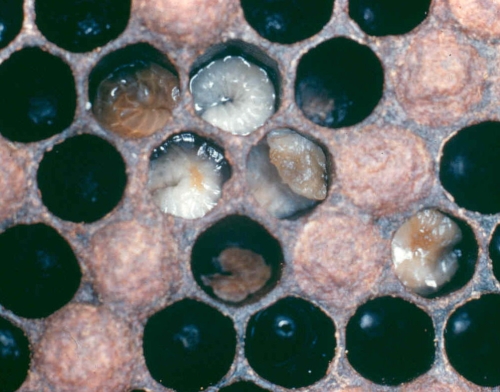
| European Foulbrood (EFB): It is a bacteria called melissococcus pluton that infects the guts of bee larvae. The infected larvae lose their pearly white colour and shape. They will become dull white and turn faint yellow before death. These will die coiled on the bottom of open cells, mostly at the age before the brood is capped. Treatment: When there is a suspect of European Foulbrood, a field test can be done by a Vita kit. This is done by placing a suspected diseased larva in a solution and after placing the solution on the test area in kit which marks if it is positive or negative to EFB. As EFB is a notifiable disease one should contact the government Apiculture Section to make their tests and recomandations. |
 |
| After a hive is positive to EFB a treatment for it is to put a piece of a queen excluder in front of the entrance of a new hive box and stock it with new foundation frames. Than shake all the bees off the frames into the new hive and remove all the old comb. When all is in place feed the bees with sugar syrup. The diseased comb is to be destroyed best by being burned and the hive and frames scorched with a blow lamp. No honey taken from the diseased hive is to be fed to the bees again as this will spread EFB. |
|
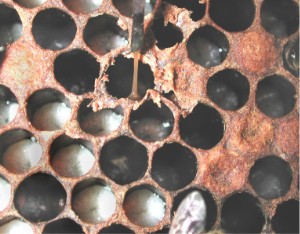 |
| American Foulbrood (AFB): American foul brood, is caused by spore forming bacillus larvae. This is the most destructive brood disease. The bacillus larvae are only visible under a high power microscope. It infects only larvae which are up to 3 days old but the most susceptible larvae are those of less than 24 hours old. The larvae are infected by ingesting spores that are present in their brood food. The spores germinate in the larvae by takings its nutriments. The infected larvae normally die after their cell is sealed. The bacterium eventually dies but not before producing millions of spores. The bees than open the brood cappings to removethe dead larvae and while doing this they will spread more bacteria spores. |
| The cappings containing |