 |
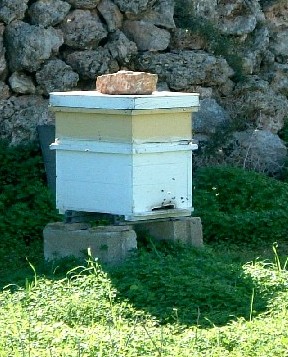 |
| A beehive is an enclosed structure where some speices of honey bees live and raise their brood. When men started to domesticate bees he used what materials he found possible to suit his needs. For many years bees where kept in many different structures and ways around the world. In the Mediterranean region bees where kept in earthenware jars. In northen parts of Europe enclosres made of straw called skeps and log gums consisting of covered hollowed tree trunks where used. |
| Modern Beehives |
 |
 |
 |
|
 |
|
|
|
|
|
|
|
|
|
| Beekeeping in Hives |
|
   |
|
|
|
|
| One of the first hives that was easily observed was the one invented by the Swiss naturalist Francois Huber. Huber was helped by his servant Francois Burnens in his observation as Huber turned blind due to a disease at age 15. This hive was called the leave hive but altough the bees were easily observed the frames could not be interchanged with other frames. Jan Dzierzon and August von Berlepsch focused on side-opened hives. The bee space was incorporated in Berlepsch following Dzierzon's discovery of the "bee space". The bee space is the correct distance between the centre of one frame's top bar to the centre of the next one where bees don't built up wax or propolis. |
| A disadvantage of these types of hives was that during honey harvesting much damage was done to the colony. This was becouse destroying comb containing honey was necessary to harvest the honey, and also that the bees where not observed as it can be easily done in modern beehives. All these enclosures had a a way how to super them so that damage was minimized to the colonies. |
 |
| Rev. Lorenzo Lorraine Langstroth used the bee space in his top opened hive. He discovered that by leaving the correct spacing between the frames and from the coverboard and the frames, he would quite easily remove the coverboard as it will not be propolised or joined by comb to the frames. The Langstroth hive is still in common use today although other sizes are used for different types of hives but with the same principles. This type of hive made beekeping more efficient and started also turning beekeeping in a commercial industry. He also noticed that by keeping the queen in the hive by means of a queen excluder and than "supering" the hive the upper chambers can be reached only by worker bees and thus only honey is stored in them. Langstroth was the first one to use invent a hive that can be supered as much as it was needed. Other hives where invented on the same principle of frames but cannot be supered to the need of the times. From my experience I don't like the use of queen excluders. Because as I see it especially when the queen is laying at full swing about 1500 eggs a day, somtimes it can be confined to the hive where all space is taken by eggs and larvae, clogging the brood area leaving no space where the queen can lay and thus makes the bees tend to swarm. |
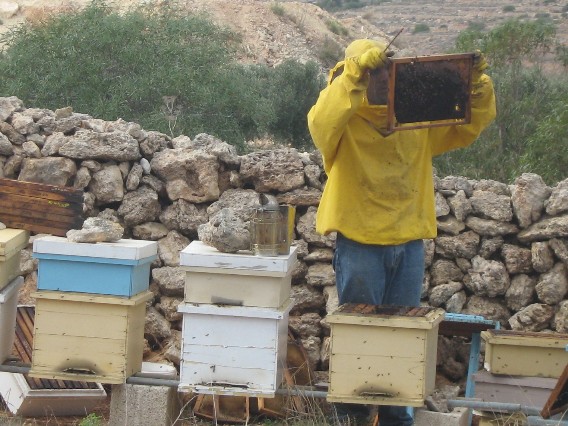 |
| There are many types of hives. These differ in dimensions and size as each is siutable for different ambients. Some of these types are the British Standard and the National which are commonly , the Langstorth hive common in the US and the Dadant hive which also have its variants. Also there are variants how frames are put in the hive. Some beekeepers put the frames of foundation parallel with the entrance or others put frames perpendicular to the entrance. Hives should be put high enough so that no excessive stress is put on the beekeeper's back when working with bees. Also they should not be put in damp or windy areas. |