|
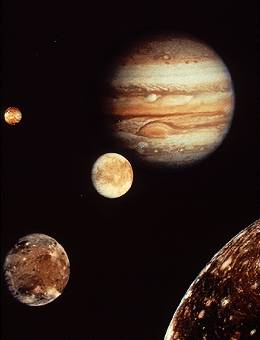
Jupiter is the fifth planet from the Sun and the largest planet in the solar system. It is the fourth brightest object in Earth's sky, after
the Sun, the Moon, and Venus, Jupiter is more than three times brighter than Sirius, the brightest star.. Jupiter orbits the Sun at an average distance of 780 million
km, which is about five times the distance from Earth to the Sun. Jupiter's year, or the time it takes to complete an orbit about the Sun, is 11.9 Earth years, and its day, or the time it takes to rotate on
its axis, is about 9.9 hours, less than half an Earth day. Unlike the rocky inner planets
of the solar system (Mercury, Venus, Earth, and Mars), Jupiter is a ball of dense gas and has no solid surface. Jupiter may have a core composed of rock-forming minerals like those trapped in comet ices, but the core makes up less than 5 percent of the planet's mass. The force of gravity at the level of the highest clouds in Jupiter's atmosphere is about 2.5 times the force of gravity at the Earth's surface. Gas and clouds in Jupiter's atmosphere travel at high speeds. This phenomenon is not fully understood but it is related to the planet's high rate of rotation. These gases and clouds travel faster at the equator than at higher latitudes. The gases and clouds of the atmosphere are thrown outward as the planet rotates. The balance between gravity and this outward force, which is proportional to the speed at which the atmosphere rotates, noticeably distorts the planet's round shape. Higher speed at the equator causes greater outward force, causing an equatorial bulge, whereas lower speed at the poles gives gravity the edge, leading to polar flattening.
|